Wiki Electronics

The charging temperature range delineates the operational envelope within which a battery system can safely and efficiently accept electrical charge. This parameter is critical for battery longevity, performance integrity, and preventing thermal runaway. It is defined by a lower and upper temperature threshold, specified in degrees Celsius (°C) or Fahrenheit (°F), outside of which charging is either inhibited, significantly slowed, or potentially damaging to the electrochemical cells. The precis...

The 'Number of Heat Pipes' is a critical design parameter and a primary performance determinant in passive thermal management systems, particularly those employing heat pipes. It quantifies the total count of individual heat transfer elements integrated within a thermal solution. Each heat pipe operates on a phase-change principle, utilizing a working fluid that evaporates at a high-temperature interface (evaporator section) and condenses at a low-temperature interface (condenser section), there...

The 'Number of Rear Mounted Fans' is a critical parameter within the vehicular thermal management system, specifically denoting the quantity of active cooling or ventilation units integrated into the rear section of an automotive chassis. These fans are typically positioned to facilitate either the expulsion of hot air generated by powertrain components, exhaust systems, or auxiliary electronics located rearward, or to draw in cooler ambient air to enhance heat dissipation from components such a...

The 'Power Bank Charge Time to 100%' metric quantifies the temporal duration required for a portable power bank to achieve a full 100% state of charge (SoC) from a completely depleted or a specified starting SoC, utilizing its designated charging input. This parameter is critically influenced by a complex interplay of factors including the power bank's internal battery capacity (measured in milliampere-hours, mAh, or watt-hours, Wh), the employed battery chemistry (e.g., Lithium-ion, Lithium-pol...

The Maximum Number of Connected Displays refers to the upper limit of distinct output devices, such as monitors or projectors, that a graphics processing unit (GPU) or integrated graphics controller can simultaneously drive and render independent visual information to. This specification is a critical hardware constraint, dictated by the GPU's architecture, its internal display controllers, the available video output interfaces (e.g., DisplayPort, HDMI, DVI, USB-C with DisplayPort Alternate Mode...
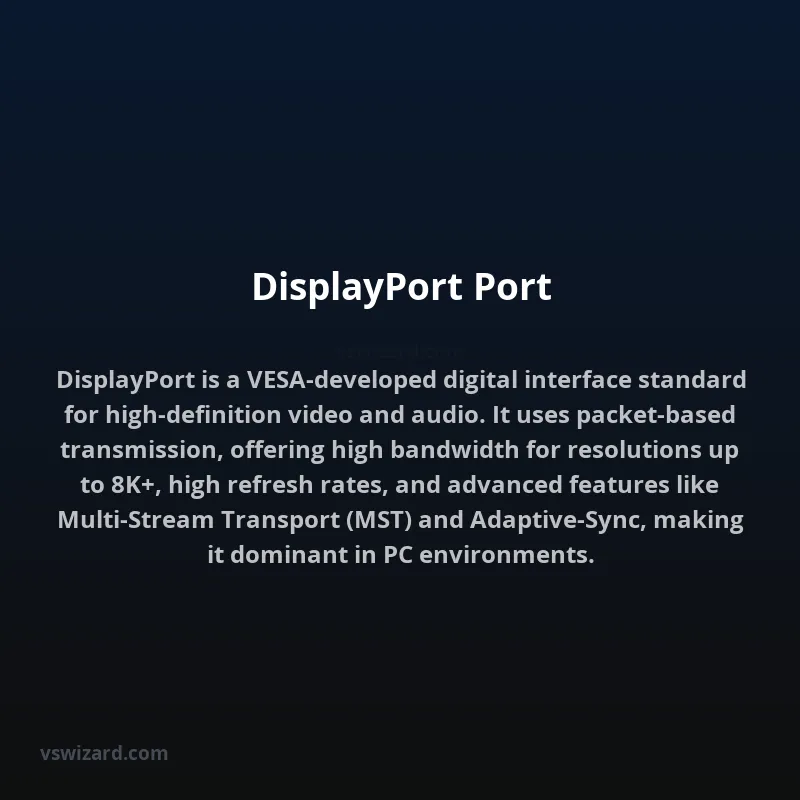
The DisplayPort (DP) port is a digital display interface standard developed by the Video Electronics Standards Association (VESA). It is engineered to facilitate high-definition video and audio transmission between a host device, such as a computer or graphics card, and a display device, like a monitor or projector. Its architecture is designed for high bandwidth and low latency, supporting features such as high resolutions (e.g., 8K and beyond), high refresh rates (e.g., 144Hz and above), and a...

Stand Height Adjustment refers to the mechanical or electromechanical capability of a support structure, commonly known as a stand, to modify its vertical dimension to accommodate varying height requirements. This functionality is crucial across a spectrum of applications, from industrial machinery and laboratory equipment to consumer electronics and ergonomic furniture. The precise engineering of these adjustment mechanisms dictates the range, stability, repeatability, and load-bearing capacity...
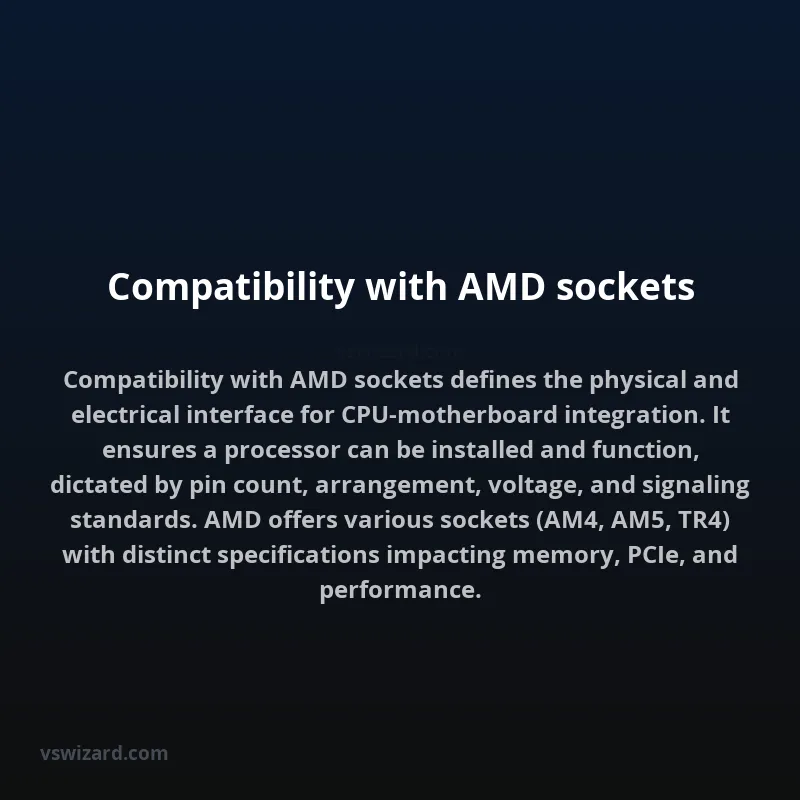
Introduction Compatibility with AMD sockets refers to the physical and electrical interface specification that dictates whether a central processing unit (CPU) manufactured by AMD can be installed and function correctly within a specific motherboard socket design. This compatibility is paramount for system integrators and end-users, as it determines the range of processors a particular motherboard can support. The socket is a crucial component of the motherboard's chipset architecture, providing...

Dedicated Graphics Memory, often referred to as VRAM (Video Random Access Memory) or graphics-specific RAM, constitutes a distinct block of high-speed volatile memory physically located on the graphics processing unit (GPU) subsystem. Unlike system RAM (e.g., DDR4, DDR5), which is shared among the CPU and other system components, dedicated graphics memory is exclusively allocated for the GPU's operations. Its primary function is to store graphical data that the GPU frequently accesses, including...

Compatible SIM Card Types refers to the interoperability and physical/electrical specifications of Subscriber Identity Module (SIM) cards that enable them to function across a range of mobile network infrastructure and device hardware. This compatibility is governed by stringent international standards, primarily defined by the European Telecommunications Standards Institute (ETSI) and the International Organization for Standardization (ISO). It encompasses physical form factors (Mini-SIM, Micro...

The classification of keyboards based on their physical dimensions directly addresses the spatial footprint and ergonomic considerations of input devices. This categorization is crucial for manufacturers, designers, and end-users, influencing workstation layout, portability, and accessibility. Key differentiating factors include the number of keys, the physical width and depth of the keyboard chassis, keycap spacing (pitch), and the overall profile or height. These parameters are not merely aest...

Audio modes represent distinct operational configurations or profiles within an audio system, designed to optimize acoustic performance, signal processing, or user experience for specific scenarios or content types. These modes are not arbitrary settings but are typically engineered based on psychoacoustic principles, signal-to-noise ratio considerations, dynamic range management, and desired output characteristics such as clarity, immersion, or speech intelligibility. The selection and implemen...

Backlit Type refers to a display technology where illumination is provided from behind the display panel itself, rather than from the front or within the pixel elements. This method of light emission is fundamental to the operation of technologies such as Liquid Crystal Displays (LCDs) and some forms of Electroluminescent Displays (ELDs). The backlight unit (BLU) typically comprises a light source (e.g., Cold Cathode Fluorescent Lamps - CCFLs, or Light Emitting Diodes - LEDs), a light guide plat...

The number of input ports quantifies the discrete interfaces or physical connection points on a hardware device, system, or network node that are designed to receive incoming data streams or signals. Each input port is typically associated with a specific communication protocol, data format, or electrical signaling standard, enabling the device to interact with one or more external entities. This parameter is fundamental in defining a system's connectivity capacity, its ability to ingest data co...

The 'Number of fans' designation quantifies the count of individual rotating impeller devices employed within a thermal management subsystem. Each fan unit, typically comprising a motor and aerodynamic blades, is engineered to induce and direct airflow across heat-generating components or through enclosed volumes. This metric is fundamental to characterizing the convective heat transfer capability and acoustic profile of a system, directly influencing its operational temperature ceilings and env...