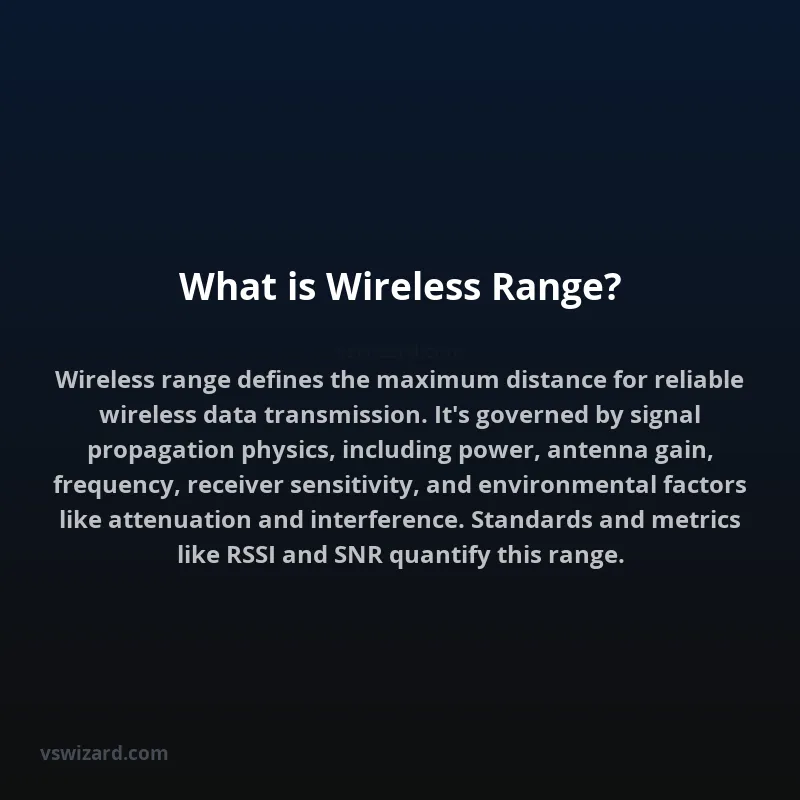
Wireless range delineates the maximum spatial extent over which a wireless communication system can reliably transmit and receive data. This parameter is fundamentally governed by the physics of electromagnetic wave propagation, including factors such as transmission power, antenna gain, operating frequency, receiver sensitivity, and environmental conditions. Signal attenuation, interference, and noise are critical limiting phenomena that dictate the practical effective range. In engineered systems, wireless range is a key design specification, balancing performance requirements against constraints such as power consumption, cost, and regulatory limits.
The effective wireless range is not a static attribute but rather a dynamic interplay between the transmitting and receiving entities and their intervening medium. It is quantified by metrics such as signal strength (e.g., received signal strength indicator, RSSI), signal-to-noise ratio (SNR), and bit error rate (BER), all of which degrade as distance increases. Standards bodies and manufacturers define operational parameters and testing methodologies to characterize and compare wireless range across different technologies and product implementations, ensuring interoperability and predictable performance within specified operational envelopes.
Mechanism of Action and Determinants
The fundamental principle underlying wireless range is the propagation of electromagnetic waves from a transmitting antenna to a receiving antenna. Several physical phenomena directly influence this propagation and thus the achievable range:
- Path Loss: This is the reduction in signal power as it travels from the transmitter to the receiver. It is primarily influenced by the inverse square law (free-space path loss), where signal power decreases proportionally to the square of the distance. In real-world environments, additional losses occur due to reflection, diffraction, and scattering from objects (buildings, terrain, foliage) which can lead to multipath fading.
- Antenna Characteristics: Antenna gain, directivity, and polarization significantly impact range. Higher gain antennas focus radiated power in specific directions, extending range along those paths. The orientation and type of antennas at both ends of the link must be considered for optimal signal coupling.
- Transmission Power: The power output of the transmitter directly correlates with the initial signal strength. Regulatory bodies often impose limits on maximum transmit power to prevent interference and ensure spectrum efficiency.
- Receiver Sensitivity: This is the minimum signal power the receiver can detect and process reliably. A more sensitive receiver can detect weaker signals, thereby extending the effective range.
- Operating Frequency: Higher frequencies (e.g., millimeter waves) generally experience greater path loss and are more susceptible to absorption by atmospheric elements and blockage by obstacles, resulting in shorter ranges. Lower frequencies (e.g., sub-GHz bands) tend to propagate further and penetrate obstacles more effectively.
- Interference and Noise: External electromagnetic signals from other devices operating in the same or adjacent frequency bands can interfere with the desired signal, reducing the SNR and thus the effective range. Noise, both thermal and environmental, also contributes to signal degradation.
Industry Standards and Protocols
Wireless range is a critical performance metric addressed by numerous industry standards, each defining specific operational parameters and characteristics:
- Wi-Fi (IEEE 802.11 standards): Different Wi-Fi generations (e.g., 802.11n, 802.11ac, 802.11ax) specify modulation schemes, channel bandwidths, and power levels that influence range. For instance, lower data rates often allow for more robust error correction, extending range at the cost of throughput.
- Bluetooth: Bluetooth specifications categorize devices into classes based on their maximum transmit power, defining typical ranges (Class 1: ~100m, Class 2: ~10m, Class 3: ~1m).
- Cellular Networks (3G, 4G LTE, 5G): Range in cellular systems is influenced by base station transmit power, antenna height, frequency bands used, and network density. Lower frequency bands are often employed for wider area coverage, while higher frequency bands (e.g., mmWave in 5G) offer higher bandwidth but shorter range.
- LoRaWAN (Long Range Wide Area Network): This standard is specifically designed for long-range, low-power IoT applications, utilizing spread spectrum modulation techniques to achieve ranges of several kilometers in urban environments and tens of kilometers in rural settings.
- Zigbee (IEEE 802.15.4): Optimized for low-power, low-data-rate applications, Zigbee devices typically have shorter ranges (tens of meters) but can form mesh networks to extend overall coverage.
Performance Metrics and Measurement
Evaluating wireless range involves several quantitative metrics:
- Received Signal Strength Indicator (RSSI): A measurement of the power level of the received radio-frequency signal. Higher RSSI values generally indicate a stronger signal and a shorter distance, or better link conditions.
- Signal-to-Noise Ratio (SNR): The ratio of the power of the received signal to the power of the background noise. A higher SNR is crucial for reliable data communication.
- Link Budget Analysis: A systematic accounting of all gains and losses in a communication system, from transmitter output power to receiver input power. This analysis predicts the expected signal strength at the receiver and helps determine the maximum achievable range under specified conditions.
- Throughput: While not a direct measure of range, the maximum achievable data rate at a given distance is an indirect indicator of link quality and effective range.
- Bit Error Rate (BER) / Packet Error Rate (PER): Measures the frequency of errors in the transmitted data. A lower BER/PER indicates a more reliable link, often achievable within a certain range.
Practical measurement involves deploying transceivers and assessing connectivity and data integrity at various distances and environmental conditions. Tools such as spectrum analyzers, dedicated wireless testers, and software-based diagnostic utilities are employed.
Factors Affecting Practical Range
Beyond fundamental physics and standards, several real-world factors pragmatically limit wireless range:
- Environmental Conditions: Obstacles such as walls, furniture, and metal objects significantly attenuate radio signals. Atmospheric conditions like rain, fog, and foliage can also absorb or scatter signals, especially at higher frequencies.
- Multipath Propagation: Signals reflecting off multiple surfaces can arrive at the receiver at slightly different times, causing constructive or destructive interference, leading to signal fluctuations (fading) that reduce effective range.
- Device Capabilities: The integrated antennas, power amplifiers, and receiver chipsets within devices vary considerably, impacting their individual transmission and reception capabilities.
- Regulatory Constraints: Transmit power, antenna height, and frequency band usage are often regulated to prevent interference and ensure public safety. These regulations directly limit the potential range of wireless systems.
- Interference: The presence of other wireless devices operating in the same or adjacent frequency bands (e.g., Wi-Fi, Bluetooth, cordless phones, microwave ovens) can create significant interference, degrading SNR and reducing usable range.
Advanced Concepts and Future Trends
Research and development are continuously pushing the boundaries of wireless range through various advanced techniques:
- Beamforming and Massive MIMO: In technologies like 5G, these techniques use multiple antennas to direct radio signals precisely towards receiving devices, improving signal strength, reducing interference, and effectively extending range for targeted users.
- Reconfigurable Intelligent Surfaces (RIS): These surfaces are composed of meta-materials that can dynamically alter the phase and amplitude of impinging electromagnetic waves, enabling controlled reflection and redirection of signals to enhance coverage and overcome obstacles.
- Cognitive Radio and Dynamic Spectrum Access: These technologies allow devices to sense available spectrum and adapt their transmission parameters to utilize underused frequencies, potentially optimizing range and mitigating interference.
- Enhanced Physical Layer Techniques: Innovations in modulation, coding, and equalization continue to improve the robustness of wireless links against noise and interference, thereby extending reliable communication distances.
- Integration of Lower Frequency Bands: For applications requiring extensive coverage (e.g., IoT, rural broadband), utilizing sub-GHz licensed and unlicensed bands remains crucial for maximizing range and penetration.
| Parameter | Typical Value/Range (Example) | Impact on Range |
|---|---|---|
| Wi-Fi 6 (802.11ax) - 2.4 GHz | Up to 100m (open space) | Lower frequencies penetrate obstacles better, extending range, but offer lower throughput. |
| Wi-Fi 6 (802.11ax) - 5 GHz | Up to 50m (open space) | Higher frequencies offer greater bandwidth and throughput but are more susceptible to attenuation and blockage. |
| Bluetooth 5.0 (Long Range Mode) | Up to 240m (open space) | Optimized for extended range at reduced data rates, using specific modulation techniques. |
| LoRaWAN (Class A) | 2-5 km (urban), 15+ km (rural) | Utilizes ultra-narrowband technology and low-power transmission for exceptional long-range capabilities in IoT. |
| 5G NR (Sub-6 GHz) | Up to 2 km (cell edge) | Balance between coverage and capacity using mid-band frequencies. |
| 5G NR (mmWave) | 100-300m (open space, line-of-sight) | Extremely high bandwidth but very short range due to high path loss and susceptibility to blockage. |
| Transmission Power (Wi-Fi) | 15-20 dBm (typical) | Higher power output directly increases the signal strength at distance, within regulatory limits. |
| Receiver Sensitivity (Wi-Fi) | -98 dBm to -70 dBm | More sensitive receivers can detect weaker signals, enabling communication over longer distances. |
Conclusion
Wireless range is a multi-faceted technical specification intrinsically linked to the fundamental physics of electromagnetic wave propagation, device engineering, and the operational environment. It is critically defined by the interplay of transmission power, antenna characteristics, receiver sensitivity, operating frequency, and the cumulative effects of path loss, interference, and multipath fading. Industry standards provide frameworks for characterizing and ensuring performance, while advanced techniques continually aim to optimize this parameter for diverse applications, from ubiquitous personal area networks to expansive wide area IoT deployments. The practical determination and optimization of wireless range necessitate a holistic understanding of these contributing factors to achieve reliable and efficient wireless communication within specified performance envelopes.