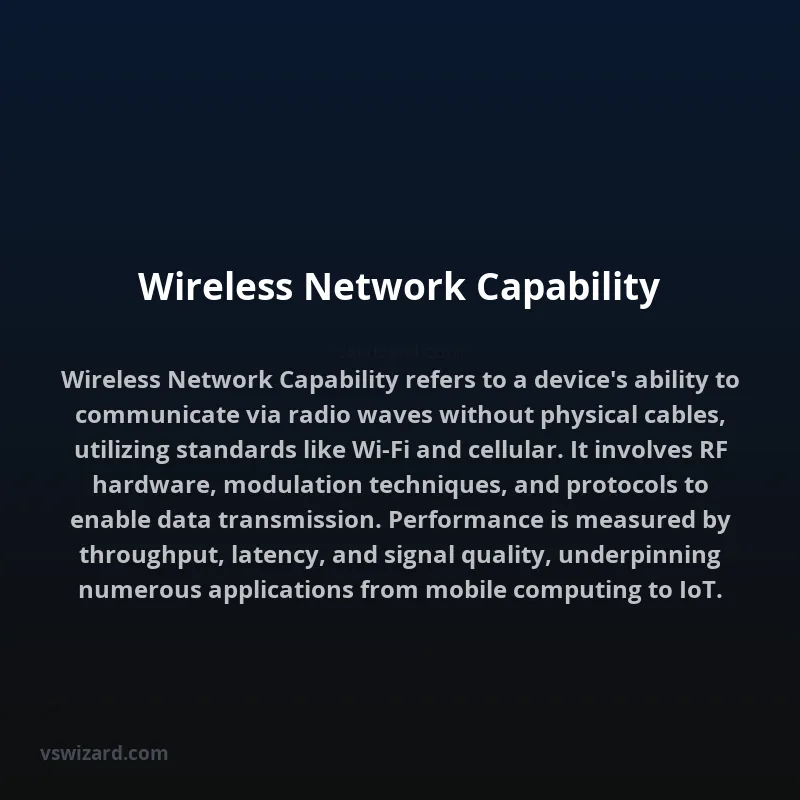
Wireless Network Capability denotes the inherent or implemented ability of a device, system, or infrastructure component to establish and maintain communication across a network without the use of physical wired connections. This capability is fundamentally predicated on the utilization of electromagnetic waves within specific frequency bands to transmit and receive data. Its scope encompasses a wide array of technologies, including but not limited to Wi-Fi (IEEE 802.11 standards), cellular (2G, 3G, 4G LTE, 5G), Bluetooth, Zigbee, and satellite communications. The operational efficacy of wireless network capability is governed by factors such as signal strength, interference levels, bandwidth allocation, protocol efficiency, and the underlying physical layer characteristics, all of which dictate data throughput, latency, and connection reliability.
The technical realization of wireless network capability involves sophisticated hardware and software components. At the hardware level, this includes radio frequency (RF) transceivers, antennas, baseband processors, and associated circuitry designed to modulate and demodulate signals. Software plays a crucial role in managing network access, implementing communication protocols, ensuring data integrity through error correction and encryption, and optimizing resource utilization. Standards bodies, such as the IEEE for Wi-Fi and cellular standards bodies like the 3GPP, define the technical specifications that ensure interoperability and performance across diverse implementations. Evaluating wireless network capability necessitates an understanding of metrics like signal-to-noise ratio (SNR), bit error rate (BER), maximum data rates, spectral efficiency, and Quality of Service (QoS) parameters.
Mechanism of Action
Wireless network capability operates through the principles of radio wave propagation. Data is encoded into electrical signals, which are then modulated onto a carrier wave by a transmitter. This modulated signal is amplified and broadcast by an antenna. The electromagnetic waves travel through space and are intercepted by a receiving antenna. The receiver then demodulates the signal, extracting the original data, which is subsequently processed. Key physical phenomena influencing this process include reflection, refraction, diffraction, and scattering, all of which contribute to signal fading and multipath interference. Advanced techniques like Orthogonal Frequency Division Multiplexing (OFDM) and Multiple-Input Multiple-Output (MIMO) antenna technology are employed to mitigate these effects and enhance spectral efficiency and link robustness, particularly in cellular and Wi-Fi systems.
Frequency Bands and Spectrum Allocation
The operation of wireless network capability is dependent on access to specific portions of the electromagnetic spectrum. These frequency bands are allocated by regulatory bodies (e.g., FCC in the US, ETSI in Europe) to different services to prevent interference. Common bands include 2.4 GHz and 5 GHz for Wi-Fi, various licensed bands for cellular services (e.g., 700 MHz, 1.9 GHz, 3.5 GHz for 5G), and unlicensed bands for short-range communications like Bluetooth. The choice of frequency band impacts range, penetration through obstacles, and potential for interference.
Modulation and Demodulation Techniques
Modulation is the process of encoding information onto a carrier wave. Common techniques include Amplitude Shift Keying (ASK), Frequency Shift Keying (FSK), Phase Shift Keying (PSK), and Quadrature Amplitude Modulation (QAM). Demodulation is the reverse process, extracting the original information from the received carrier wave. The complexity and sophistication of these techniques directly affect data rates and reliability. For instance, higher-order QAM schemes (e.g., 256-QAM, 1024-QAM) allow for more bits per symbol, thus increasing throughput but requiring higher SNR.
Industry Standards and Protocols
The interoperability and widespread adoption of wireless technologies are underpinned by a suite of industry standards. These standards define the physical (PHY) and media access control (MAC) layers of the network stack, ensuring that devices from different manufacturers can communicate seamlessly.
IEEE 802.11 Standards (Wi-Fi)
The IEEE 802.11 family of standards governs Wireless Local Area Networks (WLAN). Key iterations include 802.11n (Wi-Fi 4), 802.11ac (Wi-Fi 5), and 802.11ax (Wi-Fi 6/6E), which introduced improvements in speed, capacity, and efficiency through techniques like MIMO, channel bonding, and OFDMA (in 802.11ax).
Cellular Standards (3GPP)
The 3rd Generation Partnership Project (3GPP) defines standards for mobile telecommunications. This includes GSM (2G), UMTS/HSPA (3G), LTE (4G), and 5G NR (New Radio). Each generation has brought significant advancements in data speeds, latency reduction, and the ability to support a massive number of connected devices.
Bluetooth and Other Short-Range Standards
Bluetooth, defined by the Bluetooth SIG, is a wireless technology standard for exchanging data over short distances from fixed and mobile devices. Standards like IEEE 802.15.4 form the basis for Low-Rate Wireless Personal Area Networks (LR-WPANs), commonly used in IoT applications with protocols such as Zigbee and Thread.
Evolution of Wireless Network Capability
The evolution of wireless network capability has been characterized by a continuous drive towards higher data rates, lower latency, increased device density, and improved energy efficiency. From early analog cellular systems offering voice-only communication to the ubiquitous high-speed data access provided by 5G, each generation has expanded the possibilities of wireless connectivity. Early Wi-Fi standards focused on replacing wired Ethernet, while modern standards are optimized for dense environments and diverse applications, including augmented reality and industrial IoT.
Practical Implementation and Architecture
Implementing wireless network capability involves several architectural considerations, particularly in enterprise and public networks. This includes the strategic placement of access points (APs) or base stations, network segmentation, security protocols (e.g., WPA3), and integration with wired backhaul infrastructure. The architecture must also account for mobility management, enabling seamless handover between access points or cells.
Infrastructure Components
Key components include Wireless Access Points (WAPs) or Hotspots for WLANs, and Base Transceiver Stations (BTS) or gNBs for cellular networks. These connect to network controllers and ultimately to the broader internet or private networks. User devices (clients) contain the necessary RF hardware and software stack to communicate with the infrastructure.
Performance Metrics and Quality of Service (QoS)
Evaluating the effectiveness of wireless network capability relies on several performance metrics:
| Metric | Description | Relevance |
|---|---|---|
| Throughput | The actual data transfer rate achieved. | User experience, application performance. |
| Latency | The time delay in data packet transmission. | Real-time applications (VoIP, gaming, remote control). |
| Jitter | Variation in latency. | Stability of real-time streams. |
| Signal Strength (RSSI) | Received Signal Strength Indicator. | Connection stability and potential data rate. |
| Signal-to-Noise Ratio (SNR) | Ratio of signal power to noise power. | Data integrity and achievable modulation scheme. |
| Bit Error Rate (BER) | The rate at which errors occur in transmitted data. | Reliability of data transmission. |
| Connection Stability/Uptime | Consistency of the network connection. | Overall user satisfaction and operational continuity. |
Applications
Wireless network capability is fundamental to a vast array of modern applications, enabling mobility, flexibility, and the Internet of Things (IoT). This includes consumer electronics, mobile computing, public safety communications, industrial automation, smart city infrastructure, and telecommunications services.
Pros and Cons
Advantages
- Mobility and Flexibility: Users are not tethered by physical cables, allowing movement within the network coverage area.
- Ease of Deployment: Simplifies network setup and expansion, especially in complex or existing structures.
- Scalability: Easier to add new devices or users compared to running new cables.
- Support for IoT: Essential for connecting a multitude of low-power, distributed devices.
Disadvantages
- Security Vulnerabilities: Wireless signals can be intercepted more easily than wired connections if not properly secured.
- Interference: Susceptible to interference from other wireless devices, physical obstructions, and environmental factors.
- Limited Bandwidth and Throughput: Often lower and more variable compared to high-end wired connections like Gigabit Ethernet.
- Power Consumption: RF transceivers can consume significant power, impacting battery life in mobile devices.
- Health Concerns: While extensively studied and deemed safe within established limits by regulatory bodies, public perception sometimes raises concerns about electromagnetic radiation.
Alternatives and Future Outlook
While wireless network capability has become dominant in many areas, wired technologies like Ethernet (especially fiber optic) remain critical for high-bandwidth, low-latency backhaul and fixed infrastructure where mobility is not a requirement. Future developments are focused on enhancing spectral efficiency through advanced antenna arrays (e.g., Massive MIMO), AI-driven network optimization, cognitive radio, and the integration of new spectrum bands (e.g., millimeter-wave and terahertz frequencies for 6G and beyond). The trend is towards ubiquitous, high-performance, and highly reliable wireless connectivity seamlessly integrated with wired infrastructure.