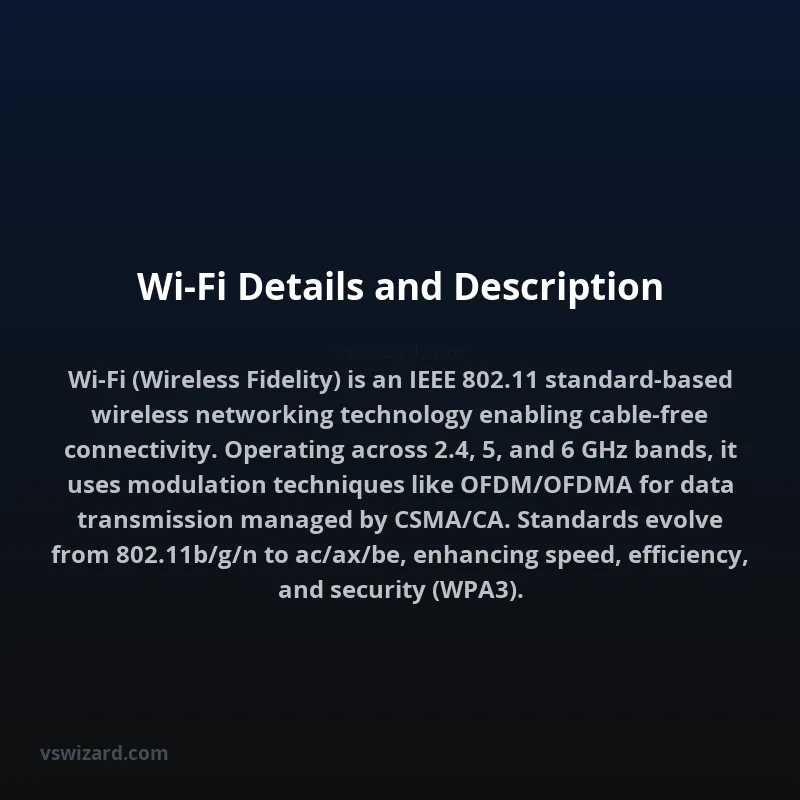
Wi-Fi, technically referring to Wireless Fidelity, is a ubiquitous wireless networking technology standardized by the IEEE 802.11 family of protocols. It enables devices to connect to a local area network (LAN) and, consequently, the internet without physical cables. The technology operates within specific radio frequency bands, primarily 2.4 GHz and 5 GHz, with newer iterations incorporating 6 GHz (Wi-Fi 6E) and upcoming standards extending into higher millimeter-wave frequencies. Its fundamental mechanism involves radio transceivers employing modulation techniques such as Orthogonal Frequency-Division Multiplexing (OFDM) and its successor, Orthogonal Frequency-Division Multiple Access (OFDMA), to transmit and receive data packets across shared wireless channels. This allows for the creation of wireless local area networks (WLANs) from a wireless access point (AP) that connects to a wired network, or as a standalone peer-to-peer network (ad hoc mode).
The operational details of Wi-Fi encompass a complex interplay of physical (PHY) and medium access control (MAC) sublayers as defined in the IEEE 802.11 specifications. The PHY layer dictates the radio wave propagation characteristics, modulation schemes, channel bandwidths, and data rates achievable, which are continually enhanced with each new amendment (e.g., 802.11a, b, g, n, ac, ax, be). The MAC layer manages how devices access the wireless medium, employing protocols like Carrier Sense Multiple Access with Collision Avoidance (CSMA/CA) to mitigate data collisions. Security is a critical aspect, implemented through protocols such as Wired Equivalent Privacy (WEP), Wi-Fi Protected Access (WPA), WPA2, and the current standard, WPA3, which offer varying levels of encryption (e.g., TKIP, AES) and authentication mechanisms (e.g., PSK, Enterprise/802.1X) to protect data confidentiality and integrity from unauthorized access.
Mechanism of Action
Wi-Fi communication is fundamentally a radio frequency (RF) transmission process. Devices equipped with Wi-Fi chipsets act as transceivers. When a device, such as a laptop or smartphone, needs to transmit data, its Wi-Fi adapter converts the digital data into analog radio waves. These waves are then broadcast through an antenna on a specific frequency band allocated by regulatory bodies (e.g., FCC in the US, ETSI in Europe). The data transmission utilizes modulation techniques to encode information onto the carrier wave. Early standards employed Direct Sequence Spread Spectrum (DSSS) and Frequency Hopping Spread Spectrum (FHSS), but modern standards predominantly use OFDM and OFDMA. OFDM divides the available bandwidth into numerous narrow subcarriers, allowing for more efficient data transmission and better resilience against multipath fading. OFDMA, introduced with 802.11ax, further enhances efficiency by dividing channels into smaller Resource Units (RUs), enabling simultaneous transmission to multiple users and reducing latency.
Reception follows the inverse process. A Wi-Fi access point (AP) or another wireless device listens for these radio signals on the designated channels. Upon receiving a signal, the adapter demodulates it, converting the analog radio waves back into digital data, which is then processed by the device's network stack. The CSMA/CA protocol is crucial for managing shared access to the wireless medium. Before transmitting, a device listens to the channel (carrier sense) to detect if it's busy. If idle, it transmits but also employs mechanisms to avoid collisions with other devices that might have started transmitting simultaneously. Acknowledgement (ACK) frames are sent by the receiver to confirm successful reception of data frames; if an ACK is not received within a specified timeout, the sender retransmits the data.
Physical Layer Standards and Operation
Frequency Bands and Channels
Wi-Fi operates in unlicensed industrial, scientific, and medical (ISM) radio bands. The most common are:
- 2.4 GHz Band: Offers a longer range but suffers from more interference due to its widespread use by other devices (e.g., Bluetooth, microwave ovens) and has fewer non-overlapping channels (typically 3 in the US: 1, 6, 11).
- 5 GHz Band: Provides significantly more bandwidth and a greater number of non-overlapping channels, leading to higher data rates and less interference. However, its range is shorter, and it is more susceptible to obstruction by solid objects.
- 6 GHz Band: Introduced with Wi-Fi 6E (and further utilized in Wi-Fi 7), this band offers a vast amount of new spectrum, free from legacy device interference, enabling very high throughput and low latency.
Channel Bandwidth
Channel bandwidth refers to the width of the frequency range used for a single transmission. Wider channels allow for higher data throughput. Common bandwidths include 20 MHz, 40 MHz, 80 MHz, and 160 MHz. Modern standards like 802.11ac and 802.11ax support channel bonding, where multiple contiguous channels are combined to create wider bandwidths.
Modulation and Coding Schemes (MCS)
MCS indexes define the specific combination of modulation technique (e.g., BPSK, QPSK, 16-QAM, 64-QAM, 256-QAM, 1024-QAM, 4096-QAM) and coding rate used to encode data bits onto the carrier wave. Higher-order modulation and lower coding rates enable higher data rates but require a better signal-to-noise ratio (SNR) and are more susceptible to errors.
Medium Access Control (MAC) Layer
CSMA/CA and Contention-Based Access
As mentioned, CSMA/CA is the fundamental protocol for managing shared access to the wireless medium. It involves:
- Carrier Sense: Devices listen to the channel. If busy, they defer transmission.
- Interframe Spaces (IFS): Standardized delays between frames.
- Random Backoff: If the channel is idle, devices wait for a random backoff period before transmitting to further reduce collision probability.
- Acknowledgement (ACK): Positive confirmation of successful frame reception.
Frame Aggregation
To improve efficiency and reduce MAC overhead, Wi-Fi standards support frame aggregation. This involves combining multiple MAC Service Data Units (MSDUs) into a single Aggregate MAC Protocol Data Unit (A-MPDU) or combining multiple MAC layer frames into a single physical layer frame (A-MSDU). This significantly reduces the overhead associated with acknowledgments and interframe spacing.
Quality of Service (QoS)
IEEE 802.11e introduced enhanced QoS mechanisms, allowing for traffic prioritization. This is achieved through different Access Categories (ACs), each with its own queue and arbitration interframe space (AIFS), enabling real-time applications like voice and video streaming to receive preferential treatment over best-effort data traffic.
Industry Standards and Evolution
The evolution of Wi-Fi is defined by successive amendments to the IEEE 802.11 standard, each introducing improvements in speed, range, efficiency, and security. These standards are often marketed under the Wi-Fi Alliance's certification program, which uses simplified names for enhanced interoperability and consumer understanding.
Key IEEE 802.11 Amendments and Wi-Fi Alliance Designations
The following table summarizes major revisions and their common Wi-Fi designations:
| IEEE Standard | Wi-Fi Designation | Frequency Band(s) | Max Theoretical Data Rate | Key Features |
|---|---|---|---|---|
| 802.11 | (Legacy) | 2.4 GHz | 2 Mbps | Original standard, FHSS/DSSS |
| 802.11b | Wi-Fi 1 | 2.4 GHz | 11 Mbps | DSSS, improved speed over 802.11 |
| 802.11a | Wi-Fi 2 | 5 GHz | 54 Mbps | OFDM, higher speed, less interference |
| 802.11g | Wi-Fi 3 | 2.4 GHz | 54 Mbps | OFDM, backward compatible with 802.11b |
| 802.11n | Wi-Fi 4 | 2.4 GHz, 5 GHz | 600 Mbps | MIMO, Channel Bonding (up to 40 MHz) |
| 802.11ac | Wi-Fi 5 | 5 GHz | 6.9 Gbps | MU-MIMO (downlink), Wider Channels (up to 160 MHz), 256-QAM |
| 802.11ax | Wi-Fi 6/6E | 2.4 GHz, 5 GHz, 6 GHz (6E) | 9.6 Gbps | OFDMA, MU-MIMO (uplink/downlink), BSS Coloring, Target Wake Time (TWT), 1024-QAM |
| 802.11be | Wi-Fi 7 | 2.4 GHz, 5 GHz, 6 GHz | 46 Gbps+ | Extremely High Throughput (EHT), Wider Channels (up to 320 MHz), Multi-Link Operation (MLO), 4096-QAM |
Security Evolution
Security protocols have evolved in tandem with the standard to address vulnerabilities:
- WEP (Wired Equivalent Privacy): Early, fundamentally flawed encryption.
- WPA (Wi-Fi Protected Access): Introduced TKIP for better security than WEP, designed as an interim solution.
- WPA2: Mandated AES encryption, providing robust security for many years.
- WPA3: Offers enhanced security features including individualized data encryption in public networks, stronger authentication, and protection against brute-force attacks.
Practical Implementation and Deployment
Access Points (APs) and Routers
Wireless local area networks are typically established using wireless routers or standalone access points. A wireless router integrates routing functions, a network switch, and an AP into a single device, commonly used in homes and small offices. Enterprise-grade APs offer more advanced management, scalability, and security features, often managed by a wireless LAN controller (WLC).
Network Topologies
- Infrastructure Mode: The most common topology, where wireless devices (clients) connect to a central AP, which bridges them to a wired network.
- Ad Hoc Mode: A peer-to-peer network where devices connect directly to each other without an AP. This is less common for general internet access but useful for temporary, localized connections.
Client Devices
Virtually all modern consumer electronics, including smartphones, tablets, laptops, smart TVs, game consoles, and an ever-increasing array of Internet of Things (IoT) devices, incorporate Wi-Fi connectivity. The integration of Wi-Fi chipsets has become a standard feature for network-connected devices.
Antenna Design and MIMO
Multiple-Input Multiple-Output (MIMO) technology utilizes multiple antennas at both the transmitter and receiver to improve communication performance. By transmitting multiple data streams simultaneously over the same channel (spatial multiplexing), MIMO significantly increases data rates. Beamforming is another antenna technique that focuses the RF energy towards the receiving device, improving signal strength and reducing interference.
Performance Metrics and Considerations
Throughput and Data Rates
Theoretical maximum data rates specified by standards are rarely achieved in real-world conditions due to factors such as protocol overhead, interference, distance from the AP, and the number of connected devices. Actual throughput is influenced by the specific MCS used, channel width, and signal quality (SNR).
Latency
Latency, the time delay in data transmission, is critical for real-time applications like online gaming and video conferencing. Wi-Fi latency is influenced by channel congestion, processing delays in APs and client devices, and the efficiency of the MAC protocol. Newer standards like Wi-Fi 6 and Wi-Fi 7, with OFDMA and other enhancements, aim to reduce latency.
Range and Coverage
The effective range of a Wi-Fi network depends on the frequency band, transmit power, antenna design, environmental obstructions (walls, furniture), and interference. Higher frequencies (5 GHz, 6 GHz) offer less range than lower frequencies (2.4 GHz). Mesh Wi-Fi systems and Wi-Fi extenders are often used to improve coverage in larger areas.
Interference
Co-channel interference (from other Wi-Fi networks on the same channel) and adjacent-channel interference (from networks on nearby channels) can significantly degrade performance. Non-Wi-Fi interference sources (e.g., microwaves, Bluetooth devices, cordless phones operating in the 2.4 GHz band) also pose challenges. Techniques like BSS Coloring in 802.11ax help mitigate interference by allowing devices to ignore traffic from other networks that are not their own.
Power Consumption
For battery-powered devices, power consumption is a key consideration. Features like Target Wake Time (TWT) in 802.11ax allow devices to schedule when they will wake up to communicate with the AP, enabling them to sleep for extended periods and conserve battery life, which is particularly important for IoT devices.
Alternatives to Wi-Fi
While Wi-Fi is dominant for wireless local area networking, other technologies serve different purposes or offer specific advantages:
- Ethernet: Provides a wired, generally more stable, and higher-speed connection, ideal for stationary devices and critical network infrastructure.
- Bluetooth: Designed for short-range, low-power communication between devices (e.g., headphones, keyboards, mice), not for general network access.
- Cellular Networks (4G/5G): Provide wide-area wireless connectivity, essential for mobile devices when Wi-Fi is unavailable, but typically incur data charges and can have higher latency.
- Zigbee and Z-Wave: Low-power, low-data-rate wireless protocols primarily used for home automation and IoT devices, forming mesh networks.