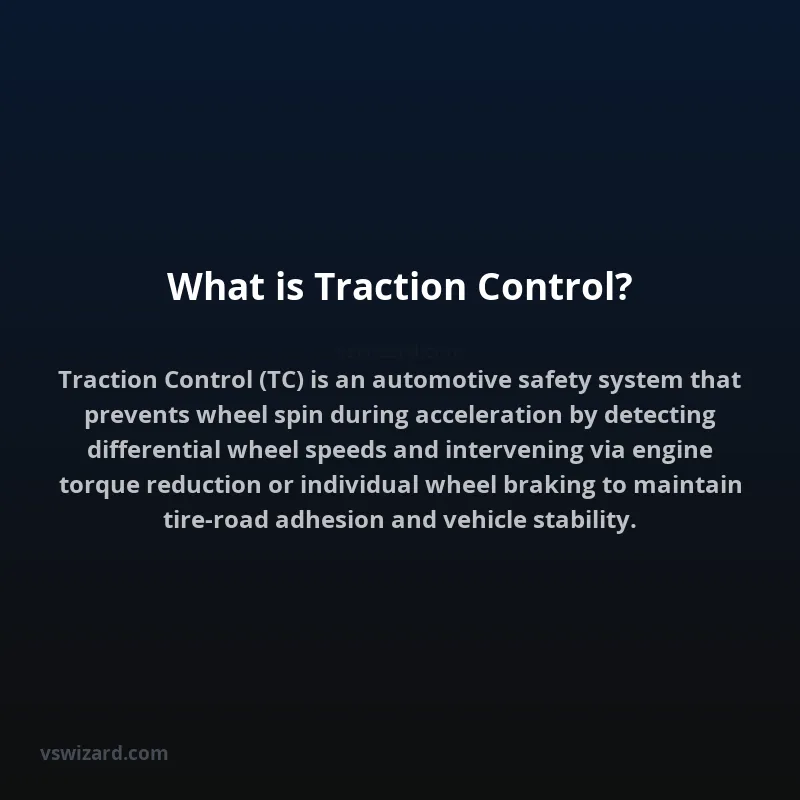
Traction Control (TC), formally known as Electronic Stability Control (ESC) when integrated with other stability systems, is an active automotive safety system designed to prevent loss of traction during acceleration. It operates by detecting wheel slip, typically when a driven wheel begins to rotate faster than the non-driven wheels or the vehicle's actual speed, which indicates a loss of grip with the road surface. When excessive wheel spin is detected, the system intervenes by modulating engine torque and/or applying braking force to the individual slipping wheel(s). This intervention aims to restore optimal tire-road adhesion, thereby enhancing vehicle stability, directional control, and the ability to accelerate safely, particularly on low-friction surfaces or during aggressive maneuvers.
The fundamental principle underpinning traction control relies on the differential rotation speeds of wheels, a parameter monitored by wheel speed sensors. These sensors, commonly used in Anti-lock Braking Systems (ABS), provide real-time data to a dedicated Electronic Control Unit (ECU). The TC ECU analyzes this data, comparing the rotational velocities of driven wheels against non-driven wheels or a calculated vehicle speed. When the differential exceeds a predetermined threshold, signifying wheel spin, the ECU initiates control actions. These actions can include reducing engine throttle electronically (drive-by-wire systems) or selectively applying the brake caliper to the spinning wheel, effectively simulating a limited-slip differential effect and redistributing torque to wheels with better traction. Advanced TC systems often integrate with other vehicle dynamics control systems, such as ESC, to provide comprehensive stability management.
Mechanism of Action
Wheel Speed Sensing
Wheel speed sensors, typically employing Hall-effect or magnetoresistive technologies, are mounted at each wheel hub. They measure the rotational speed by detecting the passage of teeth on a rotatingrelu ring or the magnetic field fluctuations of a coded rotor. The ECU receives these signals as pulse trains, from which precise angular velocity can be calculated for each wheel.
ECU Processing and Logic
The Traction Control ECU continuously monitors the data from all wheel speed sensors. A core algorithm compares the speed of the driven wheels against the non-driven wheels. If a driven wheel's speed exceeds a calculated threshold relative to other wheels, indicating slip, the algorithm triggers an intervention. The sensitivity of this threshold is often adjustable, either manually by the driver or automatically based on vehicle dynamics sensors like yaw rate and lateral acceleration.
Torque Reduction Strategies
Engine Torque Management
In vehicles equipped with electronic throttle control (ETC) or drive-by-wire systems, the TC ECU can directly command a reduction in engine torque by closing the throttle plate. This is the primary method for managing excessive wheel spin during acceleration on slippery surfaces. The rate and magnitude of torque reduction are dynamically controlled to maintain optimal acceleration without compromising stability.
Brake Intervention
For rear-wheel-drive or all-wheel-drive vehicles where engine torque reduction might be insufficient or undesirable, the TC system can apply selective braking to the spinning wheel. The ECU activates the ABS hydraulic modulator to apply pressure to the appropriate brake caliper. This action slows the spinning wheel, effectively transferring torque to the opposite driven wheel through the differential, mimicking the function of a mechanical limited-slip differential.
Architecture and Integration
Standalone vs. Integrated Systems
Early traction control systems operated independently. However, modern automotive safety architectures integrate TC as a subroutine within a broader Electronic Stability Control (ESC) system. ESC also incorporates yaw rate sensors, lateral acceleration sensors, and steering angle sensors to detect and counteract skidding, understeer, and oversteer. TC, in this integrated context, primarily addresses acceleration-induced instability and wheel spin.
Hardware Components
- Wheel Speed Sensors (per wheel)
- Traction Control ECU (often integrated with ABS/ESC module)
- Electronic Throttle Control Actuator (for engine torque reduction)
- ABS Hydraulic Modulator (for brake intervention)
- Yaw Rate Sensor (for advanced integration)
- Lateral Acceleration Sensor (for advanced integration)
- Steering Angle Sensor (for advanced integration)
Applications
On-Road Driving
TC is crucial for safe acceleration in diverse road conditions, including wet surfaces, snow, ice, gravel, and even during spirited driving on dry pavement. It enhances vehicle control during cornering exits and while accelerating uphill.
Off-Road Driving
In off-road scenarios, TC can be particularly beneficial when traversing loose surfaces like sand or mud. By managing wheel slip, it helps maintain forward momentum without excessively digging the tires or causing damage.
Industry Standards and Evolution
Early Developments
Pioneering work in traction control began in the late 1970s and early 1980s, with manufacturers like General Motors and Mercedes-Benz introducing rudimentary systems. These were often complex and expensive, primarily available on high-end luxury vehicles.
Standardization and widespread adoption
The advent of more sophisticated and cost-effective microcontrollers and sensor technologies in the 1990s led to the widespread adoption of TC. By the early 2000s, it became a common feature across various vehicle segments. In many jurisdictions, Electronic Stability Control (which includes TC functionality) has become a mandatory safety feature.
Advanced Features
Modern TC systems exhibit enhanced programmability and integration. Features such as Off-Road Modes, which may allow for a controlled degree of wheel slip to aid in clearing obstacles, and Sport Modes, which permit more aggressive driving dynamics before intervention, are becoming prevalent. Advanced TC can also work in conjunction with torque vectoring systems to actively distribute torque between wheels for improved cornering performance.
Performance Metrics and Evaluation
The efficacy of a traction control system is evaluated through several metrics:
- Acceleration Time: Time taken to reach a specific speed from a standstill, particularly on low-friction surfaces.
- Deceleration/Acceleration Consistency: Smoothness of power delivery and absence of abrupt changes in acceleration.
- Lateral Acceleration Limits: The maximum lateral acceleration achievable before tire slip becomes excessive, influencing cornering stability.
- Yaw Rate Stability: The system's ability to maintain a desired yaw rate and prevent uncontrolled rotation.
Pros and Cons
Pros
- Enhanced vehicle stability during acceleration.
- Improved control on low-friction surfaces (wet, snow, ice, gravel).
- Reduced risk of wheel spin and associated loss of directional control.
- Assistance in accelerating on inclines and out of corners.
- Can act as a virtual limited-slip differential, improving traction management.
Cons
- Can sometimes reduce acceleration performance on very loose surfaces (e.g., deep sand or mud) where some wheel slip is beneficial for momentum.
- Over-reliance can lead to a false sense of security, potentially encouraging riskier driving.
- In rare cases, aggressive intervention can lead to unexpected vehicle behavior if not properly calibrated.
- Adds complexity and cost to the vehicle's systems.
Alternatives and Related Technologies
Limited-Slip Differentials (LSD)
Mechanical LSDs provide a passive method for torque distribution, biasing torque to the wheel with more traction. Unlike TC, they do not actively modulate engine power or apply brakes.
Locking Differentials
These mechanically lock the axles together, forcing both wheels to rotate at the same speed, providing maximum traction in extreme off-road conditions but severely hindering cornering on paved surfaces.
Torque Vectoring
An advanced form of active differential control that uses electronic systems to precisely distribute torque not only between the left and right wheels but sometimes also between the front and rear axles. It often works in conjunction with TC and ESC.
Future Outlook
Future advancements in traction control will likely focus on even deeper integration with vehicle autonomy, advanced sensor fusion (including cameras and lidar for road condition sensing), and more sophisticated predictive algorithms. The goal is to anticipate and manage traction loss proactively rather than reactively, ensuring seamless and safe vehicle operation across an ever-wider range of dynamic scenarios.
| Parameter | Specification Range/Description | Notes |
|---|---|---|
| Wheel Speed Sensor Type | Hall Effect / Magnetoresistive | Typically 4 channels, one per wheel |
| Wheel Speed Measurement Accuracy | ± 1 km/h | Under normal operating conditions |
| Slip Threshold (Typical) | 5-15% differential wheel speed | Adjustable based on driving mode and conditions |
| Brake Intervention Pressure | Up to ABS maximum | Modulated to control slip |
| Engine Torque Reduction Latency | 20-100 ms | Dependent on throttle control system |
| Yaw Rate Sensor Range | ± 30 to ± 150 degrees/second | For ESC integration |
| Lateral Acceleration Sensor Range | ± 0.5 to ± 2.0 g | For ESC integration |
| Standard Compliance | ECE R140 (ESC), FMVSS 126 (ESC) | Mandatory in many regions |