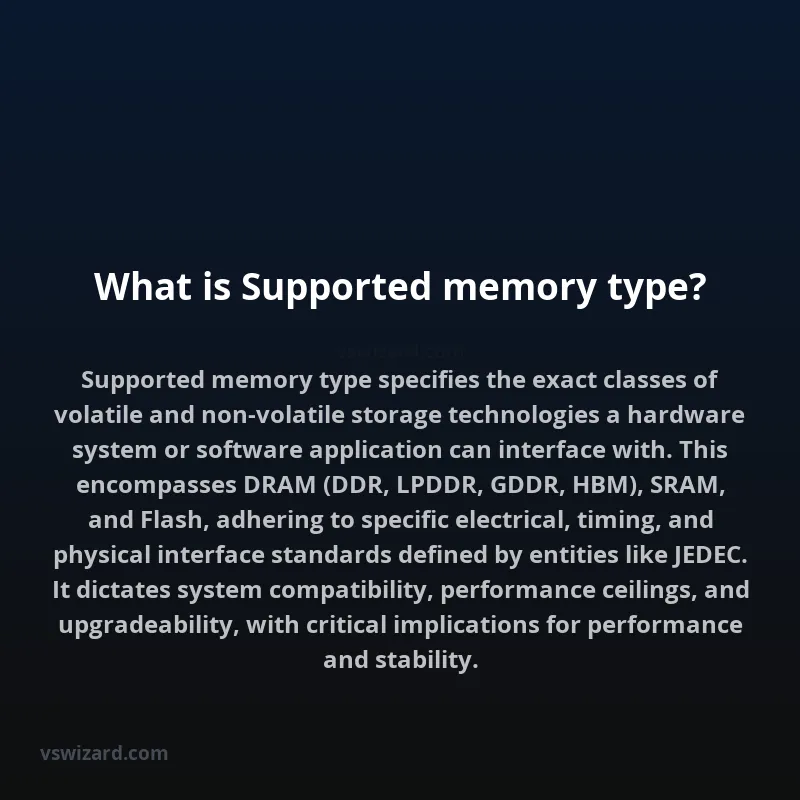
Supported memory type designates the specific categories and protocols of volatile and non-volatile storage technologies that a given hardware component, system, or software application is engineered to interface with and utilize. This encompasses a broad spectrum of semiconductor memory technologies, including but not limited to Synchronous Dynamic Random-Access Memory (SDRAM) variants (DDR, DDR2, DDR3, DDR4, DDR5), Low-Power DDR (LPDDR) generations, Graphics Double Data Rate (GDDR) standards, High Bandwidth Memory (HBM), Static Random-Access Memory (SRAM), NAND Flash (used in SSDs), and potentially emerging memory architectures like Resistive RAM (ReRAM), Phase-Change Memory (PCM), and Magnetoresistive RAM (MRAM). The precise definition of 'supported' implies adherence to specific electrical signaling standards, timing parameters, physical interface specifications (e.g., pinout, form factor like DIMM or SO-DIMM), and addressing schemes, all of which are dictated by industry bodies such as JEDEC (Joint Electron Device Engineering Council).
The explicit declaration of supported memory types is a critical technical specification, particularly for central processing units (CPUs), graphics processing units (GPUs), memory controllers, motherboards, and embedded systems. It directly influences system compatibility, performance potential, and upgradeability. For instance, a CPU's memory controller dictates the maximum frequency, capacity, and number of memory channels that can be employed, effectively limiting the choice of RAM modules. Similarly, software designed to leverage specific hardware acceleration features may require memory with particular characteristics, such as high bandwidth or low latency, available only through certain supported memory types. Failure to match the system's requirements with the installed memory's capabilities can result in system instability, reduced operational efficiency, or outright failure to boot.
Mechanism of Action and Interface Standards
The interaction between a processing unit and supported memory types is governed by a complex set of electrical and logical protocols. Memory controllers, integrated within the CPU or as discrete chips, act as the intermediary. They translate memory access requests from the processor into specific electrical signals that command the memory modules. For DRAM technologies, this involves precise timing of read, write, refresh, and precharge commands to the memory array. The physical interface is defined by standards such as DDR5's 288-pin DIMM form factor, which specifies voltage rails, data bus widths (typically 64-bit per channel), clock frequencies, and signal integrity requirements to ensure reliable data transfer at speeds often exceeding 4800 MT/s (MegaTransfers per second).
Each memory generation (e.g., DDR4 vs. DDR5) introduces significant architectural changes that necessitate specific support. DDR5, for instance, features two independent 32-bit sub-channels per module, improving concurrency and latency, alongside on-module Voltage Regulator Modules (VRMs) for finer voltage control and enhanced power efficiency. Supported memory types must align with these specifications, including the voltage requirements (e.g., 1.1V for DDR5), command/address bus signaling, and data strobe signals. Beyond DRAM, support for non-volatile memory types like NVMe (Non-Volatile Memory Express) interfaces for SSDs relies on protocols running over PCIe (Peripheral Component Interconnect Express) lanes, requiring specific controller logic and firmware to manage the flash memory's access patterns and error correction.
Industry Standards and Evolution
The landscape of supported memory types is primarily shaped by JEDEC standards, which define the specifications for DRAM, SRAM, and increasingly, emerging non-volatile memory technologies. The evolution from SDR (Single Data Rate) SDRAM to the current DDR generations has been driven by the relentless demand for increased bandwidth and capacity to feed ever-more powerful processors. Each DDR iteration has introduced innovations, such as Double Data Rate signaling (transferring data on both the rising and falling edges of the clock signal) in DDR, burst modes for sequential data access, improved prefetching mechanisms, and advanced error correction codes (ECC) at the module level.
The trajectory of memory technology development is also influenced by specialized needs. GDDR (Graphics DDR) standards, for example, are optimized for the massive parallel processing demands of GPUs, prioritizing very high bandwidth over latency. HBM (High Bandwidth Memory) represents a further leap, utilizing 3D stacking of DRAM dies and a very wide interface (1024-bit or more per stack) connected via interposers to GPUs, achieving unparalleled bandwidth densities. The ongoing development of persistent memory technologies, such as Intel's Optane (based on 3D XPoint, a form of PCM), aims to bridge the gap between DRAM and NAND Flash, offering byte-addressability and near-DRAM performance with the persistence of Flash, requiring new controller architectures and software support.
Applications and Implementation Considerations
The 'supported memory type' specification is a cornerstone for system integrators, hardware designers, and end-users across diverse computing domains. In consumer electronics, such as laptops and desktops, it dictates the RAM upgrade path and ensures compatibility with off-the-shelf memory modules. For high-performance computing (HPC) and server environments, the supported memory type directly impacts total system throughput, the ability to handle large datasets, and the efficiency of parallel workloads. Specific applications, like real-time video editing or scientific simulations, often necessitate memory configurations that maximize bandwidth and minimize latency, thus requiring hardware that explicitly supports advanced memory types like LPDDR5X or ECC RDIMMs (Registered DIMMs with Error Correction Code).
For embedded systems and specialized hardware, such as automotive infotainment systems or industrial control units, the supported memory type is often a design constraint dictated by power consumption, thermal management, and cost targets. For instance, automotive applications might prioritize LPDDR variants due to their lower power draw and compact form factors. The implementation involves selecting memory controllers that are architecturally capable of handling the chosen memory technology and integrating these components onto printed circuit boards (PCBs) with precise signal routing and impedance control to meet the stringent timing and signal integrity requirements of high-speed memory interfaces.
Performance Metrics and Benchmarking
Evaluating the performance impact of supported memory types involves assessing several key metrics. Bandwidth, measured in gigabytes per second (GB/s), quantifies the maximum rate at which data can be transferred to and from memory. This is crucial for data-intensive tasks. Latency, typically measured in nanoseconds (ns), represents the delay between initiating a memory request and receiving the first piece of data. Lower latency is critical for applications sensitive to response times. Capacity, measured in gigabytes (GB) or terabytes (TB), determines the amount of data that can be stored in volatile memory simultaneously.
When comparing different supported memory types, a tabular representation can elucidate their performance characteristics. For example, comparing DDR4, DDR5, and GDDR6:
| Memory Type | Typical Voltage (V) | Typical Data Rate (MT/s) | Effective Bandwidth (GB/s per channel/rank, theoretical max) | Key Feature |
| DDR4 | 1.2 | 2400 - 3200 | 19.2 - 25.6 | Mature technology, wide compatibility |
| DDR5 | 1.1 | 4800 - 7200+ | 38.4 - 57.6+ | Dual sub-channels, on-die ECC, higher speeds |
| GDDR6 | 1.35 (core) | 14000 - 20000+ | 56 - 80+ (per chip, wide bus) | Optimized for high bandwidth, common in GPUs |
These figures are illustrative and actual performance depends heavily on the specific implementation, controller capabilities, and system configuration. Benchmarking tools like AIDA64, MemTest86, or specific application-level profilers are used to measure real-world performance gains or limitations associated with different supported memory types.
Pros and Cons
The selection of supported memory types presents trade-offs.
- Advantages: Modern supported memory types like DDR5 and HBM offer substantially higher bandwidth and improved energy efficiency per bit transferred compared to their predecessors. Support for ECC memory enhances data integrity, crucial for mission-critical systems like servers and workstations. The availability of a wide range of memory capacities allows for tailoring systems to specific application demands. Emerging non-volatile memory types promise to reduce the memory hierarchy bottleneck.
- Disadvantages: Newer memory technologies (e.g., DDR5, HBM) typically come with a higher unit cost and may require specialized motherboards and CPUs, increasing the initial system investment. Compatibility can be an issue; older systems cannot utilize newer memory types even if physically compatible, and vice-versa. High-performance memory configurations can also increase power consumption and thermal output, necessitating more robust cooling solutions. The complexity of modern memory interfaces also increases design and manufacturing challenges.
Alternatives and Future Outlook
While DDR and GDDR technologies represent the current mainstream for volatile high-speed memory, research and development are continuously exploring alternatives and enhancements. Compute Express Link (CXL) is an emerging open standard interface that promises to enable more flexible memory pooling and resource sharing across CPUs, GPUs, and accelerators, potentially allowing systems to support memory types beyond what is directly integrated into the CPU. This could lead to architectures where memory is treated as a fabric, disaggregated from the processor.
The future outlook for supported memory types points towards further increases in bandwidth and capacity, alongside advancements in energy efficiency and persistence. Technologies like DDR6 are expected to push data rates even higher, while HBM continues to evolve with HBM3 and beyond. Persistent memory technologies are likely to become more integrated, blurring the lines between RAM and storage. Novel memory materials and architectures, such as MRAM and ReRAM, may offer unique advantages in specific applications requiring non-volatility, high endurance, or ultra-low power operation, provided they can overcome current manufacturing scalability and cost challenges.