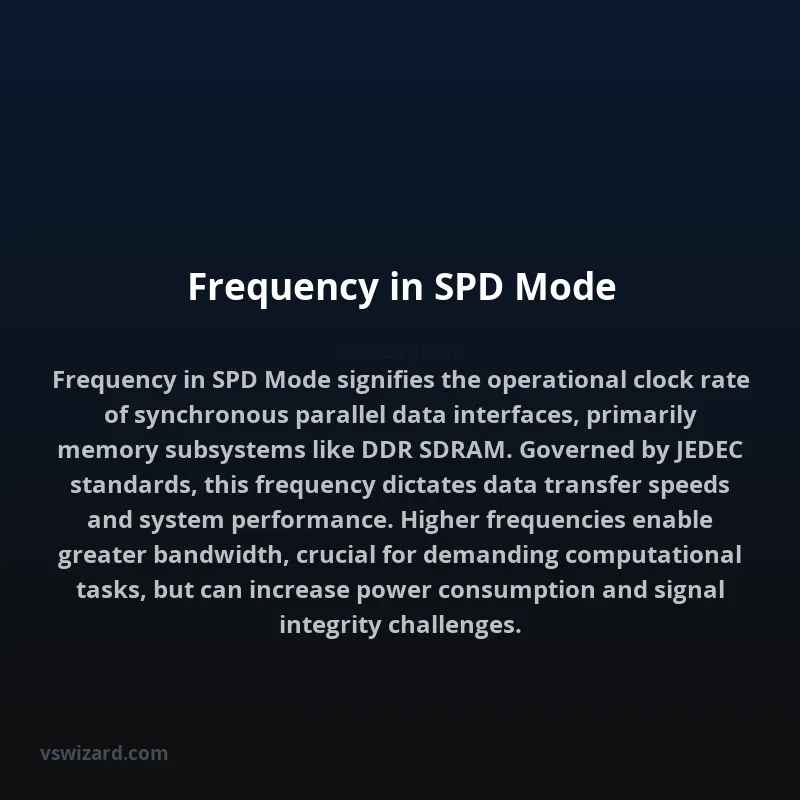
Speed, in the context of signal processing and oscillatory phenomena, refers to the rate at which a periodic waveform completes cycles. It is fundamentally a measure of how quickly something oscillates or propagates over time or space, quantified as the number of cycles per unit of time. This parameter is intrinsic to a vast array of physical and digital systems, ranging from the mechanical vibrations of a tuning fork to the electromagnetic oscillations of radio waves and the clock signals governing digital logic. Mathematically, frequency (denoted by f) is the reciprocal of the period (denoted by T), the time taken for one complete cycle, expressed as f = 1/T. The standard SI unit for frequency is Hertz (Hz), where 1 Hz is equivalent to one cycle per second.
The concept of speed as frequency is pivotal in characterizing the behavior and capabilities of dynamic systems. In telecommunications, it dictates the bandwidth and data transfer rates achievable by modulating carrier waves at specific frequencies. In materials science, resonant frequencies determine structural integrity under dynamic loads, with excessive vibration speeds potentially leading to catastrophic failure. In digital electronics, the clock speed, a direct manifestation of frequency, sets the operational pace for microprocessors and other integrated circuits, influencing computation speed and overall system performance. Understanding and controlling speed as frequency is therefore essential for designing, analyzing, and optimizing systems across engineering and scientific disciplines.
Historical Context and Evolution
The scientific understanding of speed as frequency emerged with the study of wave phenomena and oscillations. Early investigations by physicists like Christiaan Huygens and Isaac Newton laid the groundwork for describing periodic motion. However, it was James Clerk Maxwell's unification of electricity and magnetism in the late 19th century that solidified the link between oscillating electric and magnetic fields and the concept of electromagnetic waves propagating at the speed of light, characterized by their frequency. Heinrich Hertz's subsequent experimental verification of these waves further established frequency as a fundamental property.
The 20th century witnessed an exponential increase in the application and manipulation of frequency. Radio communication, built upon controlled frequency generation and modulation, revolutionized global connectivity. The development of quartz crystal oscillators provided unprecedented frequency stability, enabling precise timekeeping and the foundation for electronic computing. The advent of solid-state electronics and integrated circuits in the latter half of the century allowed for the generation, detection, and processing of signals across an ever-widening spectrum of frequencies, from audio to gigahertz ranges, driving advancements in computing, sensing, and information transmission.
Fundamental Principles and Measurement
At its core, frequency quantifies the temporal aspect of cyclical events. For a phenomenon occurring periodically, frequency is the count of occurrences within a standard unit of time. In mechanical systems, this could be the number of oscillations of a spring-mass system per second. In electrical circuits, it is the number of cycles of alternating current (AC) per second. In digital systems, the clock frequency represents the number of state transitions per second.
Measurement of frequency relies on various techniques depending on the domain:
- Electronic Counters: For electrical signals, frequency counters directly measure the number of pulses or cycles within a precisely timed interval.
- Oscilloscopes: These instruments visualize the waveform of a signal, allowing for the direct measurement of its period (T) and subsequently its frequency (f = 1/T).
- Spectrum Analyzers: Used for analyzing signals in the radio frequency and microwave domains, these devices display the signal's power distribution across different frequencies.
- Optical Methods: For very high frequencies, such as those associated with lasers, techniques like heterodyne detection or interferometry are employed.
Applications Across Industries
The precise control and measurement of speed as frequency are indispensable in numerous technological sectors.
Telecommunications and Broadcasting
Frequency is the fundamental carrier of information. Radio, television, and mobile communication systems rely on assigning specific frequency bands to different services to avoid interference. Modulation techniques like Amplitude Modulation (AM) and Frequency Modulation (FM) encode data onto carrier waves of specific frequencies. Higher frequencies enable wider bandwidths, thus supporting higher data transmission rates, as seen in 5G and Wi-Fi 6 standards.
Computing and Digital Electronics
The clock speed of a microprocessor, measured in Hertz (MHz or GHz), dictates the number of operations it can perform per second. Higher clock frequencies generally correlate with faster processing capabilities, although architectural efficiency plays a crucial role. Synchronous digital circuits depend on a stable clock signal to coordinate data transfer and execution of logic operations.
Medical Imaging and Diagnostics
Ultrasound imaging utilizes high-frequency sound waves (typically in the MHz range) to generate images of internal body structures. The frequency of the ultrasound waves affects penetration depth and image resolution. Magnetic Resonance Imaging (MRI) relies on the resonant frequencies of atomic nuclei in a magnetic field to create detailed anatomical images.
Industrial Automation and Control
Variable Frequency Drives (VFDs) are used to control the speed of AC electric motors by adjusting the frequency of the electrical power supplied to them. This allows for precise control over machinery in manufacturing, HVAC systems, and electric vehicles, leading to energy savings and improved process efficiency.
Scientific Research
In fields like spectroscopy, the absorption or emission of specific frequencies of electromagnetic radiation by matter is used to identify substances and study molecular structures. Particle accelerators use precisely controlled oscillating electromagnetic fields to accelerate charged particles to high speeds.
Performance Metrics and Specifications
When evaluating systems where speed as frequency is a key parameter, several metrics are critical:
| Metric | Description | Units | Typical Range/Context |
| Clock Speed | Rate at which a processor executes instructions. | Hertz (Hz) | MHz to GHz (CPUs, GPUs) |
| Carrier Frequency | Frequency of the signal used to transmit information. | Hertz (Hz) | kHz to THz (Radio, Wi-Fi, 5G) |
| Sampling Rate | Number of samples of a signal taken per unit of time. | Samples per second (SPS) | kHz to GHz (ADCs, Audio/Video) |
| Resonant Frequency | Frequency at which a system oscillates with maximum amplitude. | Hertz (Hz) | Varies widely (Mechanical structures, electrical circuits) |
| Bandwidth | Range of frequencies over which a system operates effectively. | Hertz (Hz) | kHz to hundreds of GHz (Communication systems) |
| Frequency Stability | Measure of how constant a frequency source is over time. | Parts per million (ppm) or relative frequency deviation | Varies (Atomic clocks to general oscillators) |
Challenges and Considerations
Despite its ubiquity, managing speed as frequency presents several engineering challenges:
- Signal Integrity: At very high frequencies, parasitic capacitance and inductance become significant, leading to signal degradation, reflections, and timing inaccuracies.
- Electromagnetic Interference (EMI): High-frequency signals can radiate electromagnetic energy, interfering with other electronic devices. Conversely, systems are susceptible to external EMI.
- Power Consumption: Higher operating frequencies, particularly in digital circuits, generally lead to increased power consumption and heat generation.
- Measurement Accuracy: Precisely measuring and generating very high or very low frequencies with high stability requires sophisticated and often expensive equipment.
- Bandwidth Limitations: Physical constraints and regulatory limits dictate the available frequency spectrum for many applications.
Future Outlook
The pursuit of higher speeds and more precise frequency control continues to drive innovation. Terahertz (THz) gap research aims to unlock the potential of frequencies between microwaves and infrared light for applications in high-speed data transfer, security screening, and non-ionizing medical imaging. Advancements in quantum computing may leverage quantum phenomena at extremely high frequencies. Furthermore, the ongoing miniaturization and integration of frequency-generating and -processing components will enable more sophisticated and ubiquitous applications across all technological domains, pushing the boundaries of what is currently possible in speed and performance.