Understanding Simultaneous Multi-GPU Setup
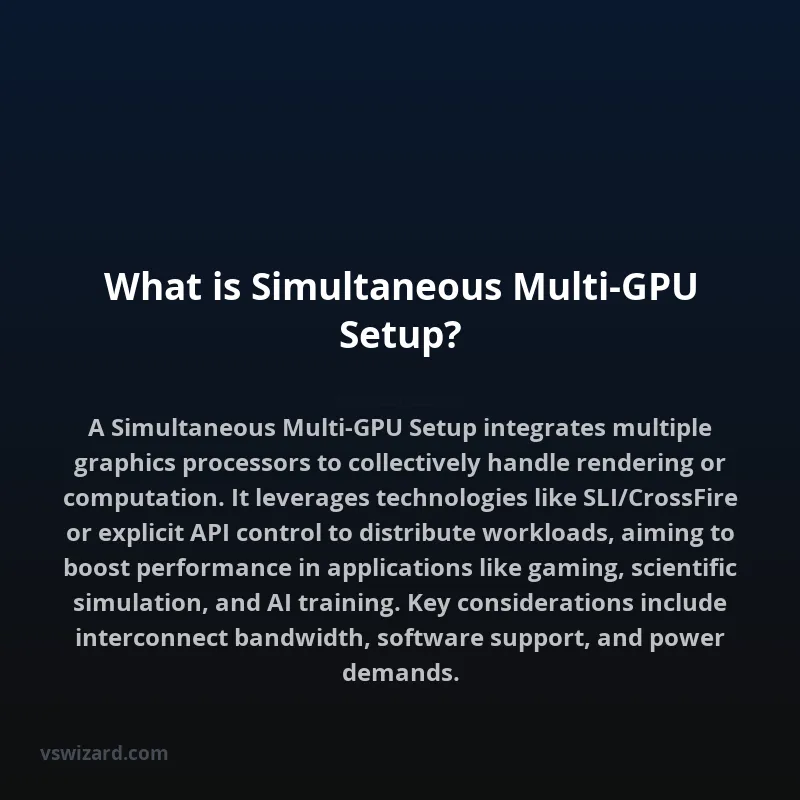
A Simultaneous Multi-GPU (Graphics Processing Unit) setup refers to a hardware configuration wherein multiple discrete GPU units are operatively integrated within a single computational system to collaboratively process graphical rendering tasks or accelerate general-purpose computing workloads. This architecture leverages inter-GPU communication protocols and specific software frameworks, such as NVIDIA's SLI (Scalable Link Interface) or AMD's CrossFire, to distribute computational load across available graphics processors. The primary objective is to augment overall processing throughput, enhance frame rates in complex visual applications, or significantly reduce computation times for highly parallelizable scientific simulations and machine learning model training. The effectiveness and feasibility of such setups are contingent upon the interoperability of the GPUs, motherboard chipset, power delivery system, and the application's inherent support for parallel processing paradigms.
The technical implementation of simultaneous multi-GPU configurations involves intricate data synchronization, workload partitioning, and inter-GPU communication management. Unlike sequential processing where tasks are handled by a single unit, multi-GPU systems require sophisticated scheduling algorithms to divide complex operations into smaller, manageable sub-tasks that can be executed concurrently. This necessitates high-bandwidth interconnects, such as PCI Express (PCIe) lanes and, in some proprietary architectures, dedicated inter-GPU links, to facilitate rapid data exchange and synchronization. Furthermore, the software stack, including the graphics driver and application programming interfaces (APIs), must be explicitly designed to recognize, address, and orchestrate multiple GPUs as a unified computational resource, effectively abstracting the physical multiplicity of the hardware from the end-user or application developer.
Historical Evolution and Rationale
The genesis of simultaneous multi-GPU configurations can be traced back to the increasing demand for computational power in 3D graphics rendering during the late 1990s and early 2000s. As single GPUs approached the limits of their performance capabilities within thermal and cost constraints, manufacturers explored methods to scale performance by deploying multiple GPUs. Initial attempts often involved rudimentary frame-buffering techniques or simple workload splitting. Technologies like SLI and CrossFire emerged as proprietary solutions to enable a more sophisticated form of parallelism, allowing consumer-grade systems to achieve higher visual fidelity and frame rates than would be possible with a single, equivalently priced GPU. The underlying rationale was to provide a cost-effective upgrade path for performance-intensive applications, primarily gaming, by allowing users to combine the power of two or more graphics cards.
Architectural Frameworks and Interconnects
Simultaneous multi-GPU setups are architecturally defined by how GPUs communicate and synchronize. Key components include:
- Motherboard Chipset: Provides the underlying PCI Express (PCIe) bus infrastructure. The number of available PCIe lanes and their generation (e.g., PCIe 3.0, 4.0, 5.0) critically influence inter-GPU bandwidth.
- GPU Interconnects:
- PCI Express (PCIe): The standard bus connecting GPUs to the CPU and, consequently, to each other through the motherboard. High-lane configurations (e.g., x16/x16, x8/x8) are preferred for optimal bandwidth.
- Proprietary Interconnects: Technologies like NVIDIA's NVLink and AMD's Infinity Fabric (though primarily for CPU-GPU or GPU-APU communication in consumer contexts, it historically had GPU-to-GPU roles) offered dedicated high-speed links between GPUs, bypassing the PCIe bus for direct, higher-bandwidth communication.
- Graphics Drivers: Software layers that manage GPU resources, enable communication protocols (SLI/CrossFire), and facilitate workload distribution.
- APIs and Software: DirectX, Vulkan, and OpenGL provide interfaces for applications to utilize multiple GPUs. Direct3D 12, for instance, offers explicit Multi-Adapter support.
SLI and CrossFire Technologies
NVIDIA's Scalable Link Interface (SLI) and AMD's CrossFire represented dominant proprietary frameworks for enabling simultaneous multi-GPU operation in consumer platforms. SLI utilized a bridge connector to link GPUs and synchronize frame rendering, primarily through techniques like Alternate Frame Rendering (AFR) or Split Frame Rendering (SFR). CrossFire employed a similar philosophy, often relying on driver-level optimizations and, in some generations, an external bridge (CrossFire Bridge Interconnect) for synchronized operation. Both technologies aimed to scale performance beyond that of a single card but were subject to driver overhead, application compatibility issues, and potential latency penalties.
Mechanisms of Load Distribution
The collaborative processing in multi-GPU setups is achieved through several primary rendering techniques:
- Alternate Frame Rendering (AFR): Each GPU renders alternate frames. GPU 0 renders frame 1, GPU 1 renders frame 2, and so on. This method offers significant performance gains but can introduce micro-stuttering due to synchronization latency between frames.
- Split Frame Rendering (SFR): The rendering workload for a single frame is divided among the GPUs. The frame buffer is split into sections (e.g., top half, bottom half), with each GPU rendering a portion. This reduces latency compared to AFR but can introduce artifacts at the split boundaries and is more dependent on scene complexity.
- Multi-GPU Explicit Control: Modern graphics APIs like Vulkan and Direct3D 12 allow developers to manage multiple GPUs explicitly. This provides finer-grained control over workload partitioning and synchronization, mitigating driver overhead and potential compatibility issues inherent in older implicit systems.
Performance Metrics and Evaluation
Evaluating the efficacy of a simultaneous multi-GPU setup involves several key performance indicators:
| Metric | Description | Measurement Tools |
| Frame Rate (FPS) | Average frames rendered per second. A primary indicator of gaming performance. | FRAPS, MSI Afterburner, GPU-Z |
| Frame Time Consistency | Variability in the time taken to render each frame. Low variability indicates smoother gameplay (minimal stuttering). | CapFrameX, OCAT |
| GPU Utilization | Percentage of the GPU's processing capacity being used. Ideal setups aim for near 100% utilization on all active GPUs. | Task Manager, MSI Afterburner, NVIDIA System Management Interface (NVSMI) |
| Interconnect Bandwidth Utilization | The amount of data being transferred between GPUs. High utilization may indicate a bottleneck. | NVSMI (for NVIDIA), AMD GPU Profiler |
| Rendering Latency | The time delay between input and the corresponding frame appearing on screen. | Input lag testing hardware/software |
Applications and Use Cases
Beyond gaming, simultaneous multi-GPU setups find application in various computationally intensive fields:
- Scientific Simulations: Computational fluid dynamics (CFD), molecular dynamics, finite element analysis (FEA), and cosmological simulations benefit from parallel processing capabilities.
- Machine Learning and Deep Learning: Training complex neural networks, particularly those with large datasets and architectures, can be significantly accelerated by distributing the computational load across multiple GPUs.
- 3D Rendering and Animation: Professional rendering engines (e.g., OctaneRender, Redshift) can leverage multiple GPUs to drastically reduce render times for complex visual effects and architectural visualizations.
- Video Editing and Post-Production: Accelerating complex effects, color grading, and encoding/decoding operations in high-resolution video workflows.
- Cryptocurrency Mining: While less common now with ASICs, historically, GPU farms utilized multi-GPU setups for proof-of-work computations.
Challenges and Limitations
Despite potential performance gains, simultaneous multi-GPU setups present several challenges:
- Software and Driver Support: Application developers and driver engineers must actively implement and maintain support for multi-GPU configurations. Older or less optimized applications may not scale effectively or may exhibit visual artifacts.
- Power Consumption and Heat: Multiple high-performance GPUs consume substantial electrical power and generate significant heat, necessitating robust power supply units (PSUs) and advanced cooling solutions.
- Cost: Acquiring multiple discrete GPUs and ensuring a compatible system infrastructure (motherboard, PSU, cooling) can be more expensive than a single, higher-end GPU.
- Diminishing Returns: Performance scaling is rarely linear. Often, two GPUs do not yield twice the performance of a single GPU due to communication overhead, synchronization bottlenecks, and software limitations.
- Increased Complexity: Troubleshooting and system configuration become more complex with multiple GPUs.
- Obsolescence of Proprietary Standards: Technologies like SLI and CrossFire have seen reduced development focus and support from GPU manufacturers and game developers in recent years, favoring explicit multi-GPU control via modern APIs.
Alternatives and Future Trends
The landscape of high-performance computing is shifting. Alternatives and future trends include:
- Heterogeneous Computing: Integrating different types of processors (CPUs, GPUs, FPGAs, AI accelerators) to leverage their respective strengths for specific tasks.
- Dedicated AI Accelerators: Specialized hardware like NVIDIA's Tensor Cores or Google's TPUs are optimized for AI workloads, often outperforming general-purpose GPUs in that domain.
- Cloud Computing: Accessing scalable GPU resources via cloud platforms (AWS, Google Cloud, Azure) eliminates the need for local hardware investment and maintenance.
- Integrated Graphics: While not directly comparable for high-end performance, integrated GPUs are becoming increasingly powerful, sufficient for many mainstream computing tasks and casual gaming.
- Explicit Multi-GPU Programming: The move towards explicit control via APIs like Vulkan and Direct3D 12 allows developers to manage GPU resources more efficiently, potentially enabling more robust and scalable multi-GPU solutions in the future, even if not through proprietary bridge technologies.
Conclusion
Simultaneous multi-GPU setup represents a specialized hardware configuration designed to aggregate the computational power of multiple graphics processors. While historically significant for augmenting graphical performance in consumer and professional applications, its practical utility is increasingly dictated by sophisticated software support, application-specific parallelism, and the availability of high-bandwidth interconnects. The ongoing evolution in computing architecture, favoring specialized accelerators and heterogeneous systems, alongside the maturation of explicit multi-GPU programming models, continues to shape the relevance and implementation strategies for multi-GPU deployments in demanding computational environments.