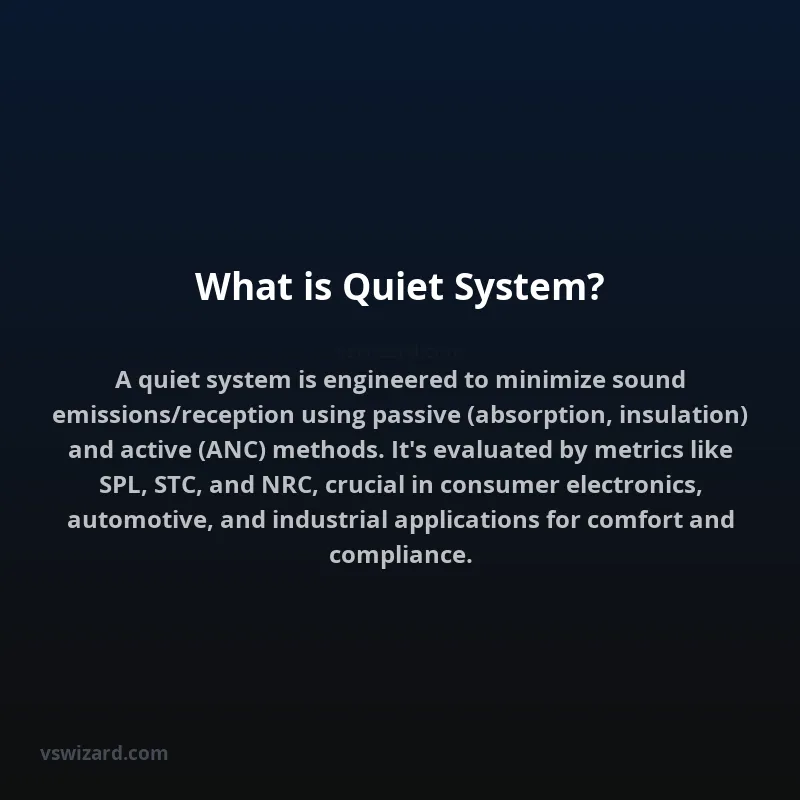
A quiet system, within the domain of acoustic engineering and environmental control, refers to a designed environment or a manufactured product engineered to minimize or eliminate undesirable sound emissions and reception. This encompasses a broad spectrum of applications, from architectural acoustics, where the goal is to achieve specific reverberation times and sound isolation, to the design of consumer electronics and industrial machinery, where noise reduction is paramount for user comfort, regulatory compliance, and operational efficiency. The fundamental principles involve the strategic application of sound absorption, sound reflection, sound insulation, and active noise cancellation techniques, often integrated within a complex interplay of material science, fluid dynamics, and electromagnetic principles. Understanding a quiet system necessitates an appreciation for the physics of sound propagation, psychoacoustics, and the specific acoustic signatures of its constituent components and the surrounding environment.
The operationalization of a quiet system relies on a multi-faceted engineering approach. This typically involves the identification of primary noise sources (e.g., mechanical vibrations, airflow turbulence, electrical interference), the characterization of their acoustic outputs across relevant frequency bands, and the subsequent implementation of mitigation strategies. These strategies can range from passive measures, such as the use of viscoelastic damping materials, acoustic baffles, and resonant absorbers, to active control systems employing microphones, signal processors, and loudspeakers to generate anti-phase sound waves. The efficacy of a quiet system is quantitatively assessed using metrics like sound pressure level (SPL), sound transmission class (STC), noise reduction coefficient (NRC), and various psychoacoustic indices, benchmarked against established industry standards and performance objectives.
Mechanism of Action
Passive Acoustic Mitigation
Passive techniques for achieving a quiet system focus on physical barriers and material properties to attenuate sound. Sound absorption involves materials designed with porous structures or fibrous matrices that convert acoustic energy into heat through friction. Examples include mineral wool, fiberglass, open-cell foams, and specialized acoustic fabrics. Sound insulation, or blocking, is achieved through dense, massive materials that resist sound transmission, such as concrete, mass-loaded vinyl, and laminated glass. Damping is employed to reduce structural-borne vibrations by dissipating vibrational energy as heat, often through viscoelastic materials applied to vibrating surfaces. Resonant absorbers, like Helmholtz resonators or panel absorbers, are tuned to target specific problematic frequencies, offering efficient attenuation within a narrow band.
Active Noise Control (ANC)
Active Noise Control is a signal processing technique that utilizes destructive interference to cancel out unwanted sound waves. In a typical ANC system, microphones capture ambient noise, which is then processed by a digital signal processor (DSP). The DSP generates an anti-noise signal, precisely out of phase with the original noise, and this anti-noise is reproduced by loudspeakers. When the original noise and the anti-noise waves meet, they cancel each other out, significantly reducing the perceived sound level. The effectiveness of ANC is highly dependent on the frequency of the noise, the geometry of the space, and the responsiveness of the feedback loop. It is most effective against low-frequency, consistent noise sources.
Industry Standards and Regulations
The development and implementation of quiet systems are often governed by a complex web of international and national standards, as well as specific industry regulations. For instance, architectural acoustics standards such as ISO 717 (Acoustics – Rating of sound insulation in buildings) and ASTM E413 (Classification for Sound Transmission Class) provide methodologies for evaluating the sound insulation performance of building elements. In the automotive industry, regulations concerning in-cabin noise levels (e.g., those set by the Society of Automotive Engineers - SAE) and external noise emissions are critical. For consumer electronics, standards related to permissible noise levels for appliances (e.g., IEC standards) are enforced. Regulatory bodies like the Environmental Protection Agency (EPA) in the United States and similar organizations globally set noise pollution limits for industrial and urban environments, indirectly driving the adoption and refinement of quiet system technologies.
Applications of Quiet Systems
Consumer Electronics
In consumer electronics, quiet systems are integral to enhancing user experience. Examples include noise-cancelling headphones that use ANC to create personal quiet zones, quiet-running vacuum cleaners, washing machines with reduced operational noise, and silent computer cooling systems. The design prioritizes minimal acoustic output while maintaining functional performance. The engineering involves material selection for casing and internal components, vibration isolation mounts, and often sophisticated ANC integration.
Automotive Industry
Automotive applications are extensive, focusing on both interior comfort and external noise compliance. This includes designing quieter powertrains, exhaust systems, and tire-tread patterns to reduce road noise. Furthermore, active noise cancellation systems are increasingly integrated into vehicle cabins to counteract engine and wind noise, creating a more serene driving environment. Windshield and door seals, insulation layers in firewall and floor panels, and aerodynamic body designs all contribute to the overall quiet system.
Industrial and Commercial Environments
In industrial settings, quiet systems are crucial for worker safety, productivity, and compliance with occupational health regulations. Machinery enclosures, acoustic barriers around noisy equipment (e.g., generators, compressors, HVAC units), and sound-dampened ventilation systems are common implementations. In commercial spaces like offices and hospitals, creating quiet zones for concentration, patient care, and communication is achieved through specialized ceiling tiles, wall panels, and careful HVAC design.
Performance Metrics and Evaluation
The performance of a quiet system is assessed using a variety of quantitative metrics:
| Metric | Description | Typical Application |
|---|---|---|
| Sound Pressure Level (SPL) | Measured in decibels (dB), representing the magnitude of sound waves. | Overall noise assessment of devices and environments. |
| Sound Transmission Class (STC) | A single-figure rating of an airborne-sound isolation of a building element (e.g., wall, door). Higher is better. | Building acoustics, soundproofing. |
| Noise Reduction Coefficient (NRC) | A measure of the sound-absorbing efficiency of a material. Ranges from 0 to 1. Higher is better for absorption. | Acoustic treatment of surfaces. |
| A-weighting (dBA) | A frequency-weighting network approximating the human ear's response at typical loudness levels. | Environmental noise assessment, regulatory compliance. |
| Tonal Noise Index (TNI) | Measures the prominence of discrete tones in a sound spectrum, which can be particularly annoying. | Machinery noise analysis. |
Challenges and Future Outlook
Developing highly effective quiet systems presents several engineering challenges. Achieving broadband noise reduction, particularly at higher frequencies, with passive methods can require bulky or expensive solutions. Active noise cancellation faces limitations with transient or complex sounds and can introduce its own artifacts if not expertly implemented. Furthermore, balancing acoustic performance with other design constraints such as cost, weight, thermal management, and aesthetics remains a constant challenge. Future advancements are expected to focus on more intelligent adaptive ANC systems, novel metamaterials for acoustic manipulation, and integrated multi-functional materials that provide both structural integrity and superior acoustic performance. The increasing societal emphasis on health, well-being, and sustainability will continue to drive innovation in creating quieter, more comfortable, and less intrusive environments and products.