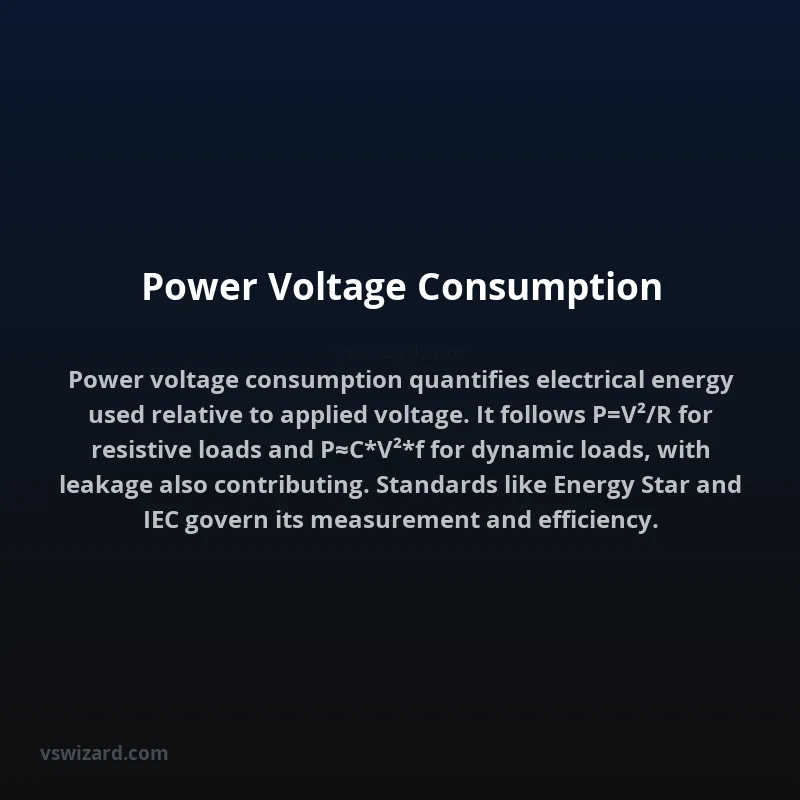
Power voltage consumption quantifies the electrical energy a device or system expends over a defined period, specifically as a function of the applied voltage. It is intrinsically linked to the fundamental principles of electrical circuits, where power (P) is the product of voltage (V) and current (I), often expressed as P = VI. However, in the context of consumption, the relationship is more nuanced, frequently involving impedance (Z), which dictates the current drawn at a given voltage (I = V/Z). For resistive loads, power consumption is proportional to the square of the voltage (P = V²/R), highlighting the critical impact of voltage fluctuations or levels on energy expenditure. Understanding this relationship is paramount for designing energy-efficient systems, managing electrical grid loads, and predicting operational costs in industrial and consumer electronics.
The concept extends beyond simple Ohm's law calculations to encompass dynamic power consumption characteristics in modern electronic components. Integrated circuits, for example, exhibit leakage currents and dynamic power dissipation dependent on clock frequencies and capacitive loads, which are themselves influenced by operating voltage. Therefore, power voltage consumption analysis often involves detailed characterization across a range of applied voltages and operating conditions, employing techniques such as power profiling, transient analysis, and semiconductor device modeling. This meticulous evaluation is crucial for thermal management, battery life optimization in portable devices, and ensuring compliance with increasingly stringent energy efficiency regulations across diverse technological sectors.
Mechanism of Action
Power voltage consumption is governed by fundamental electrical laws and material properties. At its core, it represents the rate at which electrical energy is converted into other forms, typically heat, light, or mechanical work, within an electrical circuit or device. The primary relationship is defined by Ohm's Law (V = IR) and the power equation (P = VI). When a voltage (V) is applied across a component with resistance (R), a current (I) flows, and power is dissipated. For purely resistive components, this power dissipation is directly proportional to the square of the applied voltage (P = V²/R) and inversely proportional to resistance. This quadratic relationship signifies that even small increases in voltage can lead to disproportionately larger increases in power consumption and heat generation.
In more complex electronic systems, particularly those incorporating semiconductor devices, power consumption is multifactorial. Dynamic power consumption arises from charging and discharging internal capacitances (Pdynamic = C * V² * f), where C is the capacitance and f is the switching frequency. Static power consumption, or leakage power, occurs even when the device is not actively switching, due to unintended current flow through semiconductor junctions. This leakage is highly dependent on voltage and temperature. Therefore, power voltage consumption is not merely a static value but a dynamic characteristic influenced by the applied voltage levels, the operating frequency, the device's internal capacitance, leakage characteristics, and ambient temperature.
Resistive Loads
For components exhibiting predominantly resistive behavior, such as heating elements, incandescent bulbs, or simple resistors, the power voltage consumption follows the relationship P = V²/R. This means that if the voltage across a resistor is doubled, its power consumption will quadruple, assuming the resistance remains constant. This principle is fundamental in understanding energy dissipation in simple electrical circuits and is critical for thermal design, where excessive voltage can lead to overheating and component failure.
Capacitive Loads and Switching
In circuits with capacitive elements, particularly in digital electronics where transistors switch states, dynamic power consumption becomes significant. The power required to charge and discharge these capacitances is directly proportional to the square of the operating voltage and the switching frequency (Pdynamic ≈ C * V² * f). This equation highlights the substantial impact of voltage scaling in reducing power consumption in processors and other integrated circuits. Lowering the operating voltage is a primary strategy for improving energy efficiency in high-frequency applications.
Leakage Current
Semiconductor devices, even when idle, exhibit leakage currents that contribute to static power consumption. These currents, often flowing through reverse-biased junctions or subthreshold regions of transistors, are highly sensitive to voltage. As operating voltages decrease, the exponential dependence of leakage on gate-to-source voltage (Vgs) can become a dominant factor in power consumption, especially in very large-scale integration (VLSI) designs operating at low voltages.
Industry Standards and Regulations
The measurement and reporting of power voltage consumption are often governed by international and regional standards to ensure comparability and promote energy efficiency. Organizations like the International Electrotechnical Commission (IEC) and the Institute of Electrical and Electronics Engineers (IEEE) publish standards that define methodologies for testing and specifying power consumption characteristics. Regulations such as the European Union's Ecodesign Directive and the U.S. Energy Star program set minimum energy efficiency requirements for various product categories, influencing design choices and mandating specific voltage operating ranges or power management features.
| Parameter | Symbol | Unit | Typical Value Range | Notes |
| Nominal Operating Voltage | Vnom | Volts (V) | 1.8 - 5.0 | Common range for digital ICs |
| Maximum Operating Voltage | Vmax | Volts (V) | Higher than Vnom | Absolute maximum to prevent damage |
| Minimum Operating Voltage | Vmin | Volts (V) | Lower than Vnom | Voltage below which functionality is not guaranteed |
| Dynamic Power Consumption Factor | kdyn | Farads * Volts² * Hertz | Varies by technology | Related to C * V² * f |
| Leakage Current Density | Jleak | Amperes / square meter (A/m²) | Highly dependent on process node | Impacts static power |
Energy Star Program
The Energy Star program, a joint initiative of the U.S. Environmental Protection Agency (EPA) and the U.S. Department of Energy (DOE), certifies energy-efficient products. Products bearing the Energy Star label meet strict energy efficiency guidelines, often including specifications related to power consumption at various voltage levels and operating modes (e.g., active, standby, sleep). Manufacturers must adhere to specific testing protocols to demonstrate compliance.
IEC Standards
The IEC develops international standards for electrical and electronic devices. For power consumption, relevant standards might include those for energy measurement (e.g., IEC 62301 for household appliances) or specific product types. These standards provide a common framework for assessing and reporting power usage, facilitating international trade and consumer understanding.
Applications and Implications
Understanding and managing power voltage consumption is critical across a vast spectrum of applications, from low-power embedded systems to high-performance computing and industrial machinery. In mobile and portable devices, minimizing power consumption at specific operating voltages is essential for extending battery life and thermal envelopes. For data centers, the aggregate power voltage consumption of servers, networking equipment, and cooling systems represents a significant operational expense and environmental concern, driving innovations in voltage scaling, power management integrated circuits (PMICs), and efficient power supply design.
Consumer Electronics
In devices like smartphones, laptops, and televisions, manufacturers aim to optimize power voltage consumption for a balance between performance and battery longevity or energy efficiency. This involves designing power management units that dynamically adjust operating voltages and frequencies based on the workload. For instance, a mobile processor might operate at a lower voltage when displaying static content and increase voltage for demanding gaming or video processing.
Industrial Automation
In industrial settings, power voltage consumption is a key factor in operational costs and system reliability. High-power machinery, control systems, and robotics must be designed with efficient power conversion and distribution in mind. Understanding how voltage variations affect the power draw of motors, actuators, and control circuits is crucial for preventing overloads, ensuring consistent performance, and optimizing energy usage in manufacturing processes.
Data Centers and High-Performance Computing
The enormous energy demands of data centers make power voltage consumption a primary concern. Server power supplies, CPUs, GPUs, and memory modules are designed with sophisticated power management techniques. Advanced processors employ techniques like dynamic voltage and frequency scaling (DVFS) to reduce power consumption when under low load. The efficiency of the power delivery network (PDN) within these systems, including voltage regulators, directly impacts the overall energy footprint.
Pros and Cons
Pros
- Energy Efficiency Optimization: Precise knowledge of power voltage consumption allows for targeted design improvements to reduce energy waste, leading to lower operational costs and environmental impact.
- Performance Tuning: Understanding the voltage-performance trade-off enables dynamic adjustment of operating parameters to achieve desired levels of performance while managing power draw.
- Thermal Management: Accurately predicting power consumption is crucial for designing effective cooling solutions and preventing thermal runaway in electronic devices.
- Battery Life Extension: For portable devices, minimizing power voltage consumption at various operational states directly translates to longer usage times between charges.
- Regulatory Compliance: Adherence to energy efficiency standards and regulations often hinges on accurate measurement and management of power consumption.
Cons
- Complexity of Measurement: Accurately measuring power consumption, especially under dynamic voltage and load conditions, can be complex and require specialized equipment.
- Design Trade-offs: Achieving extremely low power consumption may necessitate compromises in performance, features, or cost.
- Sensitivity to Voltage Fluctuations: Components can be sensitive to variations in input voltage, potentially leading to instability or damage if power voltage consumption characteristics are not well-understood and managed.
- Advanced Technologies: Newer semiconductor processes, while enabling higher performance, often introduce new leakage mechanisms that complicate power consumption analysis.
- Dynamic Variability: In modern systems, power consumption is highly dynamic, making it challenging to provide a single, static value that accurately represents real-world usage.
Future Outlook
The ongoing drive towards greater energy efficiency and sustainability will continue to emphasize the importance of understanding and controlling power voltage consumption. Advances in semiconductor technology, such as 3D stacking and novel transistor architectures, will necessitate new approaches to power management. Research into ultra-low-power design techniques, energy harvesting, and advanced materials is expected to further push the boundaries of what is achievable in minimizing energy expenditure across all technological domains. Furthermore, the integration of artificial intelligence and machine learning for optimizing power delivery and consumption in real-time across complex systems represents a significant future direction.