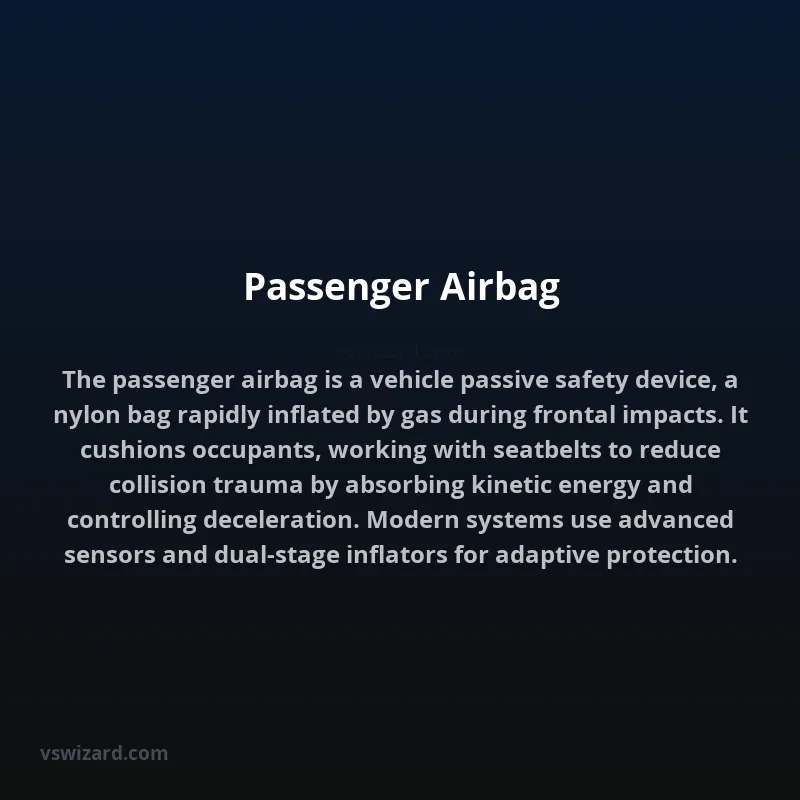
The passenger airbag is a crucial component of a vehicle's passive safety system, engineered to mitigate occupant injury during a frontal collision. It is a flexible fabric bag, typically constructed from nylon coated with a sealant such as neoprene, which rapidly inflates with an inert gas, primarily argon or nitrogen, or by generating gas through a pyrotechnic reaction. Its deployment is precisely timed and controlled by an automotive control unit that processes data from various crash sensors located throughout the vehicle's chassis and interior. The primary function is to create a cushion between the forward-moving passenger and the vehicle's interior structures, absorbing and dissipating kinetic energy during the deceleration phase of an impact.
The system operates in conjunction with the vehicle's seatbelt, which serves to initially restrain the occupant. The airbag acts as a secondary restraint system, providing supplemental protection, particularly in severe frontal or near-frontal impacts where the seatbelt alone may be insufficient. The design considerations for passenger airbags are complex, involving considerations of inflation speed, bag volume, tear seams to control deflation rate, and the placement of the inflator module and bag within the dashboard or seat. Advanced systems incorporate occupant detection sensors and dual-stage inflators to modulate deployment force based on the occupant's size, position, and the severity of the crash, aiming to optimize protection while minimizing the risk of airbag-induced injuries.
Mechanism of Deployment and Inflation
The deployment sequence of a passenger airbag is initiated by a network of sensors that detect rapid deceleration characteristic of a collision. These sensors, often accelerometers and pressure sensors, feed data to an Electronic Control Unit (ECU) dedicated to the Supplemental Restraint System (SRS). Upon exceeding predefined thresholds for impact velocity and deceleration, the ECU triggers the airbag module. This trigger activates an igniter within the inflator assembly, which in turn initiates a rapid chemical reaction (pyrotechnic) or releases stored gas. The pyrotechnic method commonly involves the rapid combustion of a propellant, such as sodium azide (NaN3) or a guanidine nitrate-based composition, producing a large volume of nitrogen gas almost instantaneously. This gas fills the nylon bag, causing it to expand through a precisely engineered rupture in its housing, typically located within the dashboard panel on the passenger side.
Inflation Dynamics and Deceleration Absorption
The inflation process is extremely rapid, occurring in milliseconds. The bag expands from a folded state to its full volume, creating a robust cushioning surface. The design of the bag includes specific tear seams that allow for controlled deflation once the occupant makes contact. This controlled deflation is critical; it allows the bag to absorb the occupant's forward momentum gradually, rather than acting as a rigid barrier. The force exerted by the inflating bag and the subsequent deceleration experienced by the occupant are carefully managed through the bag's material properties, tear seam design, and the inflation gas volume. The physics involved centers on impulse and momentum transfer, aiming to increase the duration of the impact event, thereby reducing the peak force experienced by the occupant and minimizing the risk of severe trauma such as thoracic or head injuries.
Industry Standards and Regulatory Compliance
The design, testing, and performance of passenger airbags are governed by stringent international and national safety standards. Organizations such as the National Highway Traffic Safety Administration (NHTSA) in the United States, through the Federal Motor Vehicle Safety Standards (FMVSS), particularly FMVSS 208 (Occupant Crash Protection), mandate specific performance requirements. European standards, developed by entities like the European New Car Assessment Programme (Euro NCAP), also influence airbag development and testing protocols. These standards dictate crash test conditions, occupant dummy specifications (e.g., Hybrid III), and performance metrics that vehicles must meet to achieve safety ratings. Key performance indicators include the evaluation of injury criteria, such as the Head Injury Criterion (HIC) and the chest compression metric, to ensure that the airbag system provides effective protection without introducing undue risk to occupants of varying sizes and seating positions.
Testing and Validation Protocols
Rigorous testing protocols are employed throughout the development and production lifecycle of passenger airbag systems. These include component-level testing of inflators and bags, sled tests simulating various impact scenarios, and full-vehicle crash tests. Advanced Anthropometric Test Devices (ATDs), commonly known as crash test dummies, are utilized to measure the forces and accelerations experienced by occupants during a collision. Sophisticated sensor arrays integrated into the ATDs record data relevant to various body regions. Furthermore, sophisticated computational modeling and simulation (e.g., Finite Element Analysis - FEA) are extensively used to predict system performance, optimize design parameters, and reduce the number of physical tests required. These simulations allow engineers to analyze complex interactions between the occupant, seatbelt, and airbag under a wide range of conditions.
| Parameter | Specification Range | Unit | Notes |
|---|---|---|---|
| Deployment Time (0-95% inflation) | 15 - 50 | ms | Typical range for frontal impact |
| Gas Volume (Typical) | 50 - 90 | Liters | Varies by vehicle class and airbag design |
| Inflation Pressure (Peak) | 1.5 - 3.0 | bar | Internal bag pressure during inflation |
| Nylon Fabric Tensile Strength | > 600 | N/mm | Coated nylon, e.g., Ripstop |
| Operating Temperature Range | -40 to +85 | °C | Environmental tolerance for ECU and sensors |
| Sensor Triggering Threshold (Deceleration) | 20 - 30 | g | Vehicle deceleration requiring deployment |
Evolution and Advanced Features
The passenger airbag system has undergone continuous evolution since its introduction. Early systems were primarily single-stage, deploying with a fixed force. Modern systems often feature dual-stage or multi-stage inflators, which modulate the inflation force based on the detected severity of the crash and occupant characteristics. Occupant detection systems, utilizing weight sensors in the seat or optical sensors, allow the vehicle's SRS ECU to disable or adjust the airbag deployment for smaller occupants or children, or in specific seating positions. Advanced features also include knee airbags, side curtain airbags, and more sophisticated sensor fusion techniques that integrate data from multiple sources for enhanced impact detection and response. The trend is towards increasingly intelligent systems that can differentiate a wider range of impact types and occupant conditions to optimize safety outcomes.
Integration with Other Safety Systems
Passenger airbags are not isolated safety devices but are integral parts of a comprehensive vehicle safety architecture. They work synergistically with pre-tensioning seatbelts, which tighten the belt immediately upon impact detection to remove slack. The SRS ECU communicates with other vehicle control modules, such as the Electronic Stability Control (ESC) and Anti-lock Braking System (ABS), to provide a holistic safety response. In the event of a severe crash, airbag deployment may also trigger post-crash functions, such as unlocking doors, activating hazard lights, and disconnecting the battery to prevent electrical fires. This interconnectedness ensures that all passive and active safety systems function in concert to protect occupants under diverse crash scenarios.
Pros and Cons
Advantages
- Significant reduction in head and chest injuries during frontal collisions.
- Acts as a secondary restraint, complementing seatbelts.
- Can be designed to protect occupants of varying sizes through advanced systems.
- Mandated by safety regulations, contributing to overall vehicle safety standards.
Disadvantages
- Risk of injury from rapid inflation and forceful deployment, particularly to smaller occupants or those not properly seated.
- Can be ineffective or even detrimental in non-frontal collisions (e.g., side impacts, rollovers) without complementary airbag systems.
- System complexity adds to vehicle cost and potential maintenance issues.
- Deployment requires specific impact conditions; may not deploy in less severe crashes or certain types of impacts.
Practical Implementation and Design Considerations
The physical integration of a passenger airbag module into the vehicle interior requires careful engineering. The module, comprising the inflator, folded bag, and housing, is typically concealed behind a plastic or composite panel designed to fracture cleanly during deployment. The location must ensure that the inflated bag intercepts the occupant effectively without obstructions. Engineers must account for the space required for inflation and the trajectory of the deploying bag. Material selection for the bag is crucial; high-tensile strength nylon, often with a specialized coating and tear seams, ensures controlled inflation and deflation. The placement and calibration of crash sensors are paramount, requiring extensive simulation and testing to define the precise acceleration thresholds that trigger deployment, balancing timely intervention with the avoidance of spurious activations.
Future Outlook and Technological Advancements
The future of passenger airbag technology points towards further integration of intelligent sensing and adaptive deployment strategies. Advances in sensor technology, including radar, lidar, and advanced vision systems, could provide even more granular data on occupant position, size, and posture, enabling hyper-personalized restraint. Research is ongoing into alternative inflation methods, such as compressed gas systems or micro-gas generators, which might offer more controlled inflation profiles. The development of 'smart' fabrics and self-healing materials could also enhance airbag durability and performance. As vehicles become more automated, the role of airbags may evolve to complement advanced driver-assistance systems (ADAS) and autonomous driving, ensuring occupant safety in scenarios where human control is reduced or absent, while also adapting to new seating arrangements and cabin configurations.