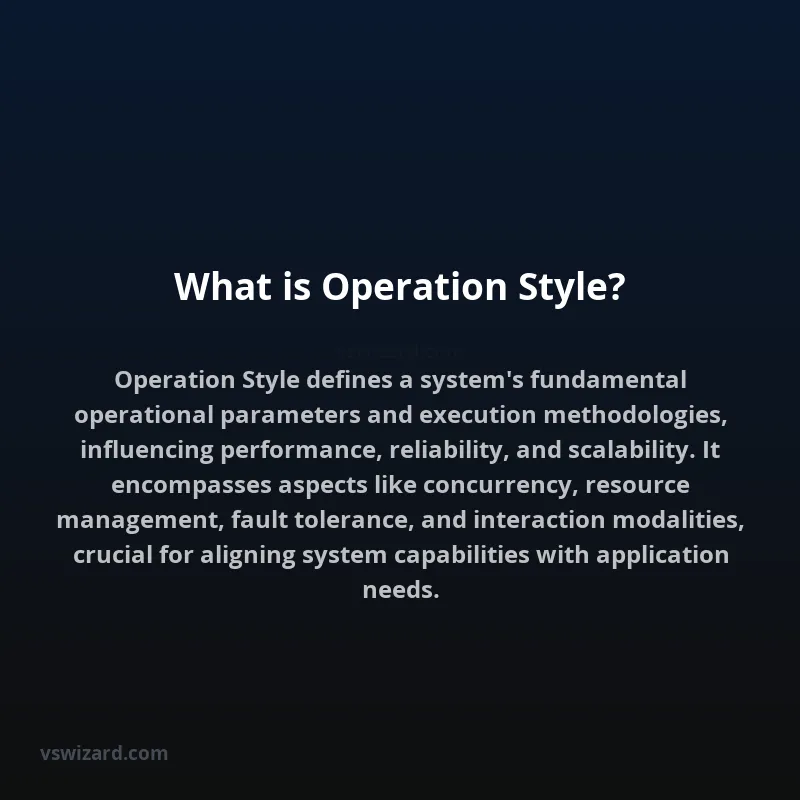
Operation Style, within the domain of technical specifications and system design, denotes the aggregate of fundamental operational parameters and methodologies that define how a given technology, process, or system executes its intended functions. It is not merely a singular setting but a composite characteristic encompassing the underlying logic, resource allocation strategies, concurrency models, and error handling protocols. The selection and configuration of an operation style directly impact performance, efficiency, reliability, scalability, and security. For instance, in computing systems, this could range from deterministic, batch-oriented processing to highly dynamic, event-driven, and real-time adaptive operations. The precise definition is context-dependent, but its essence lies in codifying the inherent behavioral patterns and governing principles of operation.
The granularities of Operation Style are diverse and can be analyzed across multiple dimensions. These include the mode of interaction (e.g., synchronous vs. asynchronous), the temporal execution paradigm (e.g., real-time, batch, on-demand), the resource management approach (e.g., dedicated, shared, virtualized), the fault tolerance mechanisms (e.g., fail-safe, fail-operational, fail-soft), and the data consistency models (e.g., ACID, BASE). Understanding the Operation Style is critical for system architects and engineers to ensure alignment between system capabilities and application requirements, predict system behavior under various load conditions, and facilitate interoperability within complex technological ecosystems. It provides a conceptual framework for evaluating and comparing different system designs based on their operational philosophies.
Core Components and Characteristics
An Operation Style is architected from a confluence of interconnected elements, each contributing to the system's overall behavioral profile. Key components include:
- Execution Paradigm: This defines the fundamental approach to processing tasks, such as synchronous (sequential processing where each operation must complete before the next begins), asynchronous (operations can be initiated and proceed independently of the completion of others), or a hybrid model.
- Concurrency Control: Mechanisms for managing simultaneous access to shared resources, encompassing techniques like locking, transactional memory, or message passing. This directly influences throughput and the potential for deadlocks or race conditions.
- Resource Management: Strategies for allocating and deallocating system resources (CPU, memory, network bandwidth, storage). This can be static (pre-allocated), dynamic (on-demand), or governed by sophisticated scheduling algorithms.
- Fault Tolerance and Resilience: The inherent capacity of the system to continue operation in the presence of failures. This can manifest as redundancy, error detection and correction codes, graceful degradation, or failover mechanisms.
- Data Consistency and Integrity: The rules and protocols governing the state of data, particularly in distributed or concurrent environments. Models range from strict consistency (all nodes see the same data at the same time) to eventual consistency (data will converge over time).
- Interaction Modality: The methods by which external entities or internal components communicate. This includes protocols, message formats, and the nature of the exchange (e.g., request-response, publish-subscribe).
Operational Paradigms and Their Implications
Different Operation Styles are suited for distinct use cases, each presenting a unique set of trade-offs:
Real-time Operation
Characterized by strict timing constraints, where the correctness of an operation depends not only on its logical result but also on the time at which it is produced. Systems operating in this style often employ deterministic scheduling algorithms and prioritize low latency and predictable response times. Examples include control systems for aerospace, industrial automation, and high-frequency trading platforms.
Batch Processing Operation
Tasks are grouped together and executed sequentially or in parallel without human intervention. This style is optimized for high throughput and efficient utilization of resources when immediate results are not required. Common in payroll systems, large-scale data analytics, and report generation.
Event-Driven Operation
Systems react to external or internal events as they occur. This paradigm is highly responsive and scalable, leveraging message queues or event streams to decouple components. It is prevalent in microservices architectures, IoT platforms, and financial market data feeds.
On-Demand Operation
Resources and services are provisioned and executed in response to explicit user requests or system triggers. This is the foundational style for cloud computing and Software-as-a-Service (SaaS) offerings, emphasizing elasticity and pay-per-use models.
Technical Standards and Interoperability
While Operation Style is a conceptual framework, its implementation often adheres to or is influenced by established technical standards. These standards facilitate interoperability, ensure predictable behavior, and provide benchmarks for performance evaluation. For instance, in distributed systems, standards like those defined by the IEEE (e.g., for networking protocols) or the ISO (e.g., for communication protocols) dictate aspects of interaction and data exchange. Within specific industries, consortia may define operational profiles. For example, the Data Distribution Service (DDS) standard, governed by the Object Management Group (OMG), specifies a data-centric publish-subscribe communication mechanism that can be configured to support various operation styles suitable for real-time systems.
| Attribute | Real-time | Batch Processing | Event-Driven | On-Demand |
|---|---|---|---|---|
| Primary Objective | Timeliness, Predictability | Throughput, Efficiency | Responsiveness, Scalability | Elasticity, Cost-Effectiveness |
| Latency Tolerance | Very Low | High | Moderate to Low | Moderate |
| Resource Utilization | Optimized for peak load | Optimized for average load | Variable, scales with events | Variable, scales with demand |
| Complexity | High | Moderate | High | Moderate to High |
| Typical Use Cases | Aerospace, Industrial Control | Data Analytics, Payroll | Microservices, IoT, Finance | Cloud Computing, SaaS |
| Failure Mode Example | Missed deadline critical | Data loss/corruption | Event loss/duplication | Service unavailability |
Evolution and Future Trends
The evolution of Operation Style is intrinsically linked to advancements in hardware, networking, and software engineering paradigms. The shift from monolithic architectures to microservices and serverless computing has driven the prominence of event-driven and on-demand operation styles. Future trends indicate a move towards more intelligent and adaptive operation styles, incorporating machine learning for predictive resource allocation, self-optimizing concurrency control, and automated fault prediction and mitigation. The increasing complexity of distributed systems and the rise of edge computing will necessitate operation styles that are not only efficient and resilient but also highly decentralized and context-aware, capable of dynamically reconfiguring based on environmental factors and workload fluctuations.