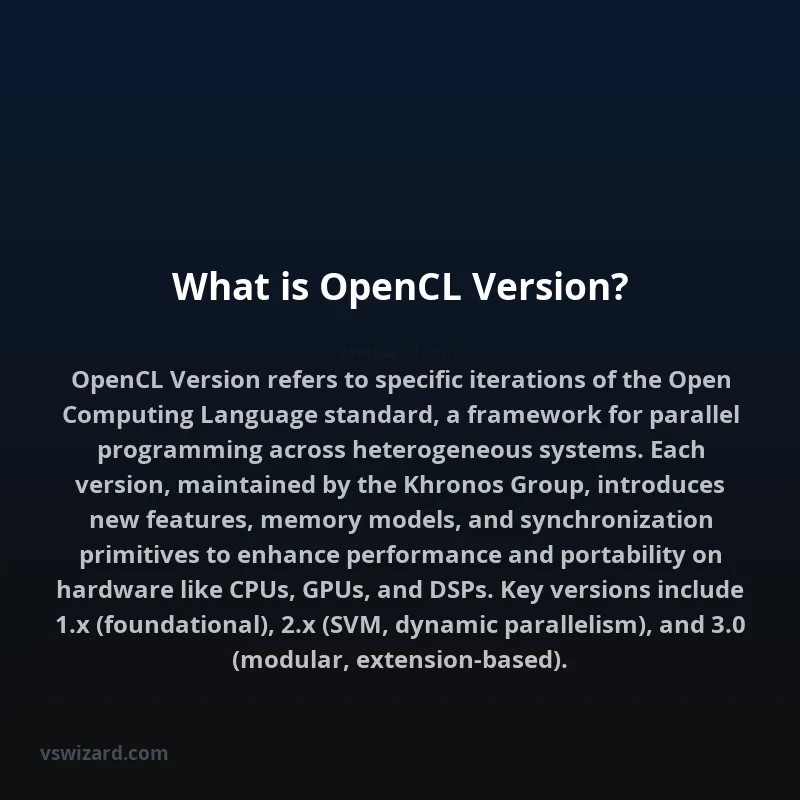
An OpenCL Version designates a specific release of the Open Computing Language (OpenCL) standard, a framework for parallel programming of heterogeneous systems. Each version introduces distinct features, enhancements, and mandates for compliance, influencing the capabilities and interoperability of parallel applications across diverse hardware architectures including CPUs, GPUs, DSPs, and FPGAs. These versions are formally defined by the Khronos Group, an industry consortium responsible for maintaining and evolving open standards for graphics, parallel computation, and advanced APIs.
The evolution of OpenCL Versions is driven by the demand for more sophisticated parallel programming paradigms, improved performance characteristics, and broader hardware support. Key advancements have included the introduction of finer-grained synchronization mechanisms, enhanced memory models, improved error handling, support for new hardware features like integrated GPUs and specialized accelerators, and extensions for specific domains such as machine learning and high-performance computing. Adherence to a particular OpenCL Version by both the host API and the device driver ensures predictable behavior and portability of kernel code across compliant platforms.
OpenCL Standard Evolution and Versioning
The OpenCL standard has progressed through several major versions, each building upon the foundations of its predecessors. This evolution addresses the dynamic landscape of parallel hardware and the increasing complexity of computational tasks. The versioning scheme, typically expressed as a major.minor number (e.g., 1.2, 2.0, 3.0), indicates significant feature introductions or architectural changes in the major revision and incremental improvements or bug fixes in the minor revision.
OpenCL 1.x Series
The initial releases, OpenCL 1.0 and 1.1, established the fundamental framework for heterogeneous parallel programming. Key features included kernels written in a C-based language, a host API for managing devices, contexts, command queues, and memory buffers. OpenCL 1.2 introduced significant enhancements such as the ability to link SPIR (Standard Portable Intermediate Representation) code, pipe objects for producer-consumer parallelism, and enhanced support for unified memory. This version also standardized support for features previously available only through vendor extensions, promoting greater interoperability.
OpenCL 2.x Series
OpenCL 2.0 marked a substantial paradigm shift by introducing support for shared virtual memory (SVM), enabling more flexible memory management between host and device. It also introduced dynamic parallelism, allowing kernels to enqueue their own kernels, and improved synchronization primitives like atomics and generic event wait lists. OpenCL 2.1 further refined this by adding support for SPIR-V, a Khronos-standard intermediate representation for graphics and compute, and introduced concepts like Kernel Subgroups for finer-grained intra-device parallelism. OpenCL 2.2 standardized many features previously exposed as extensions, particularly those related to generic atomics and the C++ kernel language.
OpenCL 3.0 and Beyond
OpenCL 3.0 represents a significant architectural change in how features are supported. Instead of mandating a comprehensive feature set for each version, OpenCL 3.0 adopts an opt-in extension model. This means that OpenCL 3.0 compliant implementations are only required to support the OpenCL 1.2 core feature set. All other features, including those introduced in OpenCL 2.x and newer advancements, are exposed as extensions. This approach allows for wider hardware compatibility and a more modular adoption of new capabilities, enabling vendors to implement only the features relevant to their hardware and target markets.
| OpenCL Version | Key Features/Enhancements | Release Year (Approx.) |
| 1.0 | Basic kernel execution, buffer objects, context management | 2009 |
| 1.1 | Atomic operations, pipe objects, global work-size | 2010 |
| 1.2 | SPIR support, device enqueue, improved error handling | 2011 |
| 2.0 | Shared Virtual Memory (SVM), dynamic parallelism, C++ kernel support | 2013 |
| 2.1 | SPIR-V support, kernel sub-groups, improved profiling | 2015 |
| 2.2 | Standardized extensions (e.g., generic atomics, C++ kernel language) | 2016 |
| 3.0 | Core subset with optional extensions, backward compatibility with 1.2 | 2019 |
Mechanism of Action and Implementation
An OpenCL Version dictates the programming model, API calls, and kernel language syntax that developers can utilize. The host application, typically running on a CPU, uses the OpenCL API to:
- Discover and select available compute devices.
- Create an OpenCL context, which manages devices and their resources.
- Compile or build OpenCL kernels (programs written in OpenCL C or C++) for the target devices.
- Allocate memory buffers on host and device memory spaces.
- Enqueue commands to transfer data, execute kernels, and synchronize operations.
The version compliance determines the availability of specific programming constructs. For instance, OpenCL 2.x versions enable kernels to dynamically launch other kernels or use SVM, offering more flexible data access patterns. OpenCL 3.0 implementations must support at least OpenCL 1.2 functionality, with higher-numbered features being optional extensions that can be queried at runtime.
Industry Standards and Compliance
The Khronos Group manages the OpenCL specification, ensuring its evolution and defining compliance requirements. Implementations are typically validated through a conformance testing suite. A device driver and its corresponding host API are considered compliant with a specific OpenCL Version if they correctly implement all mandatory features defined by that version. Developers often query the OpenCL Version and available extensions at runtime to adapt their application's behavior, ensuring optimal performance and functionality across diverse hardware.
Applications and Use Cases
OpenCL, across its various versions, finds application in a multitude of computationally intensive domains:
- Scientific Simulation: Molecular dynamics, computational fluid dynamics, weather forecasting.
- Machine Learning and AI: Training and inference of neural networks.
- Image and Video Processing: Real-time filtering, encoding/decoding, computer vision algorithms.
- Financial Modeling: Risk analysis, Monte Carlo simulations.
- High-Performance Computing (HPC): Data analytics, cryptography, signal processing.
The choice of OpenCL version can impact the expressiveness and efficiency of parallel algorithms for these applications. For example, applications benefiting from fine-grained memory sharing between kernels or dynamic kernel invocation would leverage OpenCL 2.x features.
Advantages and Limitations
Advantages
- Heterogeneous Computing: Enables unified programming across diverse hardware architectures.
- Portability: Source code can be written once and executed on compliant hardware from different vendors.
- Performance: Offers potential for significant speedups in parallelizable tasks compared to CPU-only execution.
- Open Standard: Developed and maintained by a consortium, ensuring broad industry support and preventing vendor lock-in.
Limitations
- Complexity: Developing and debugging OpenCL applications can be more complex than traditional sequential programming.
- Driver Quality: Performance and stability can be heavily dependent on the quality of vendor-specific drivers.
- Version Fragmentation: Differences in supported features across versions and vendor implementations can complicate portable development.
- Competition: Alternatives like CUDA (NVIDIA-specific) and SYCL offer different programming models and ecosystems.
Future Outlook
The OpenCL standard continues to adapt to the evolving computational landscape. The flexible, extension-driven model of OpenCL 3.0 allows it to remain relevant by accommodating new hardware capabilities and programming paradigms without mandating a complete overhaul for all implementations. Its role in enabling cross-platform parallel computing persists, particularly in embedded systems, specialized accelerators, and scenarios where vendor-neutrality is paramount. While other frameworks like SYCL, built atop backends like OpenCL or Vulkan, are gaining traction for higher-level abstractions, OpenCL remains a foundational technology for direct hardware access in heterogeneous environments.