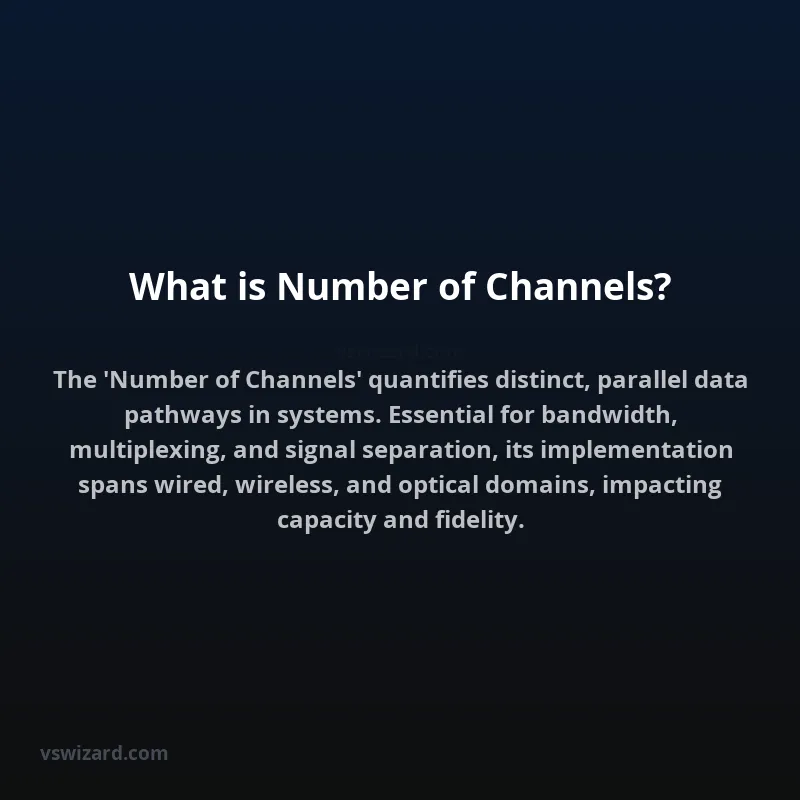
The term 'Number of Channels' quantifies the distinct, parallel data or signal pathways available within a given system or transmission medium. In telecommunications, signal processing, and audio-visual engineering, each channel represents an independent conduit capable of carrying discrete information streams. This multiplicity of channels is fundamental to achieving higher bandwidth, enabling multiplexing techniques such as Time-Division Multiplexing (TDM) or Frequency-Division Multiplexing (FDM), and facilitating spatial or temporal separation of signals for enhanced fidelity or reduced interference. The physical implementation varies significantly, ranging from distinct electrical conductors in a cable to allocated frequency bands in wireless spectrum or specific light paths in fiber optics.
The strategic utilization of multiple channels is a cornerstone of modern data transmission and signal management, directly impacting system capacity, throughput, and the ability to support complex, simultaneous operations. In audio contexts, it refers to the discrete sound sources or playback pathways, such as in stereo (two channels) or surround sound systems (five, seven, or more channels), each delivering specific acoustic information to reproduce a spatial soundfield. Similarly, in digital imaging and sensor arrays, the 'number of channels' often denotes the different spectral bands or types of data captured by each sensing element, such as in RGB (Red, Green, Blue) color imaging, where three channels are used to represent visible light color. The efficiency and efficacy of systems are intrinsically linked to how effectively these channels are managed, allocated, and processed.
Mechanism of Action and Underlying Principles
The operational principle behind employing multiple channels hinges on the concept of signal segregation and independent transmission or reception. In wired systems, distinct physical conductors or optical fibers often serve as individual channels. For instance, in Ethernet cabling, twisted pairs are dedicated to specific transmission and reception functions, forming logical channels. In optical communications, different wavelengths of light can be transmitted over a single fiber using Wavelength-Division Multiplexing (WDM), effectively creating multiple optical channels. In wireless communication, channels are typically defined by allocated frequency bands, time slots, or code sequences, as mandated by standards like Wi-Fi (IEEE 802.11) or cellular technologies (e.g., LTE, 5G).
The ability to isolate signals within their respective channels is critical for preventing inter-channel interference (ICI), which can degrade signal quality and reduce data integrity. Techniques such as guard bands in FDM, guard intervals in TDM, and orthogonalization schemes like Orthogonal Frequency-Division Multiplexing (OFDM) or Code-Division Multiple Access (CDMA) are employed to maintain this separation. Each channel is designed to carry a specific portion of the overall data stream or a distinct type of signal, which are then recombined at the receiving end through corresponding demultiplexing processes.
Spatial and Spectral Channelization
In advanced applications, channels can also refer to spatial or spectral distinctions. Spatial multiplexing, employed in MIMO (Multiple-Input Multiple-Output) antenna systems in wireless communications, utilizes multiple antennas at both transmitter and receiver to create multiple independent spatial channels. These channels exploit the phenomenon of multipath propagation to transmit multiple data streams concurrently, significantly increasing data rates. Spectral channelization, as seen in radio astronomy or satellite communications, divides the electromagnetic spectrum into numerous discrete frequency channels, each capable of carrying a separate signal or a segment of a larger data transmission.
Digital Signal Processing and Channel Bandwidth
The effectiveness of each channel is also defined by its bandwidth, which dictates the rate at which information can be transmitted. In digital systems, bandwidth is often measured in bits per second (bps). The total system capacity is frequently the product of the number of channels and the effective bandwidth of each channel. Digital Signal Processing (DSP) techniques are crucial for modulating data onto these channels, extracting signals, filtering out noise and interference, and demodulating the data at the receiver. Advanced algorithms are employed to dynamically allocate channel resources, adapt to changing channel conditions, and maximize spectral efficiency.
Industry Standards and Specifications
The definition and utilization of channels are rigorously governed by various industry standards to ensure interoperability and performance. For instance:
- Telecommunications: Standards like those from the ITU (International Telecommunication Union) define channelization schemes for carrier frequencies and bandwidths in cellular networks (e.g., 3GPP standards for 5G NR) and digital subscriber lines (DSL).
- Networking: IEEE 802.3 standards for Ethernet specify the number of twisted pairs used for data transmission and their roles. Wi-Fi standards (IEEE 802.11) define distinct channels within the 2.4 GHz and 5 GHz (and now 6 GHz) bands.
- Audio/Video: Standards like HDMI (High-Definition Multimedia Interface) and DisplayPort define multiple data lanes that can be considered independent channels for carrying video, audio, and control signals. Audio standards like AES67 define network audio channels for professional broadcast and production.
- Broadcasting: Standards for digital television (e.g., DVB, ATSC) define channel bandwidths and frequency allocations for over-the-air transmission.
Key Standards Table
| Standard | Technology | Description of Channels | Typical Number of Channels |
| IEEE 802.11ax (Wi-Fi 6) | Wireless LAN | Frequency bands divided into distinct channels (e.g., 20 MHz, 40 MHz, 80 MHz, 160 MHz) | Variable, typically 1-8 non-overlapping channels in 2.4 GHz, more in 5/6 GHz |
| 3GPP TS 38.xxx (5G NR) | Cellular Mobile Communication | Frequency bands partitioned into Resource Blocks (RBs), each RBs consisting of subcarriers. Multiple bands (component carriers) can be aggregated. | Variable, depends on bandwidth and carrier aggregation |
| HDMI 2.1 | Digital Video/Audio Interface | Multiple high-speed data lanes (TMDS channels) | 4 primary data lanes (often considered channels) |
| SFP+ / QSFP+ Modules | Fiber Optic Transceivers | Each port typically supports a single data channel, but some WDM variants multiplex multiple channels over one fiber. | 1 (standard), up to 4 or more (WDM) |
Applications and Implementations
The concept of 'Number of Channels' is pervasive across numerous technological domains:
Audio and Video Systems
In audio, the number of channels dictates the spatial realism of playback. Stereo systems use two channels (left and right), while surround sound systems employ multiple channels (e.g., 5.1, 7.1) to place sounds in specific locations around the listener. In video, multi-channel audio is synchronized with the video stream. High-definition and ultra-high-definition video transmission often utilize multiple parallel data channels to accommodate the high bandwidth requirements.
Telecommunications and Networking
Wireless communication systems leverage multiple channels to serve numerous users simultaneously and to increase aggregate throughput via techniques like carrier aggregation or MIMO. Wired networks, such as optical fiber systems, employ WDM to send multiple independent data streams over a single fiber, each on a different wavelength, effectively creating numerous channels. Ethernet standards define specific pairs within a cable for transmit and receive operations, effectively creating channels for bidirectional communication.
Sensors and Imaging
In digital cameras and imaging sensors, the 'number of channels' often refers to the spectral information captured. A monochrome sensor has one channel (luminance). A color sensor typically has three channels (e.g., Red, Green, Blue) or more in multispectral and hyperspectral imaging systems, each capturing light intensity within a specific spectral band. This allows for detailed analysis of material properties and environmental conditions.
Instrumentation and Test Equipment
Oscilloscopes, spectrum analyzers, and data acquisition systems are characterized by their number of input channels, which determine how many independent signals can be measured or monitored concurrently. High-channel-count systems are essential for complex system analysis, simulation, and debugging.
Evolution and Historical Context
The progression from single-channel systems to multi-channel architectures reflects the relentless demand for increased data capacity, fidelity, and efficiency. Early telegraphy and telephony were inherently single-channel. The advent of FDM in the early 20th century enabled multiple voice calls to share a single physical line, marking a significant expansion. TDM further refined this by dividing time into slots for different signals. The development of digital signal processing and advanced modulation techniques, coupled with miniaturization of electronic components, has led to the sophisticated multi-channel systems prevalent today, supporting everything from high-definition streaming to global satellite communications.
Pros and Cons
Pros
- Increased Capacity and Throughput: Multiple channels allow for parallel data transmission, significantly increasing the overall data rate.
- Improved Signal Quality: Independent channels can be optimized for specific signal types or spectral characteristics, potentially reducing interference.
- Enhanced Functionality: Enables complex applications like spatial audio, stereoscopic vision, and advanced sensor data fusion.
- Spectral Efficiency: Techniques like OFDM and MIMO make efficient use of limited available spectrum.
- Redundancy and Reliability: In some designs, multiple channels can provide backup in case of failure.
Cons
- Increased Complexity: Managing and synchronizing multiple channels requires sophisticated hardware and software.
- Higher Cost: Implementing multi-channel systems often involves more components, demanding higher manufacturing and integration costs.
- Interference Potential: Despite mitigation techniques, improper design or dense deployments can lead to inter-channel interference.
- Power Consumption: More active channels generally translate to higher energy requirements.
- Synchronization Challenges: Ensuring precise timing and phase alignment across multiple channels can be difficult, especially in high-speed or distributed systems.
Performance Metrics
Performance related to the number of channels is evaluated through several key metrics:
- Aggregate Bandwidth/Throughput: The total data rate achievable across all channels.
- Spectral Efficiency: Data rate per unit of bandwidth (bits/sec/Hz).
- Channel Utilization: The percentage of time or frequency allocated to useful data versus overhead.
- Signal-to-Noise Ratio (SNR) / Signal-to-Interference-plus-Noise Ratio (SINR): Measures the quality of the signal within each channel and across the system.
- Latency: The time delay for data to traverse the channel(s).
- Jitter: Variation in the timing of data arrival across channels.
Future Outlook
The trajectory points towards even greater channel density and complexity. Innovations in optical networking, such as coherent WDM and space-division multiplexing, promise to multiply channel capacity. In wireless, the expansion into higher frequency bands (e.g., millimeter-wave and sub-terahertz) and the refinement of MIMO and beamforming technologies will enable new forms of multi-channel communication. Quantum computing may also introduce novel paradigms for channel multiplexing and information encoding. The ongoing drive for higher bandwidth, lower latency, and increased connectivity will continue to push the boundaries of channel management and implementation.