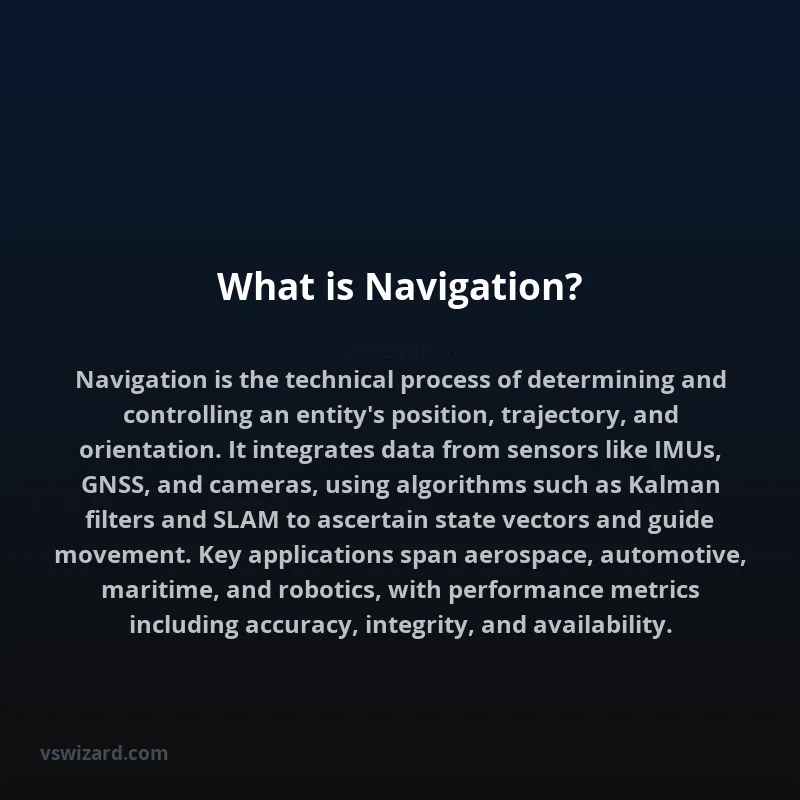
Navigation, in its broadest technical interpretation, refers to the process of determining and controlling the position, trajectory, and orientation of an entity (vehicle, vessel, aircraft, spacecraft, robotic system, or even a digital asset within a network) relative to a reference frame. This process fundamentally involves the acquisition, processing, and integration of data from various sources to ascertain the entity's state vector—comprising position, velocity, and attitude—and subsequently to guide its movement towards a designated goal. The underlying principles span disciplines including geodesy, physics (kinematics and dynamics), mathematics (calculus, linear algebra, differential equations), and computer science (algorithms, sensor fusion, control theory). Effective navigation systems are characterized by their accuracy, precision, reliability, and robustness against environmental disturbances and sensor noise.
The technical implementation of navigation systems relies on a diverse array of sensing technologies and computational methodologies. Terrestrial and celestial observation methods, dead reckoning techniques (integrating inertial measurements), radio-based positioning (e.g., LORAN, VOR), satellite-based systems (e.g., GPS, GLONASS, Galileo, BeiDou), and more recently, vision-based navigation and simultaneous localization and mapping (SLAM) algorithms represent distinct technological paradigms. Each approach possesses unique error characteristics and operational envelopes. Sensor fusion, a critical component in modern navigation, employs algorithms such as Kalman filters, extended Kalman filters, unscented Kalman filters, and particle filters to combine data from heterogeneous sources, thereby mitigating individual sensor limitations and enhancing overall state estimation accuracy. Control systems then utilize this estimated state to generate commands for actuators, enabling the entity to follow a planned path or maintain a desired orientation.
History and Evolution
The earliest forms of navigation were empirical, relying on celestial observations, landmarks, and rudimentary instruments like the astrolabe and compass. The development of chronometers in the 18th century significantly improved longitudinal accuracy at sea. The advent of radio navigation systems in the 20th century, such as LORAN and VOR/DME, provided more precise positional information, particularly during periods of poor visibility or when celestial navigation was impractical. The most transformative development was the deployment of the Global Positioning System (GPS) in the late 20th century, which offered global, continuous, three-dimensional positioning with unprecedented accuracy. Subsequent advancements include the proliferation of other Global Navigation Satellite Systems (GNSS), the integration of Inertial Navigation Systems (INS) with GNSS for augmented accuracy and continuity, and the rise of sensor fusion techniques to combine these with other data sources. More recently, sophisticated algorithms for visual odometry and SLAM have enabled navigation in GPS-denied environments, crucial for autonomous vehicles and robotics.
Core Principles and Mechanisms
Navigation fundamentally relies on two key processes: determining current position and orientation (localization), and calculating a trajectory towards a target (path planning and guidance). Localization mechanisms vary widely:
- Dead Reckoning: Estimates current position based on a previously determined position and an estimated or measured speed and elapsed time. Inertial Measurement Units (IMUs) are central to this, measuring linear acceleration and angular velocity. Integration of these measurements yields velocity and displacement, but is susceptible to accumulated drift due to sensor inaccuracies and environmental factors.
- Geodetic/Celestial Navigation: Utilizes the positions of known celestial bodies or ground-based landmarks and their angular relationships to determine one's position on Earth's surface. This often involves spherical trigonometry and knowledge of astronomical ephemerides.
- Radio Navigation: Employs radio signals from fixed transmitters. Systems like GPS/GNSS rely on precise timing of signals from a constellation of satellites. The receiver calculates its distance from each satellite based on the signal's time-of-flight and, using trilateration (or multilateration), determines its position.
- Visual Navigation: Leverages camera input to identify features in the environment and match them against known maps or previous observations. SLAM algorithms simultaneously build a map of an unknown environment while tracking the entity's position within that map.
Guidance involves comparing the current state to a desired trajectory and calculating corrective control commands. This often employs control laws such as Proportional-Integral-Derivative (PID) controllers or more advanced model predictive control (MPC) techniques.
Key Technologies and Components
Sensors
Inertial Measurement Units (IMUs)
IMUs typically comprise accelerometers and gyroscopes. Accelerometers measure specific force along sensitive axes, while gyroscopes measure angular rate. High-grade IMUs, often employing Ring Laser Gyros (RLG) or Fiber Optic Gyros (FOG), are critical for high-accuracy INS, particularly in aerospace and defense applications where drift must be minimized over extended periods.
Global Navigation Satellite Systems (GNSS) Receivers
These devices capture signals from constellations like GPS, GLONASS, Galileo, and BeiDou. The quality of a GNSS receiver is often characterized by its sensitivity, accuracy (horizontal and vertical), update rate, and its ability to reject interference and multipath signals.
Magnetometers
Used to determine magnetic heading relative to the Earth's magnetic field. Often fused with IMU data to provide attitude information, though susceptible to local magnetic anomalies.
Barometric Altimeters
Measure atmospheric pressure to estimate altitude. Useful for vertical navigation, especially when fused with GNSS or INS data.
Cameras and LiDAR
Essential for visual odometry, feature detection, and SLAM. Cameras capture visual information, while LiDAR (Light Detection and Ranging) uses pulsed laser beams to create precise 3D point clouds of the environment, enabling highly accurate mapping and localization.
Algorithms and Software
Sensor Fusion Algorithms
Techniques like Kalman Filtering (KF), Extended Kalman Filtering (EKF), Unscented Kalman Filtering (UKF), and Particle Filtering (PF) are used to optimally combine data from multiple sensors, accounting for their respective noise characteristics and error models.
Path Planning Algorithms
Algorithms such as A*, Dijkstra's, and Rapidly-exploring Random Trees (RRT) are employed to compute optimal or feasible paths through an environment, often considering constraints like obstacle avoidance and energy efficiency.
Control Systems
Implement the guidance logic by translating desired trajectory deviations into actuator commands. PID controllers are common for their simplicity and effectiveness, while MPC offers more sophisticated trajectory tracking by optimizing control inputs over a finite horizon.
Industry Standards and Protocols
Various standards govern navigation systems, particularly in aviation and maritime contexts. For example, the International Maritime Organization (IMO) sets standards for Electronic Chart Display and Information Systems (ECDIS) and Global Maritime Distress and Safety Systems (GMDSS). In aviation, the Federal Aviation Administration (FAA) and the European Union Aviation Safety Agency (EASA) mandate specific navigation capabilities and performance standards. Protocols like NMEA 0183 (and its successor NMEA 2000) are widely used for inter-device communication of navigation data, defining formats for GPS position, course, speed, and other sensor readings.
Applications
Navigation is integral to a vast spectrum of technological domains:
- Aerospace: Flight management systems (FMS), autopilot systems, guidance for missiles and drones.
- Automotive: In-car navigation systems, Advanced Driver-Assistance Systems (ADAS), autonomous driving.
- Maritime: Ship navigation, fleet management, autonomous underwater vehicles (AUVs).
- Robotics: Mobile robot navigation, automated warehousing, inspection drones.
- Surveying and Mapping: High-precision positioning for geographic information systems (GIS) and land surveying.
- Personal Devices: Smartphone location services, fitness trackers, augmented reality (AR) applications.
Performance Metrics and Considerations
The efficacy of a navigation system is evaluated based on several key metrics:
- Accuracy: The degree of closeness of measured or calculated positions to the true position. Often expressed as Root Mean Square Error (RMSE) or Circular Error Probable (CEP)/Spherical Error Probable (SEP).
- Precision: The degree to which repeated measurements under unchanged conditions show the same results; the consistency of measurements.
- Integrity: The ability of the system to provide timely warnings or alarm when it is unsafe to use. Critical for safety-of-life applications.
- Availability: The probability that the system is operational and providing usable navigation services when required.
- Continuity: The probability that a system that is operational and not in alarm status will remain so for a specified period.
- Latency: The delay between an event occurring (e.g., a change in position) and its detection and reporting by the system.
Environmental factors such as signal obstruction (urban canyons, tunnels), multipath propagation (reflections of signals), atmospheric conditions, and deliberate jamming or spoofing can significantly degrade performance.
Comparative Table: Navigation Technologies
| Technology | Principle | Strengths | Weaknesses | Typical Accuracy | Availability |
|---|---|---|---|---|---|
| GNSS (e.g., GPS) | Trilateration using satellite signals | Global coverage, 3D positioning, absolute positioning | Susceptible to signal blockage, multipath, jamming/spoofing, ionospheric/tropospheric effects | ~2-10 meters (standard); <1 meter (RTK/PPP) | High (open sky) |
| INS (Inertial Navigation System) | Integration of acceleration and angular velocity from IMUs | Autonomous, high update rate, immune to external interference, provides attitude | Drift accumulates over time, requires initial alignment, expensive high-grade sensors | Varies widely; drift rate (e.g., 0.1-10 NM/hr) | 100% (when operational) |
| Visual Navigation (SLAM) | Feature matching and environment mapping using cameras/LiDAR | Operates in GPS-denied environments, can build maps | Requires distinct visual features, sensitive to lighting changes, computationally intensive | Centimeter-level (relative); depends on map scale | Environment dependent |
| Dead Reckoning | Integration of velocity/direction over time from a known point | Simple, low-cost implementation (basic forms) | Accumulates significant error rapidly without external updates | Poor (high drift) | 100% (when sensors operate) |
Future Outlook
The future of navigation is characterized by increased sensor fusion, enhanced robustness, and greater autonomy. Advancements in MEMS IMUs are driving down costs for high-performance inertial sensing. The integration of multi-constellation GNSS receivers and augmentation systems (like SBAS, GBAS) will improve accuracy and availability. Machine learning is increasingly being applied to sensor fusion, anomaly detection, and predictive maintenance for navigation systems. The development of precise point positioning (PPP) techniques and Real-Time Kinematic (RTK) GNSS will enable centimeter-level accuracy in a wider range of applications. Furthermore, research into quantum navigation, which aims to exploit quantum phenomena for positioning without reliance on external signals, holds significant long-term potential for truly ubiquitous and robust navigation capabilities. For autonomous systems, particularly in urban or indoor environments, the synergistic combination of GNSS, IMU, LiDAR, vision, and even Wi-Fi/cellular signal triangulation will be paramount for reliable localization and navigation.