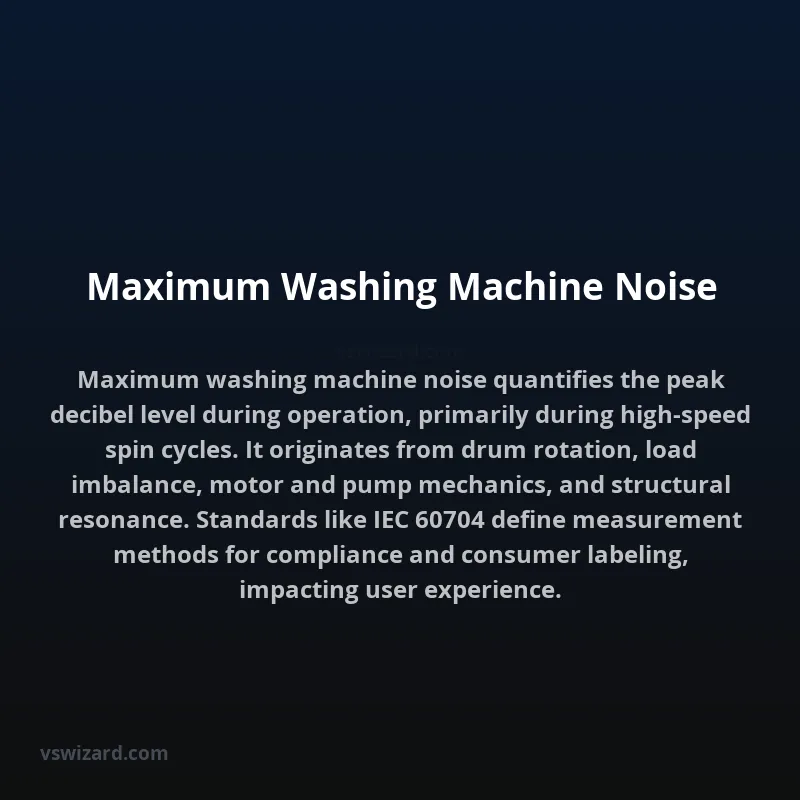
Maximum washing machine noise, often quantified as a sound pressure level, denotes the highest decibel (dB) emission registered during the appliance's operational cycle. This metric is typically measured under specific standardized conditions, encompassing various phases of operation such as spinning, washing, and draining, to ensure comparability across different models and manufacturers. The determination of maximum noise levels is critical for consumer product labeling, compliance with regulatory standards, and the engineering design process aimed at mitigating acoustic disturbances within residential environments. It reflects the peak acoustic energy produced by the dynamic mechanical and hydrodynamic processes inherent to laundry cycle execution.
The physical origins of maximum washing machine noise are multifaceted, stemming from the rotational dynamics of the drum, the mechanical stresses imparted to clothing and water, the operation of the motor and pump assemblies, and the resonance characteristics of the machine's housing and surrounding structure. Vibrations generated by the unbalanced mass of laundry during high-speed spin cycles are a primary contributor, often exciting structural modes that amplify sound. Water flow dynamics within the drum and hoses, particularly during filling and draining, also generate acoustic energy. Furthermore, the electromagnetic field fluctuations of the motor and the mechanical actuation of solenoids and valves contribute to the overall sound profile, with the summation of these sources reaching a peak during the most acoustically intensive operational phase.
Mechanism of Sound Generation
Hydrodynamic and Mechanical Sources
During the wash and rinse cycles, the tumbling action of the drum imparts kinetic energy to the laundry load and the wash liquor. The impact of garments against the drum walls and against each other generates impulsive noise. Water turbulence, particularly at higher agitation speeds, contributes a continuous broadband noise spectrum. The motor, driving the drum via a belt or direct drive system, is a significant source of mechanical and electromagnetic noise. Belt-driven systems can introduce noise from belt slippage and pulley interaction, while direct-drive motors can produce humming and whining sounds due to electromagnetic forces and bearing friction.
Rotational Dynamics and Vibration
The spin cycle represents the most acoustically demanding phase. As the drum accelerates to high rotational velocities (e.g., 1000-1600 RPM), centrifugal forces are exerted on the laundry and water. Any imbalance in the load distribution within the drum results in significant dynamic forces acting on the drum bearings and suspension system. These forces induce vibrations that propagate through the machine's frame and outer casing. If these vibrational frequencies coincide with the natural resonant frequencies of the machine's components or housing, acoustic amplification can occur, leading to a substantial increase in perceived noise. The damping characteristics of the suspension system (e.g., springs and shock absorbers) are crucial in mitigating these vibrations and their subsequent acoustic radiation.
Ancillary Components
The water inlet and drain pumps are also sources of acoustic emissions. The pump impeller's rotation and fluid flow through the pump housing generate noise, often characterized by a distinct whirring or gurgling sound. Solenoid valves, used to control water intake, produce a sharp 'click' or 'thud' sound when actuated. These individual noise contributions summate during the appliance's operation, with the maximum noise level being the peak value observed across all operational modes.
Industry Standards and Measurement
Standardized Measurement Procedures
International and national standards define the methodologies for measuring washing machine noise. Key standards include IEC 60704 (part 1 and part 2) and ISO 3744. These standards specify the acoustic environment (e.g., reverberation time), microphone placement, operating conditions (e.g., specific load, water temperature, spin speed), and measurement duration. Typically, measurements are taken at various points around the appliance, and an average or maximum value is reported. The 'A-weighting' filter is commonly applied to measured sound pressure levels to approximate human auditory perception of loudness.
Regulatory Compliance and Labeling
Maximum noise levels are a critical parameter for product certification and regulatory compliance in many regions. For instance, the European Union's Ecodesign Directive and Energy Labeling also incorporate noise emission values. Appliances are often categorized based on their maximum noise levels during spinning, with ratings provided to consumers to facilitate informed purchasing decisions. This labeling enables consumers to select appliances that meet their desired acoustic comfort levels.
Typical Decibel Ranges
Modern front-loading washing machines typically exhibit maximum noise levels during the spin cycle ranging from 45 dB(A) to 75 dB(A). Top-loading machines can sometimes be louder, particularly older designs. Specific operational phases contribute differently: washing cycles are generally quieter (40-60 dB(A)), while draining and initial spin-up phases can vary. The 'maximum washing machine noise' is almost invariably defined by the peak sound pressure level achieved during the highest speed spin cycle.
| Operational Phase | Typical Noise Range (dB(A)) | Primary Sound Sources |
|---|---|---|
| Washing/Agitation | 40-60 | Drum rotation, water turbulence, motor hum |
| Draining | 50-65 | Water pump operation, water flow |
| Spin Cycle (Low Speed) | 55-70 | Drum rotation, load imbalance, suspension vibration |
| Spin Cycle (High Speed) | 60-75 | Drum rotation, significant load imbalance, structural resonance, pump operation (if still active) |
Engineering Considerations for Noise Reduction
Vibration Damping and Isolation
Manufacturers employ sophisticated engineering techniques to minimize noise. Advanced suspension systems, often incorporating hydraulic dampers and larger, more resilient springs, are designed to absorb and dissipate vibrational energy effectively. The use of anti-vibration feet and counterweights (e.g., concrete or steel blocks integrated into the machine's base) helps to lower the center of gravity and absorb residual vibrations. The structural rigidity of the appliance's outer casing also plays a role in preventing acoustic radiation.
Motor and Pump Design
The development of quieter motors, such as brushless DC (BLDC) inverter motors, has significantly reduced noise emissions. These motors offer better control over rotational speed and torque, minimizing mechanical stress and electromagnetic interference. Similarly, pump designs are optimized for fluid dynamics to reduce turbulence and cavitation, thereby lowering noise generation. Encasing motor and pump assemblies in acoustic insulation materials further attenuates sound transmission.
Drum and Load Balancing
The design of the inner drum, including the arrangement and shape of baffles, influences how laundry is lifted and tumbled, affecting load distribution and impact noise. Advanced load balancing algorithms in the machine's control system can detect and compensate for uneven loads during spin cycles, redistributing the laundry to minimize vibrations before reaching maximum speed. Some machines also incorporate features that detect excessive imbalance and reduce spin speed or attempt a re-balance cycle.
Impact on Consumer Experience and Future Trends
Maximum washing machine noise is a key determinant of user satisfaction and appliance suitability for open-plan living spaces or noise-sensitive environments. A lower maximum noise level is a premium feature often associated with higher-end models. Future trends in appliance design are heavily focused on further noise reduction through quieter motor technologies, enhanced vibration isolation, and more intelligent load management systems. Integration with smart home systems also allows for scheduling washes during off-peak noise hours.