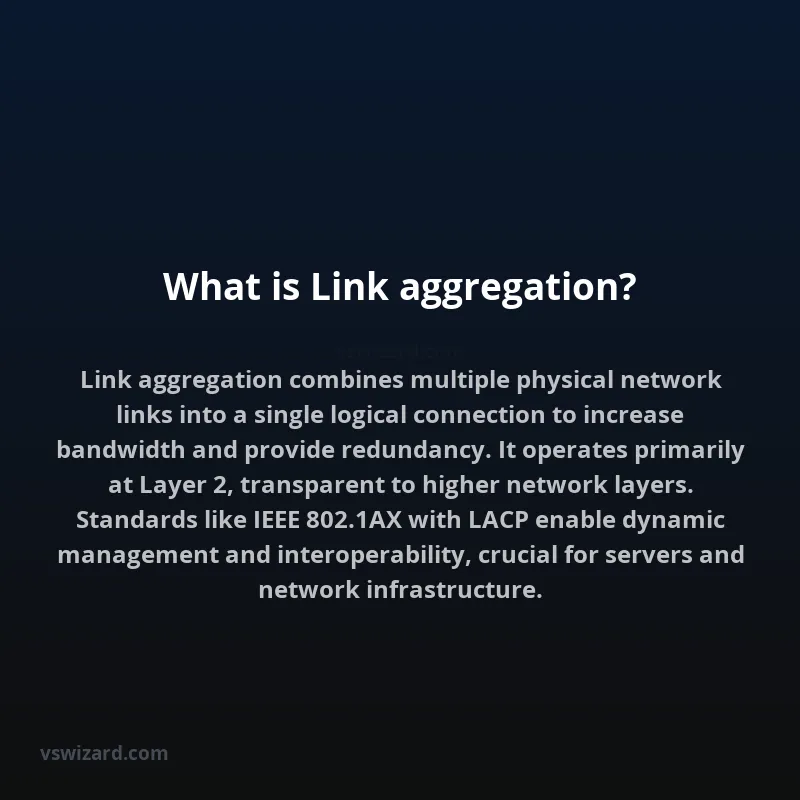
Link aggregation, often referred to as port trunking, NIC bonding, teaming, or EtherChannel, is a network technology that combines multiple physical network connections into a single logical link. This process serves to increase bandwidth and provide redundancy. By distributing network traffic across several interfaces, link aggregation can achieve a throughput equal to the sum of the individual link capacities, effectively creating a higher-capacity channel without requiring upgrades to the physical cabling or network hardware at the endpoints. The aggregation is typically managed at Layer 2 (Data Link Layer) of the OSI model, making it transparent to higher network layers, including IP, and thus to end-user applications.
The core principle behind link aggregation is the creation of a virtual interface that encapsulates multiple physical interfaces. Traffic is then distributed across these physical interfaces using various load-balancing algorithms. These algorithms can range from simple round-robin distribution to more sophisticated methods that consider MAC addresses, IP addresses, or even port numbers to ensure efficient utilization of the aggregated bandwidth. Furthermore, link aggregation provides fault tolerance; if one of the physical links in the aggregate fails, traffic can be automatically rerouted through the remaining active links, maintaining network connectivity and service availability. This resilience is crucial for mission-critical applications and high-availability network designs.
Mechanism of Action and Load Balancing
Link aggregation operates by grouping multiple network interfaces, such as Ethernet ports, into a single logical interface, often termed a bond interface or aggregate link. When network traffic is sent, a load balancing algorithm determines which physical interface within the aggregate will transmit the data. Common load balancing methods include:
- Round-Robin: Distributes packets sequentially across the available physical links.
- Active Backup: Designates one link as active and others as standby. If the active link fails, a standby link becomes active. This primarily provides redundancy.
- Source MAC Hash: Uses the source MAC address of incoming packets to select a physical link.
- Source/Destination IP Hash: Uses a hash of the source and destination IP addresses to distribute traffic. This method is effective for balancing traffic between two specific hosts.
- Source/Destination Port Hash: Uses a hash of the source and/or destination TCP/UDP port numbers. This is often used to balance traffic for applications that use multiple connections to the same destination IP.
The choice of algorithm impacts how effectively traffic is distributed and the degree of fault tolerance achieved. Protocols like the Link Aggregation Control Protocol (LACP), defined in IEEE 802.3ad and later 802.1AX, are essential for negotiating and managing these aggregated links between network devices.
Link Aggregation Control Protocol (LACP)
LACP is a crucial industry standard that facilitates the automatic configuration and management of link aggregation. It allows network devices to negotiate the formation of a link aggregation group (LAG) by exchanging control frames. LACP performs several key functions:
- Link Negotiation: It enables devices to identify each other as capable of aggregation and to agree on the parameters for forming a LAG.
- Active Monitoring: LACP continuously monitors the status of individual links within a LAG.
- Automatic Configuration: It automates the process of adding or removing links from the LAG, ensuring that the aggregated link remains operational even if individual links fail or are added.
- Multiplexing: It defines how traffic is multiplexed across the links in the LAG.
LACP operates in conjunction with the static configuration of link aggregation, where LAGs are manually defined. However, LACP adds a layer of dynamic management, making link aggregation more robust and easier to deploy in complex network environments.
Industry Standards and Evolution
The concept of link aggregation has evolved significantly, driven by the increasing demand for higher bandwidth and network resilience. Early implementations were proprietary, with vendors developing their own solutions. The standardization of link aggregation was a critical step in ensuring interoperability and widespread adoption.
IEEE Standards
The primary IEEE standard governing link aggregation is IEEE 802.3ad, which was later updated and incorporated into IEEE 802.1AX. These standards define:
- Link Aggregation Control Protocol (LACP): As described above, this protocol enables dynamic negotiation and management of aggregated links.
- Aggregation of Links: The framework for bundling multiple physical links into a single logical link.
- Load Balancing Methods: While LACP provides the framework, specific load balancing algorithms are often implemented in the network device's firmware or operating system.
Evolutionary Milestones
The progression from proprietary solutions to standardized protocols like LACP marked a significant milestone. Initially, link aggregation was primarily implemented in high-end network devices like switches and routers to increase uplink capacity. However, with the advent of multi-core processors and higher throughput network interface cards (NICs) in servers, link aggregation became essential for server connectivity, enabling servers to handle high volumes of traffic for applications like databases, web servers, and virtualization platforms.
Practical Implementation and Use Cases
Link aggregation is implemented in various network environments, from enterprise data centers to home networks, to enhance performance and reliability. Configuration typically involves enabling link aggregation on both endpoints of the connection, defining the desired physical interfaces to be included, and selecting a load balancing algorithm.
Server Connectivity
In server environments, link aggregation is commonly used to:
- Increase Bandwidth: Aggregate multiple 1GbE, 10GbE, or 40GbE interfaces to provide higher aggregate throughput for demanding applications.
- Provide Redundancy: Ensure continuous network access even if a NIC or network cable fails. This is critical for servers hosting mission-critical services.
- Improve Server Uptime: Facilitates maintenance or replacement of network components without service interruption.
Network Infrastructure
Link aggregation is also widely deployed between network devices such as switches and routers:
- Inter-switch Links (ISLs): To increase bandwidth and provide resilience between switches in a network core or distribution layer.
- Router Uplinks: To aggregate multiple links from a switch to a router, ensuring high-capacity and fault-tolerant connectivity.
Load Balancing Algorithms in Practice
The selection of the load balancing algorithm is critical for optimal performance. For instance, when aggregating multiple links from a server to a switch, a source IP hash or source/destination MAC hash is often preferred. This ensures that all traffic from a particular client IP or MAC address to a specific server IP address is consistently sent over the same physical link, which is essential for protocols that do not handle out-of-order packet delivery well.
Performance Metrics and Considerations
The effectiveness of link aggregation is measured by its ability to deliver increased bandwidth and enhanced availability. However, certain factors can influence its performance:
Bandwidth Utilization
The theoretical maximum bandwidth is the sum of individual link speeds. However, actual throughput can be limited by the load balancing algorithm. If traffic is not evenly distributed, some links may become saturated while others remain underutilized. This is particularly true for algorithms that rely on single hash values (e.g., source IP only) when communicating with a single destination.
Latency
Link aggregation generally does not introduce significant additional latency. However, the process of packet selection and the potential for retransmission in case of link failure can indirectly affect overall perceived latency under certain failure conditions.
Failover Time
The time it takes for the system to detect a link failure and reroute traffic can vary depending on the implementation and protocols used. LACP typically offers faster failover detection compared to purely static configurations.
Compatibility
Ensuring compatibility between the network interfaces, drivers, operating system, and network hardware is paramount. While IEEE standards promote interoperability, subtle differences in implementation can sometimes lead to issues.
| Feature | Description | Benefits |
|---|---|---|
| Primary Function | Combines multiple physical network links into a single logical link. | Increased bandwidth, improved throughput. |
| Redundancy | Provides fault tolerance; traffic reroutes upon link failure. | High availability, network resilience, reduced downtime. |
| Layer of Operation | Typically Layer 2 (Data Link Layer). | Transparent to higher network layers (IP, applications). |
| Management Protocol | IEEE 802.3ad/802.1AX (LACP) for dynamic negotiation. | Automated configuration, interoperability, dynamic link management. |
| Load Balancing Algorithms | Round-Robin, Active Backup, Source/Dest MAC/IP Hash, Port Hash. | Efficient traffic distribution, optimized resource utilization. |
| Common Implementations | NIC Bonding (Linux), Teaming (Windows), EtherChannel (Cisco). | Server connectivity, inter-switch links, router uplinks. |
| Theoretical Throughput | Sum of individual link speeds. | Scalable bandwidth without upgrading physical infrastructure. |
| Failover Mechanism | Automatic detection and rerouting of traffic. | Minimizes service disruption during hardware or link failure. |
Alternatives and Complementary Technologies
While link aggregation is a widely adopted solution, other technologies offer similar or complementary benefits in network design.
Multipath TCP (MPTCP)
Operating at Layer 4 (Transport Layer), MPTCP allows a single TCP connection to use multiple paths simultaneously. Unlike link aggregation, which bundles physical links, MPTCP bundles subflows within a single TCP connection, providing improved throughput and resilience at the transport layer. It can be used in conjunction with link aggregation for enhanced performance.
Routing Protocols with Equal-Cost Multi-Path (ECMP)
At Layer 3 (Network Layer), ECMP allows routers to use multiple paths of equal cost to reach a destination. By distributing traffic across these paths, ECMP achieves load balancing and redundancy. While it operates at a different layer, it serves a similar purpose of increasing capacity and providing resilience.
SDN and Network Virtualization
Software-Defined Networking (SDN) and network virtualization platforms offer more dynamic and centralized control over network traffic. These technologies can manage traffic flows and provide load balancing and redundancy at a higher level of abstraction, often orchestrating underlying physical links, including aggregated ones, to meet application demands.
Conclusion
Link aggregation is a fundamental networking technique that substantially enhances both the bandwidth capacity and fault tolerance of network connections. By intelligently bundling multiple physical links into a single logical entity, it provides a scalable and resilient foundation for data transmission, crucial for modern high-performance computing, data center operations, and critical enterprise services. Its standardization through IEEE 802.1AX and the associated LACP protocol has ensured broad interoperability and simplified deployment. The ongoing evolution of network demands ensures that link aggregation, alongside complementary technologies, will remain a vital component of robust network architecture for the foreseeable future, enabling higher throughput and unwavering connectivity.