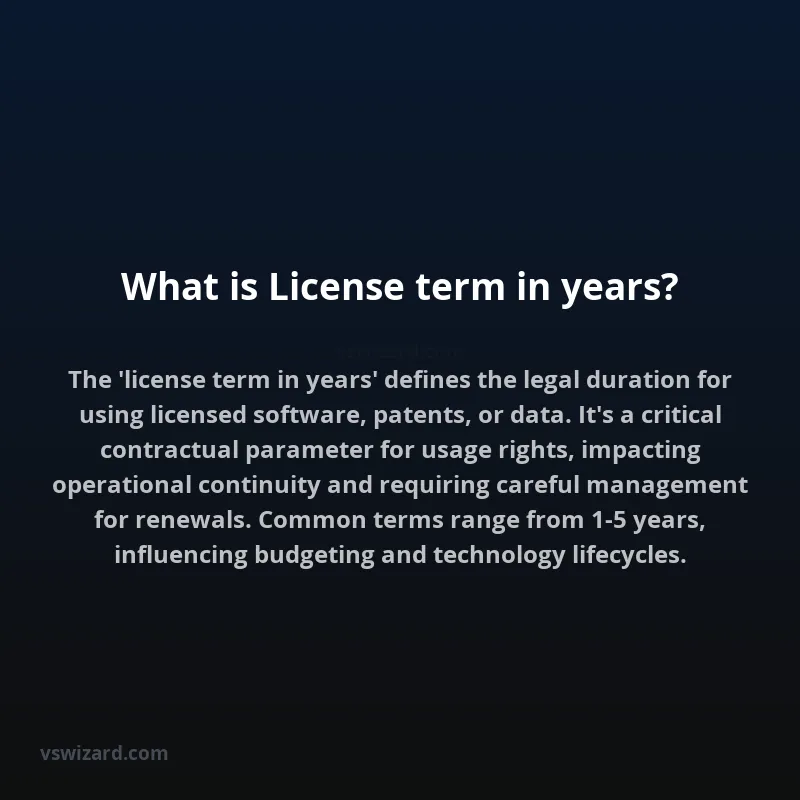
The 'license term in years' specifically quantifies the duration for which a particular software, patent, data, or intellectual property license is legally valid and enforceable. This term is a critical contractual parameter, delineating the period during which the licensee is granted specific rights to use, modify, distribute, or exploit the licensed asset under the stipulated conditions. It is independent of the software's version or the patent's filing date, focusing solely on the contractual period of granted permissions. The expiration of this term typically necessitates either a renewal, renegotiation of terms, or cessation of usage of the licensed asset by the licensee, subject to the explicit provisions within the license agreement.
In the context of technical specifications and digital asset management, particularly within categories like 'Map' data or proprietary algorithms, the 'license term in years' functions as a temporal constraint on the granted usage rights. This duration is often dictated by factors such as the expected lifecycle of the technology, the amortisation period of development costs, market exclusivity strategies, or regulatory compliance requirements. Precise definition of this term prevents ambiguity regarding ongoing legal access and operational continuity, impacting downstream development, product integration, and ongoing service provision.
Mechanism of Grant and Expiration
The mechanism underpinning the 'license term in years' is rooted in contract law, where the licensor grants rights and the licensee accepts them for a defined period. Upon the commencement of the license, the term begins, and usage is governed by the agreement. As the term approaches its conclusion, several contractual pathways may be invoked. These typically include automatic renewal clauses, options for extension subject to mutual agreement or revised consideration, or a termination clause mandating the cessation of all licensed activities. The technical implementation of license management systems often incorporates time-based validation modules that check the current date against the license expiry date to permit or deny access to the licensed functionality or data.
Industry Standards and Evolution
While there are no universally mandated industry standards for the specific duration of 'license term in years' across all software and intellectual property domains, common practices have emerged. For enterprise software, terms can range from 1 to 5 years, often with annual maintenance and support agreements. For patent licenses, terms are intrinsically linked to the statutory life of the patent, which can be up to 20 years from the filing date, though licensing agreements for specific applications might stipulate shorter, more granular terms. The evolution of cloud-based services and Software as a Service (SaaS) models has shifted many licensing models towards subscription-based, often perpetual or annually renewable, terms rather than traditional upfront, multi-year perpetual licenses. This shift reflects a business model evolution prioritizing recurring revenue and continuous service delivery over one-time asset transfer.
Practical Implementation and Technical Considerations
Implementing and managing license terms involves robust systems that track the commencement date, duration, and expiration date of each license. Technical implementations can range from simple date-based checks in application code to sophisticated license servers that validate usage against a central database of active licenses. For map data, for instance, license terms often dictate the period for which map updates are provided, along with the geographical scope and permitted use cases (e.g., internal business intelligence vs. public-facing navigation). Considerations include:
- Date Management: Accurate handling of dates, time zones, and leap years is crucial.
- Validation Logic: Secure and reliable methods to verify if a license is currently active.
- Renewal Processes: Automated or manual workflows for license renewal and re-validation.
- Grace Periods: Contractual provisions that allow continued, limited usage post-expiration while renewal is pending.
- Auditing: Mechanisms to log license usage and check compliance against terms.
| Licensing Model | Typical Term (Years) | Common Applications | Key Considerations |
|---|---|---|---|
| Perpetual License | Indefinite (often with paid updates/support) | Desktop Software, On-Premise Servers | Initial cost, ongoing maintenance fees, version obsolescence |
| Subscription License | 1 - 5 (renewable) | SaaS, Cloud Services, Online Databases | Recurring costs, continuous updates, service availability |
| Term License | 1 - 10 | Specific Projects, Temporary Access to Data, IP Usage | Clear expiration, renegotiation necessity, potential disruption |
| Patent License (Application) | Up to 20 (statutory patent life) | Inventions, Manufacturing Processes | Royalty structures, field of use limitations, territorial restrictions |
Pros and Cons
Pros:
- Predictability: Provides clear end dates for budget planning and resource allocation.
- Controlled Access: Ensures that access to intellectual property or software is only granted for a defined period, mitigating long-term risks for the licensor.
- Revenue Generation: Allows for recurring revenue streams, especially in subscription or renewal models.
- Adaptability: Facilitates easier updates and technology refresh cycles for both licensor and licensee.
Cons:
- Operational Disruption: Expiration without timely renewal can halt critical operations.
- Administrative Overhead: Requires diligent tracking, renewal management, and potential renegotiations.
- Cost Escalation: Renewals may involve price increases, impacting the total cost of ownership over time.
- Vendor Lock-in Risk: License expiration can sometimes create dependencies that make switching vendors difficult or costly.
Conclusion
The 'license term in years' is a foundational contractual element that governs the temporal scope of usage rights for licensed assets. Its precise definition and management are paramount for ensuring legal compliance, operational continuity, and effective financial planning within technology-dependent industries. As licensing models continue to evolve, particularly with the proliferation of subscription and cloud-based services, the strategic implications of the license term in years will remain a central consideration for both intellectual property holders and end-users.