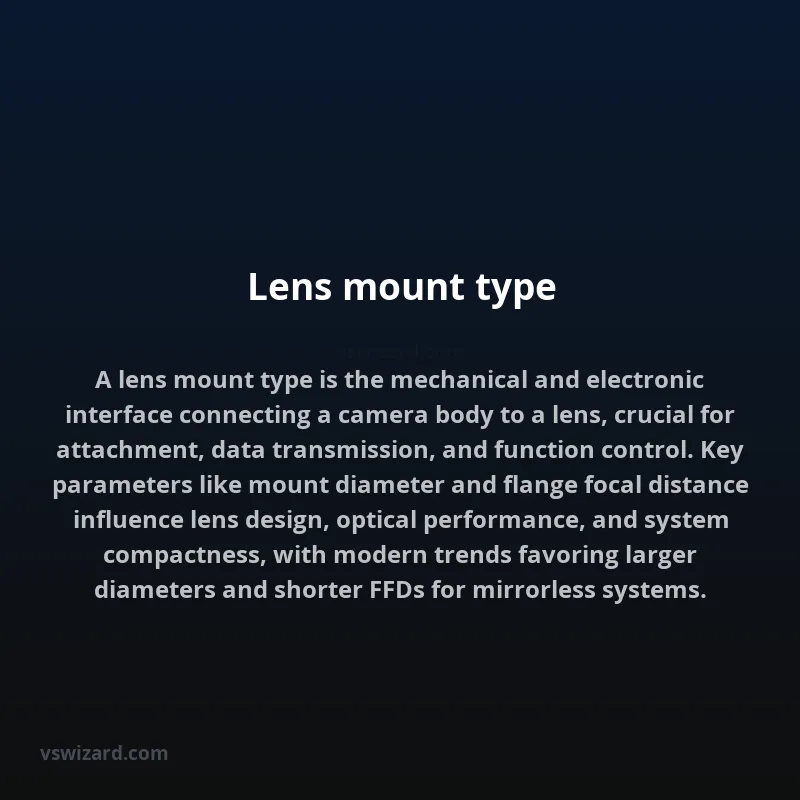
A lens mount type defines the mechanical and electronic interface between a camera body and a photographic lens. This interface is critical for enabling the secure attachment of the lens, the transmission of optical information, and the control of lens functions such as aperture, focus, and image stabilization. The design of a lens mount dictates physical compatibility, ensuring that only lenses with a matching mount can be attached. Beyond physical interlocking, lens mounts often incorporate electrical contacts or data pins that facilitate communication between the lens and the camera body. This communication protocol allows the camera to control lens parameters and receive data from the lens, such as focal length, aperture setting, and autofocus status. The standardization and evolution of lens mount types are driven by the need for interoperability, performance enhancement, and the development of advanced optical systems.
The physical dimensions of a lens mount, including its diameter, flange focal distance (FFD), and the number and arrangement of locking mechanisms or bayonet lugs, are proprietary or standardized specifications. The FFD, in particular, is a crucial parameter representing the distance from the lens mount flange to the image sensor. Different FFDs influence the design possibilities for lenses, especially concerning the rear optical element's proximity to the sensor, which affects the lens's optical design and miniaturization potential. Lens mount types can be broadly categorized by their locking mechanism (e.g., bayonet, screw thread) and by the degree of electronic integration they offer, ranging from purely mechanical connections to sophisticated digital communication interfaces that support complex autofocus and exposure control systems.
Mechanism of Action and Interfacing
The primary function of a lens mount is to provide a robust and precise physical connection. Bayonet mounts, the most prevalent in modern interchangeable-lens cameras, utilize a system of lugs on the lens that engage with corresponding slots or grooves on the camera body's mount. A rotational motion locks the lens into place, often secured by a release lever. Screw mounts, historically significant and still found in some specialized applications and legacy systems, rely on threaded engagement.
Electronic communication is managed through a series of metallic contacts, strategically placed within the mount. These contacts establish a circuit between the lens and camera body, enabling the exchange of digital signals. The camera body can send commands to the lens to adjust aperture blades, activate autofocus motors, or control image stabilization systems. Conversely, the lens can report its current settings, focal length, or status back to the camera. The specific pinout and communication protocol are defined by the mount standard and are proprietary to camera manufacturers or governed by industry consortiums.
Physical Parameters and Design Implications
Flange Focal Distance (FFD)
The flange focal distance (FFD) is a critical parameter that significantly influences lens and camera body design. It is measured from the mounting surface (the flange) to the plane of the image sensor. A shorter FFD allows for more flexibility in lens design, particularly enabling smaller, lighter lenses and facilitating the development of optical elements closer to the sensor. This is advantageous for mirrorless camera systems, which eliminate the reflex mirror found in DSLRs, allowing for shorter FFDs and thus more compact lens designs.
Mount Diameter
The diameter of the lens mount affects the maximum aperture achievable by lenses. A larger diameter permits a wider physical aperture, which can allow more light to reach the sensor, crucial for low-light photography and achieving shallow depth of field. Larger mounts also support the use of larger, high-performance optical elements within the lens, contributing to superior image quality.
Industry Standards and Evolution
The history of lens mounts is marked by proprietary systems and the eventual emergence of de facto and formal standards. Early cameras often had unique mounts, limiting lens interchangeability. The development of 35mm film cameras and later digital cameras saw a proliferation of mount types.
Key Mount Types and Their Characteristics
Various lens mount types have been developed, each with specific characteristics:
- Canon EF/EF-S/RF Mounts: The EF mount (Electro-Focus) is a robust electro-mechanical mount supporting autofocus and electronic aperture control. EF-S lenses are designed for APS-C sensors and cannot be used on full-frame EF bodies without cropping. The RF mount is Canon's modern mount for mirrorless cameras, featuring a wider diameter and shorter FFD for advanced optical designs and high-speed communication.
- Nikon F/Z Mounts: The F mount, introduced in 1959, is one of the longest-standing and most successful mounts, known for its mechanical reliability. The Z mount is Nikon's mirrorless mount, characterized by a large diameter and short FFD, enabling superior optical performance and high-speed data transfer.
- Sony E/FE Mounts: The E-mount is Sony's compact mount for APS-C mirrorless cameras, later expanded to FE for full-frame. It is designed with a short FFD and a wide diameter, supporting advanced autofocus and communication capabilities.
- Micro Four Thirds (MFT) Mount: A standardized mount shared by Olympus (now OM System) and Panasonic. It features a very short FFD and a specific mount diameter, enabling compact camera and lens designs.
- Leica M Mount: A legendary rangefinder lens mount known for its optical quality and mechanical precision, primarily used on rangefinder and some mirrorless cameras. It has a longer FFD compared to many modern mirrorless mounts.
- Pentax K Mount: A long-standing mount known for its durability and mechanical design, still supported in Pentax DSLRs.
The trend in modern interchangeable-lens camera systems has been towards larger diameter mounts and shorter flange focal distances, particularly with the advent of mirrorless technology. This allows for more sophisticated lens designs, faster data transmission for autofocus and exposure, and greater optical correction capabilities.
Technical Specifications Comparison
The differences in lens mount types are quantifiable through several key technical specifications. These include the mount diameter, the flange focal distance, the number of electrical contacts, and the supported communication protocols. These parameters directly impact lens design possibilities, autofocus speed, and overall system performance.
| Mount Type | Camera System | Mount Diameter (approx.) | Flange Focal Distance (mm) | Electrical Contacts (typical) | Primary Locking Mechanism |
|---|---|---|---|---|---|
| Canon EF | DSLR (Full Frame/APS-C) | 54 mm | 44 mm | 8 | Bayonet |
| Canon RF | Mirrorless (Full Frame/APS-C) | 54 mm | 20 mm | 12 | Bayonet |
| Nikon F | DSLR (Full Frame/APS-C) | 44 mm | 46.5 mm | 9 | Bayonet |
| Nikon Z | Mirrorless (Full Frame/APS-C) | 55 mm | 16 mm | 17 | Bayonet |
| Sony E/FE | Mirrorless (APS-C/Full Frame) | 50 mm | 18 mm | 12 | Bayonet |
| Micro Four Thirds | Mirrorless (APS-C) | 44 mm | 20 mm | 10 | Bayonet |
| Leica M | Rangefinder/Mirrorless | 45 mm | 27.8 mm | N/A (Mechanical) | Screw Thread |
Applications and Use Cases
Lens mount types are fundamental to the operation of interchangeable-lens camera systems across a vast spectrum of applications, from professional cinematography and high-resolution scientific imaging to consumer photography. The choice of mount directly influences the available lens ecosystem, system compactness, and potential for future upgrades. In cinema, specific mounts are chosen for their robust build, precise control over focus and iris, and their ability to accommodate specialized cinema lenses with large image circles and high T-stops.
For scientific and industrial applications, such as machine vision or microscopy, lens mounts are often standardized to ensure compatibility with a wide range of sensors and specialized optics. The precision of the mount is paramount in these fields to maintain accurate calibration and consistent imaging performance. For amateur and professional photographers, the lens mount defines the interoperability between camera bodies and lenses, dictating whether a user can adapt older lenses, use third-party optics, or invest in a specific brand's proprietary lens line.
Pros and Cons
The advantages of standardized lens mount types include increased interoperability and a broader selection of lenses from various manufacturers or third-party producers. For instance, the Micro Four Thirds standard ensures that lenses designed for one MFT camera body will function on any other MFT camera body. This reduces vendor lock-in and fosters competition, potentially leading to more affordable and innovative lens options.
Conversely, proprietary mounts, while offering tight integration and potentially optimized performance within a manufacturer's ecosystem, can limit user choice. Adapting lenses from one mount system to another is often possible but may involve compromises in autofocus speed, electronic control, or image quality due to differing mechanical and electronic specifications. The physical limitations imposed by a mount type, such as FFD and diameter, can also constrain optical design, affecting the achievable aberration correction, light-gathering capability, and overall lens size and weight.
Alternatives and Future Outlook
While the dominant trend is towards digital, electronically controlled bayonet mounts in mirrorless systems, alternative interfacing methods persist. Specialized optical benches and custom mechanical interfaces are used in highly controlled laboratory or industrial settings where adaptability and precision supersede the convenience of standardized mounts. Furthermore, advances in optical design software and manufacturing tolerances continue to push the boundaries of what is achievable with existing mounts, optimizing performance for sensors with higher pixel densities and dynamic range.
The future of lens mounts will likely see continued evolution driven by the pursuit of higher data bandwidth for faster autofocus and more complex lens-based computations (e.g., computational photography integration). The trend towards larger diameters and shorter FFDs is expected to continue, enabling even more advanced optical designs. The development of intelligent mounts that can dynamically adjust optical characteristics or provide enhanced diagnostic feedback may also emerge. Standardization efforts, like the ARRI Standard Mount for cinema lenses, will continue to play a role in facilitating compatibility within specific professional segments.