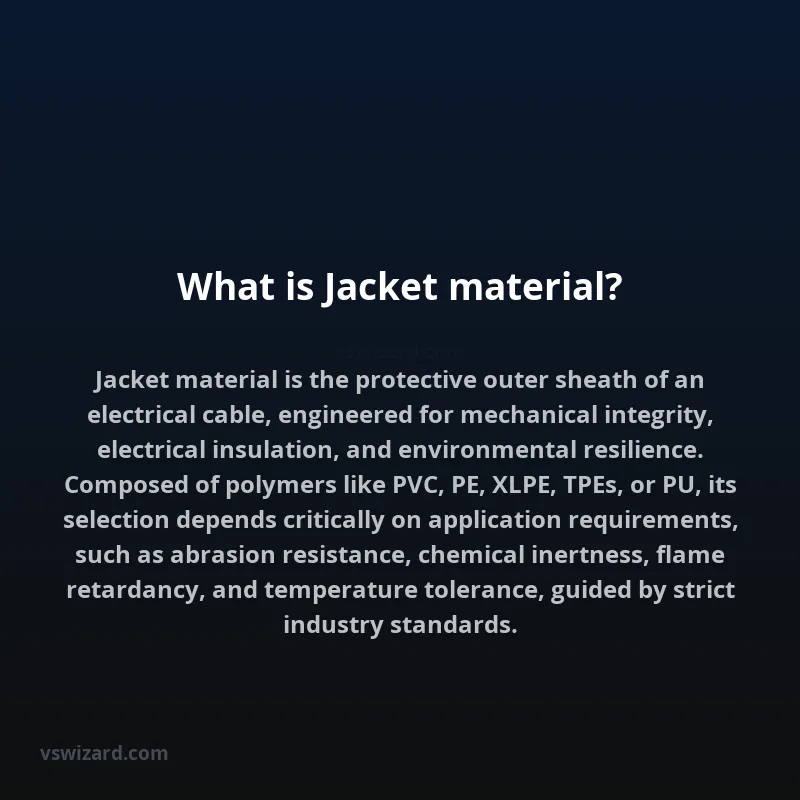
Jacket material refers to the specialized outer layer or sheathing of an electrical cable, designed to provide mechanical protection, electrical insulation, and environmental resistance. This encompassing term designates the polymer or composite substance engineered to shield the core conductors and insulating layers from physical damage such as abrasion, impact, crushing, and tension, as well as from environmental factors including moisture, chemicals, UV radiation, and extreme temperatures. The selection of jacket material is predicated on the cable's intended application, operating environment, and specific performance requirements, influencing its durability, flexibility, flame retardancy, and overall service life. Advanced jacket formulations often incorporate specific additives and reinforcements to achieve tailored dielectric properties, fire resistance ratings (e.g., UL 94 V-0), and low-smoke emission characteristics crucial for safety in various installations.
The engineering of jacket materials involves a sophisticated understanding of polymer science, material degradation mechanisms, and electrical safety standards. Common materials include polyvinyl chloride (PVC), polyethylene (PE), thermoplastic elastomers (TPEs), cross-linked polyethylene (XLPE), polyurethane (PU), and various proprietary thermoset or thermoplastic compounds. Each material class offers a distinct balance of properties; for instance, PVC provides excellent abrasion resistance and flame retardancy at a lower cost, while PE offers superior dielectric strength and moisture resistance, often used in high-voltage applications. TPEs and PUs are favored for their flexibility and resilience in dynamic environments. The manufacturing process, such as extrusion, involves carefully controlling temperature, pressure, and die geometry to ensure uniform thickness, adhesion, and the absence of voids or contaminants within the jacket, which are critical for maintaining the cable's integrity and preventing electrical faults or premature failure.
Mechanism of Action and Protective Properties
The primary function of jacket material is to act as a physical barrier. Its mechanical properties, including tensile strength, elongation at break, tear resistance, and abrasion resistance, are paramount. Tensile strength ensures the jacket can withstand pulling forces during installation and operation without rupturing. Elongation at break indicates the material's ability to stretch before failing, providing resilience against impacts and bending. Abrasion resistance prevents degradation from friction against surfaces, a common issue in industrial and mobile applications. Furthermore, the jacket's chemical resistance determines its ability to endure exposure to oils, solvents, acids, and other corrosive substances without swelling, degrading, or losing its protective capabilities. Environmental resistance encompasses protection against moisture ingress, which can compromise insulation integrity and lead to short circuits, as well as UV stability for outdoor applications and thermal stability to operate within specified temperature ranges without softening or becoming brittle.
Material Composition and Classification
Jacket materials are broadly classified into thermosets and thermoplastics, each with distinct processing and performance characteristics.
Thermoplastics
Thermoplastics soften upon heating and solidify upon cooling, a process that can be repeated. This characteristic makes them generally easier to process via extrusion. Common examples include:
- Polyvinyl Chloride (PVC): Widely used due to its good abrasion resistance, flame retardancy, and cost-effectiveness. It can be formulated with plasticizers to improve flexibility.
- Polyethylene (PE): Offers excellent electrical insulation properties, low moisture absorption, and good chemical resistance. Low-density PE (LDPE) is flexible, while high-density PE (HDPE) is more rigid and durable.
- Thermoplastic Elastomers (TPEs): Combine the processing advantages of thermoplastics with the elastic properties of rubber. They offer good flexibility, low-temperature performance, and resilience.
Thermosets
Thermosets undergo irreversible chemical cross-linking during curing, resulting in a rigid, heat-resistant structure that does not soften upon reheating. This typically leads to superior thermal stability and chemical resistance.
- Cross-Linked Polyethylene (XLPE): Achieved by chemically cross-linking PE, enhancing its thermal stability, mechanical strength, and resistance to deformation under load. It is a standard for medium and high-voltage power cable jackets.
- Polyurethane (PU): Known for its exceptional abrasion, cut, and chemical resistance, often used in demanding applications like robotics, trailing cables, and mining.
Industry Standards and Testing
The performance and safety of jacket materials are governed by numerous international and national standards. Key standards organizations include the International Electrotechnical Commission (IEC), Underwriters Laboratories (UL), American Society for Testing and Materials (ASTM), and the Institute of Electrical and Electronics Engineers (IEEE). These standards define rigorous testing protocols to verify specific properties:
- Flame Retardancy: UL 94 (various classifications like V-0, V-1, V-2), IEC 60332.
- Smoke Emission: IEC 61034, UL 2196 (low smoke).
- Toxicity of Combustion Gases: IEC 60332-3-21/-24, UL 2196.
- Mechanical Properties: ASTM D412 (tensile strength, elongation), ASTM D1053 (low-temperature brittleness), ASTM D4066 (abrasion resistance).
- Chemical Resistance: ASTM D471 (immersion in fluids).
- Environmental Resistance: UV resistance testing (e.g., SAE J1960), moisture penetration resistance.
Adherence to these standards ensures that jacket materials are suitable for their intended environments and meet safety regulations for construction, industrial, telecommunications, and transportation sectors.
Applications and Selection Criteria
The choice of jacket material is critically dependent on the specific application and its environmental demands:
- Industrial Environments: Requires high resistance to oils, chemicals, abrasion, and impact. TPEs, PUs, and robust PVC formulations are common.
- Telecommunications: Focuses on UV resistance, moisture resistance, and rodent deterrence for outdoor installations. PE and specialized PE compounds are frequently used.
- Power Distribution: Needs excellent dielectric properties, thermal stability, and flame retardancy, particularly for medium and high-voltage cables. XLPE and specialized PE are prevalent.
- Plenum and Riser Applications (Building Construction): Mandates stringent flame retardancy and low smoke/toxicity characteristics. Low-smoke PVC (LS-PVC), plenum-rated PE, or FEP/ETFE are often specified.
- Automotive and Aerospace: Requires materials resistant to extreme temperatures, fuels, hydraulic fluids, and vibration, often utilizing specialized TPEs, fluoropolymers, or silicones.
A critical selection matrix considers a balance of performance requirements, regulatory compliance, expected service life, environmental impact, and cost. Designers often employ computational material selection tools and consult manufacturer datasheets, which detail property specifications and recommended use cases.
Performance Metrics and Comparative Analysis
Key performance indicators (KPIs) for jacket materials include their service temperature range, dielectric strength, resistance to specific environmental factors, and mechanical durability over time. A comparative analysis highlights the trade-offs inherent in material selection.
| Material | Key Strengths | Key Weaknesses | Typical Applications | Temperature Range (°C) |
|---|---|---|---|---|
| PVC | Good abrasion resistance, flame retardant, cost-effective | Can become brittle at low temps, environmental concerns (plasticizers) | General wiring, industrial cables, low-voltage power | -40 to 90 |
| PE (LDPE/HDPE) | Excellent dielectric properties, low moisture absorption, good chemical resistance | Lower temperature limits than XLPE, can be susceptible to stress cracking | Power cables (LV/MV), telecommunications, data cables | -60 to 75 |
| XLPE | Superior thermal stability, high dielectric strength, good mechanical properties | More complex processing, less flexible than PE | Medium and high-voltage power cables, building wires | -50 to 90 (continuous), higher for short circuits |
| TPE | Excellent flexibility, good resilience, good low-temp performance, good abrasion resistance | Can have lower chemical resistance than PU or PVC, potentially higher cost | Robotics, medical devices, industrial automation, speaker wire | -60 to 125 |
| PU | Exceptional abrasion, cut, and tear resistance, good oil and fuel resistance | Can be sensitive to moisture and high temperatures, more expensive | Trailing cables, mining cables, robotics, heavy-duty industrial | -40 to 80 |
| Fluoropolymers (e.g., FEP, ETFE) | Excellent chemical and thermal resistance, flame retardant, low smoke | High cost, can be rigid | Aerospace, plenum cables, harsh chemical environments | -70 to 200+ (depending on type) |
Future Trends and Innovations
Ongoing research focuses on developing sustainable and high-performance jacket materials. This includes bio-based polymers, halogen-free flame retardant (HFFR) compounds that minimize toxic smoke emissions, and self-healing materials that can repair minor damage, extending cable lifespan. Advancements in nanocomposites, incorporating materials like graphene or carbon nanotubes, aim to enhance mechanical strength, thermal conductivity, and electrical properties. The development of smart jackets with embedded sensors for real-time monitoring of temperature, strain, and environmental conditions is also a significant area of innovation, enabling predictive maintenance and improving system reliability.
The evolution of jacket materials is driven by increasingly demanding operational environments, stringent safety regulations, and the growing need for sustainable and longer-lasting cable infrastructure. The interplay between polymer chemistry, material science, and manufacturing engineering will continue to define the protective envelope of electrical systems, ensuring performance, safety, and reliability across a spectrum of technological applications.