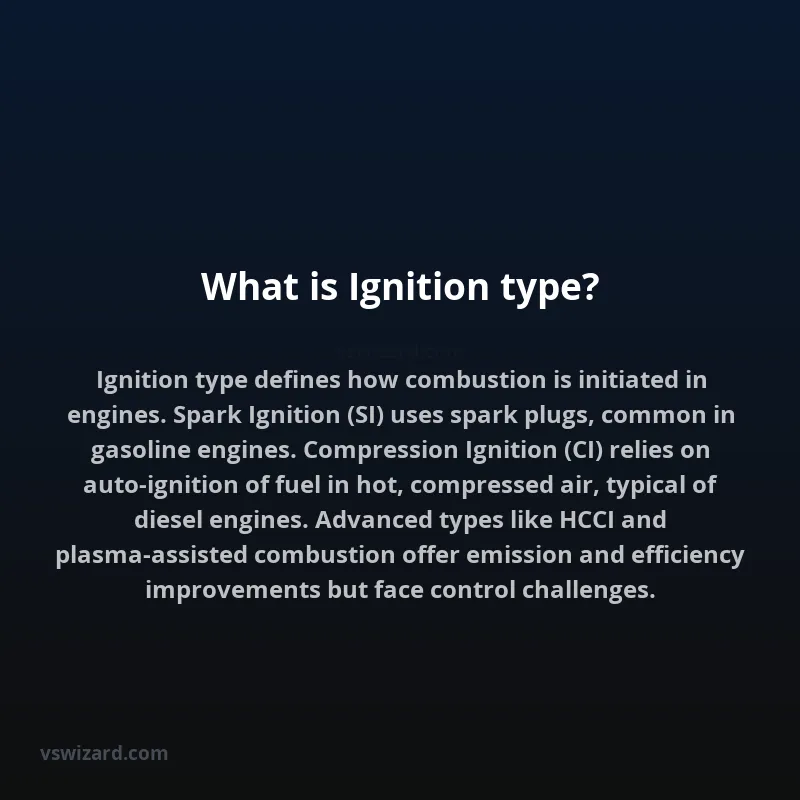
In the context of internal combustion engines, the 'ignition type' fundamentally defines the method by which the combustible fuel-air mixture within the cylinder is initiated into a rapid, controlled combustion event. This critical parameter dictates the thermodynamic cycle performance, exhaust emissions profile, and operational characteristics of an engine. Broadly, ignition types are categorized based on their energy source and initiation mechanism, primarily differentiating between spark ignition (SI) and compression ignition (CI) systems, with hybrid and advanced methodologies emerging in contemporary research.
The selection and implementation of an ignition type are governed by complex engineering trade-offs involving fuel properties (e.g., octane rating for SI, cetane rating for CI), desired power output, volumetric efficiency, thermal management, and regulatory compliance standards for pollutants. Precision in timing, energy delivery, and spatial distribution of the ignition event is paramount for achieving optimal combustion phasing, preventing pre-ignition or knocking phenomena in SI engines, and ensuring complete combustion while minimizing soot formation in CI engines. This involves sophisticated control systems that modulate ignition timing based on numerous real-time engine operating parameters.
Spark Ignition (SI)
Spark ignition systems are characteristic of Otto cycle engines, commonly found in gasoline-powered vehicles and smaller displacement engines. The core principle involves delivering a high-voltage electrical discharge across a spark plug's electrodes, generating a plasma channel that ignites the compressed fuel-air mixture. The timing of this spark is a critical control variable, typically advanced relative to Top Dead Center (TDC) to ensure peak cylinder pressure occurs shortly after TDC, maximizing work extraction. Key components include the ignition coil, distributor (in older systems), spark plugs, and an electronic control unit (ECU) that orchestrates timing based on inputs from sensors such as crankshaft position, manifold absolute pressure (MAP), throttle position, and knock sensors.
Types of Spark Ignition Systems
Conventional Ignition
Early SI engines utilized a mechanical distributor driven by the camshaft, with breaker points controlling primary coil current. This system was susceptible to wear and required regular maintenance.
Electronic Ignition (EI)
Electronic ignition systems replaced mechanical breaker points with electronic switches (e.g., Hall effect sensors, optical sensors, or variable reluctance sensors) controlled by an ECU. This offered improved dwell control, spark timing accuracy, and reliability. Primary ignition coils are energized and de-energized electronically to induce a high-voltage pulse.
Distributorless Ignition System (DIS)
DIS eliminates the distributor entirely. Instead, individual coils are assigned to pairs of cylinders firing in a 'wasted spark' configuration, or each cylinder has its own dedicated coil-on-plug (COP) system. COP systems provide the most precise ignition timing and highest energy transfer per spark, as the coil is mounted directly on the spark plug, minimizing secondary ignition lead length.
Direct Ignition (DI) / Coil-on-Plug (COP)
In COP systems, a dedicated ignition coil is situated directly atop each spark plug. This configuration minimizes parasitic losses in the high-voltage circuit, allows for individual cylinder timing control, and enhances reliability by reducing the number of high-voltage connections.
Compression Ignition (CI)
Compression ignition systems, also known as Diesel engines, rely on the auto-ignition of fuel injected into highly compressed, hot air within the cylinder. There is no requirement for a spark plug. The air is compressed to a sufficiently high temperature (typically exceeding 700-800°C) such that when diesel fuel is injected at high pressure towards the end of the compression stroke, it spontaneously ignites. The cetane number of the fuel is a key indicator of its ignition quality under these conditions, with higher cetane numbers signifying a shorter ignition delay.
Fuel Injection Strategies in CI Engines
Direct Injection (DI)
Fuel is injected directly into the combustion chamber. This is the predominant method in modern diesel engines, allowing for precise control over the start and duration of injection, which influences combustion phasing and emissions.
Indirect Injection (IDI)
Fuel is injected into a pre-combustion chamber or swirl chamber connected to the main cylinder. This was common in older diesel designs but is less efficient than DI.
Advanced and Future Ignition Types
Research and development continue to explore novel ignition strategies aimed at improving efficiency, reducing emissions, and enabling operation with alternative fuels or in advanced engine cycles.
Homogeneous Charge Compression Ignition (HCCI)
HCCI is an advanced combustion strategy that blends characteristics of SI and CI engines. A homogeneous fuel-air mixture is created (like SI), but ignition occurs through auto-ignition initiated by compression heat (like CI). This can achieve very low NOx and particulate matter emissions but presents significant challenges in controlling the combustion event across a wide operating range.
Reactivity Controlled Compression Ignition (RCCI)
RCCI is a variant of HCCI that uses two fuels with different reactivities (e.g., gasoline and diesel) to achieve controlled auto-ignition. One fuel is pre-mixed with air, and the other is injected later, allowing for stratification of reactivity to manage the combustion phasing.
Plasma-Assisted Combustion
This involves using pulsed plasma discharges to enhance the ignition and combustion process, particularly beneficial for lean fuel mixtures or alternative fuels that are difficult to ignite conventionally. Plasma can create high-temperature species and radicals that promote faster flame propagation.
Laser Ignition
Focused laser pulses can initiate ignition within the fuel-air charge. This offers precise spatial and temporal control over the ignition event and can enable ignition in challenging conditions or with novel fuel formulations, potentially overcoming limitations of spark plugs in high-temperature or high-pressure environments.
Industry Standards and Regulations
Ignition system performance and emissions are subject to stringent global standards. Organizations like the Society of Automotive Engineers (SAE) and the International Organization for Standardization (ISO) publish standards related to ignition system components, testing procedures, and performance metrics. Regulatory bodies such as the US Environmental Protection Agency (EPA) and the European Environment Agency (EEA) set emissions limits that directly influence ignition system design and calibration to minimize pollutants like hydrocarbons (HC), nitrogen oxides (NOx), carbon monoxide (CO), and particulate matter (PM).
Performance Metrics and Evaluation
The effectiveness of an ignition type is evaluated using several key performance indicators:
- Ignition Delay: The time between the start of injection (in CI) or spark timing (in SI) and the start of combustion. Shorter delays are generally desirable in CI, while optimal delays are crucial for SI.
- Combustion Duration: The time taken for the majority of the fuel to burn. Shorter durations generally lead to higher peak power and efficiency.
- Peak Cylinder Pressure (PCP): The maximum pressure achieved within the cylinder during combustion. Higher PCP generally correlates with higher thermal efficiency, but excessive pressure can lead to structural failure.
- Heat Release Rate (HRR): The rate at which chemical energy is converted into thermal energy. Controlled HRR is essential for smooth operation and emission control.
- Flame Propagation Speed: The speed at which the flame front moves across the combustion chamber in SI engines.
- Emissions: Levels of regulated pollutants in the exhaust gas.
- Fuel Efficiency: The amount of work produced per unit of fuel consumed.
Comparative Analysis of Ignition Types
| Feature | Spark Ignition (SI) | Compression Ignition (CI) | HCCI | Plasma-Assisted |
|---|---|---|---|---|
| Ignition Mechanism | Electrical Spark | Auto-ignition due to Compression Heat | Controlled Auto-ignition | Plasma Discharge |
| Fuel Flexibility | Moderate (Gasoline, Ethanol) | Limited (Diesel, Biodiesel) | High (Mixtures possible) | High (Lean mixtures, alternative fuels) |
| Emissions Profile (NOx, PM) | Low NOx, Very Low PM | High NOx, High PM (historically) | Very Low NOx and PM | Potentially Low |
| Control Complexity | High (Timing, Knock) | High (Injection timing/pressure) | Very High (Operating windows) | High (Plasma parameters) |
| Typical Application | Gasoline Engines, Motorcycles | Diesel Engines, Heavy Duty Vehicles | Research, Advanced Concepts | Lean Burn, GDI Enhancement |
| Efficiency Potential | Good | Excellent (Higher compression ratio) | Very High | Variable |