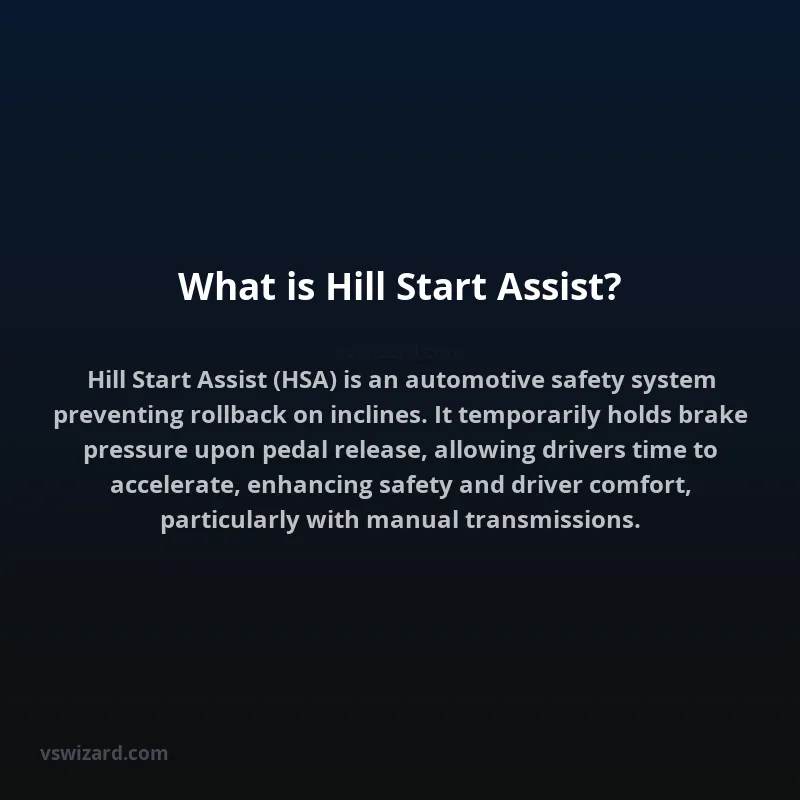
Hill Start Assist (HSA), also known as Hill Hold Control or Hill Holder, is an automotive electronic control system designed to prevent a vehicle from rolling backward or forward when the driver disengages the brake pedal to move off from a stationary position on an incline. This system functions by temporarily maintaining brake pressure after the driver releases the brake pedal, providing a critical time window—typically between 1 to 3 seconds—during which the driver can apply the accelerator. This prevents the vehicle from inadvertently moving out of its intended position, thereby enhancing safety, particularly in heavy traffic or on steep gradients, and reducing the risk of collision with vehicles or objects behind or in front of the stopped vehicle. It is a key component in modern vehicle safety and driver assistance packages.
The operational principle of HSA relies on sophisticated sensor inputs and integrated control logic. A yaw rate sensor and/or accelerometers detect the vehicle's orientation (gradient) and its tendency to move. When the system detects a significant incline and the driver releases the brake pedal, it signals the anti-lock braking system (ABS) or an independent hydraulic control unit to hold the brake pressure applied to the wheels. This internal braking action is disengaged automatically once the engine's torque is sufficient to overcome the gradient force and move the vehicle forward, or when the driver applies the accelerator pedal. The system is designed to be unobtrusive, activating only under specific conditions and disengaging seamlessly, thus simplifying the driving task on gradients without requiring the driver to perform complex clutch and brake coordination maneuvers.
Mechanism of Action
Sensor Inputs
Hill Start Assist systems typically integrate with existing vehicle sensors to determine the gradient and the vehicle's state. Key sensors include:
- Inclinometers/Accelerometers: These sensors measure the vehicle's pitch angle relative to gravity, providing a direct reading of the incline's steepness. Some systems utilize accelerometers to infer the gradient by measuring the component of gravity along the vehicle's longitudinal axis.
- Wheel Speed Sensors: Integral to the ABS, these sensors monitor the rotational speed of each wheel. This data is crucial for detecting when the vehicle begins to roll and for controlling the braking pressure precisely.
- Brake Pedal Position Sensor: Detects when the driver releases the brake pedal, signaling the transition from braking to acceleration.
- Clutch Pedal Position Sensor (Manual Transmissions): In vehicles with manual gearboxes, this sensor helps the system differentiate between a driver preparing to engage the clutch and a driver actively disengaging it to move off.
- Yaw Rate Sensor: While not always mandatory for basic HSA, advanced systems may use yaw rate sensors (often part of the Electronic Stability Control system) to monitor the vehicle's angular velocity and stability, especially on uneven or slippery surfaces.
Control Logic and Actuation
The HSA control module processes the data from these sensors. When an incline exceeding a predetermined threshold is detected, and the brake pedal is released, the module commands the ABS hydraulic unit to maintain the last applied brake pressure. This pressure is held for a set duration or until the engine's torque output, detected through signals from the engine control unit (ECU) and transmission, overcomes the vehicle's tendency to roll. The actuation involves the ABS pump and valves to modulate brake pressure independently of the driver's input on the brake pedal.
Types of Hill Start Assist
HSA can be implemented in several ways, varying in complexity and integration:
- Basic System (Pressure Hold): This is the most common type. When the brake pedal is released, brake pressure is maintained for a short period. If the accelerator is applied within this time, the brakes release. If not, the brakes disengage to prevent stalling.
- Torque-Sensing System: More advanced systems monitor engine torque output. The brakes are released only when the engine is producing sufficient torque to move the vehicle up the incline. This offers a smoother engagement and prevents unexpected rollback.
- Electronic Parking Brake (EPB) Integration: Some vehicles with EPBs use them for HSA. When the vehicle is stopped on an incline, the EPB automatically engages. Upon acceleration, the EPB disengages automatically.
Applications
Hill Start Assist is a standard or optional feature across a wide spectrum of modern road vehicles, including passenger cars, SUVs, light commercial vehicles, and even some heavy-duty trucks. Its application is particularly beneficial in urban driving environments characterized by frequent stops on gradients, such as at traffic lights, intersections, and on hilly terrain. It enhances driver comfort by eliminating the need for precise clutch-brake-accelerator coordination, which can be challenging, especially for novice drivers or in high-stress situations. For vehicles equipped with manual transmissions, it significantly reduces clutch wear by preventing unnecessary slipping.
Industry Standards and Regulations
While there are no universal, legally mandated standards specifically for Hill Start Assist systems globally, their development and performance are indirectly influenced by broader automotive safety regulations and testing protocols. Organizations like the United Nations Economic Commission for Europe (UNECE) and national agencies such as the National Highway Traffic Safety Administration (NHTSA) in the United States set performance requirements for vehicle safety systems like ABS and Electronic Stability Control (ESC), which HSA often integrates with. Manufacturers adhere to internal performance benchmarks and industry best practices to ensure reliable and safe operation. Testing typically involves evaluating the system's ability to hold the vehicle on various gradients (e.g., 10-30%) for specific durations under different load conditions and environmental factors (temperature, road surface friction).
Architecture and Implementation
The architecture of a Hill Start Assist system involves the integration of several Electronic Control Units (ECUs). The primary ECUs involved are:
- ABS/ESC Control Module: This module typically houses the core logic for HSA, managing sensor data processing, decision-making, and actuation commands to the hydraulic unit.
- Engine Control Unit (ECU): Provides information on engine speed (RPM) and torque output, critical for determining when the vehicle can move forward under its own power.
- Transmission Control Module (TCM): In automatic transmissions, the TCM signals the selected gear and gear engagement status.
- Body Control Module (BCM): May be involved in managing input from switches like the brake pedal position sensor and potentially the electronic parking brake actuator.
Hardware Components
| Component | Function | Integration |
|---|---|---|
| Brake Pressure Modulator (ABS Hydraulic Unit) | Applies and holds brake pressure at the wheel cylinders/calipers. | Core actuation component managed by the ABS/ESC module. |
| Pressure Sensors | Monitor actual brake line pressure. | Integrated within the ABS hydraulic unit. |
| Actuators (Solenoid Valves) | Control the flow of brake fluid to apply or release pressure. | Part of the ABS hydraulic unit. |
| Vehicle Speed Sensors | Monitor wheel rotation. | Integrated into wheel hubs or brake assemblies. |
| Inertial Measurement Unit (IMU) | Measures acceleration and angular velocity to determine gradient. | Often integrated with ESC module, may be separate. |
| Brake Pedal Switch | Detects brake pedal release/application. | Typically a simple switch connected to the BCM or ABS module. |
Performance Metrics and Evaluation
The effectiveness and performance of a Hill Start Assist system are evaluated based on several key metrics:
- Hold Time: The duration for which the system maintains brake pressure after the pedal is released. This is a crucial parameter for driver confidence and maneuverability.
- Rollback Distance: The maximum distance the vehicle is allowed to roll backward (or forward, depending on the incline direction) before the system disengages or engine torque takes over. Minimal or zero rollback is the ideal.
- Engagement Smoothness: The seamlessness with which the brake pressure is released and the vehicle begins to move. Jerky movements or delays can be detrimental to the driving experience.
- Gradient Capability: The maximum incline angle on which the system can reliably hold the vehicle. This is typically specified by the manufacturer.
- Response Time: The time taken from brake pedal release to the initiation of the holding action and the subsequent release.
- False Activation Rate: The frequency with which the system activates unintentionally, which can be disruptive.
Testing methodologies often involve standardized gradient plates, controlled environmental chambers, and sophisticated data acquisition systems to measure these parameters accurately under diverse conditions.
Evolution and Future Outlook
The concept of preventing rollback on inclines has evolved from manual techniques (using clutch and brake) to rudimentary mechanical aids in older vehicles, to the sophisticated electronic systems prevalent today. Early implementations were often simple, providing only a few seconds of hold time. Modern HSA systems are more intelligent, often integrating with adaptive cruise control, traffic jam assist, and autonomous driving features. Future developments may involve enhanced predictive capabilities based on real-time traffic data and road surface conditions, more precise torque management for even smoother engagement, and deeper integration with vehicle-to-everything (V2X) communication to anticipate stops and take-offs more effectively. The aim is to further enhance driving comfort, safety, and efficiency, particularly in complex, automated, or semi-automated driving scenarios.