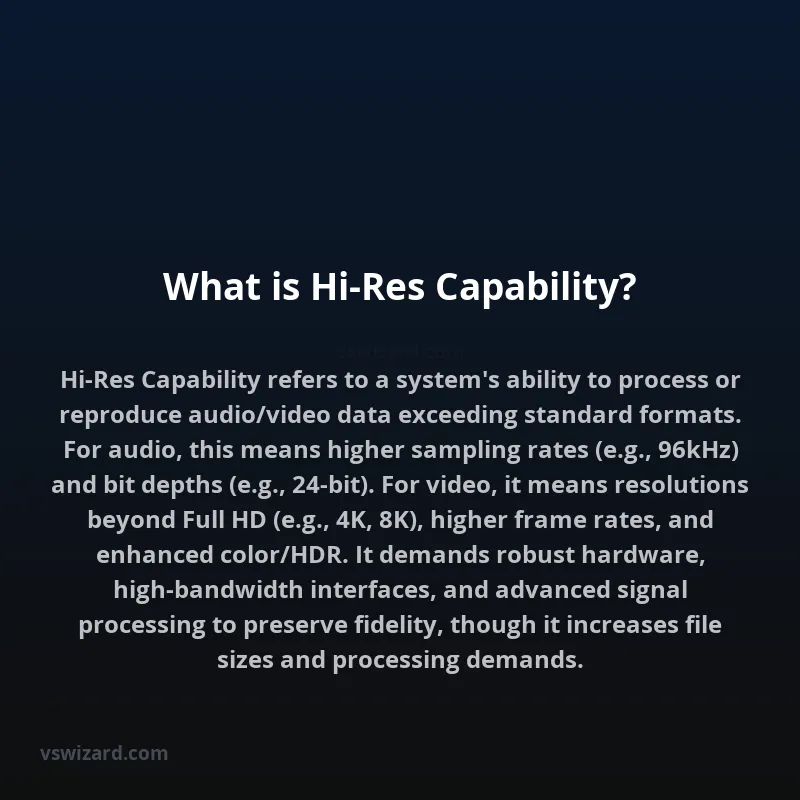
Hi-Res Capability, often denoted in technical specifications related to audio and video transmission or reproduction systems, refers to the ability of a device or system to process, transmit, and/or render data at resolutions or sample rates exceeding standard broadcast or consumer-grade formats. In audio, this typically implies sampling rates higher than 44.1 kHz (e.g., 96 kHz, 192 kHz) and bit depths greater than 16 bits (e.g., 24 bits, 32 bits), capturing a broader dynamic range and finer frequency detail. For video, Hi-Res Capability signifies resolutions surpassing High Definition (HD), such as Quad HD (QHD, 2560x1440), 4K Ultra HD (UHD, 3840x2160), and 8K UHD (7680x4320), coupled with higher frame rates and enhanced color depth (e.g., 10-bit, 12-bit color) to achieve greater visual fidelity and realism.
The implementation of Hi-Res Capability necessitates robust underlying infrastructure, including high-bandwidth communication interfaces (e.g., HDMI 2.0/2.1, DisplayPort 1.4/2.0, USB 3.x/4.0, advanced Ethernet standards), powerful processing units capable of handling the increased data throughput without latency, and sophisticated signal processing algorithms. In audio, it often involves audiophile-grade Digital-to-Analog Converters (DACs) and Analog-to-Digital Converters (ADCs) alongside lossless compression codecs or uncompressed data streams. For video, it demands advanced image processing pipelines that support high pixel counts, wide color gamuts (e.g., Rec. 2020), and high dynamic range (HDR) metadata interpretation and rendering. The primary objective is to minimize signal degradation and aliasing artifacts, thereby preserving the integrity and detail of the original source material for a more immersive and perceptually accurate user experience.
Mechanism of Action and Underlying Technologies
At its core, Hi-Res Capability relies on increased data quantization and sampling frequency. In digital audio, this translates to more discrete amplitude levels captured per sample (higher bit depth) and more samples taken per second (higher sampling rate). For instance, a 24-bit/96kHz audio stream contains significantly more information per second than a standard CD-quality 16-bit/44.1kHz stream, allowing for the representation of subtler nuances in dynamics and frequency response, theoretically extending into the ultrasonic range. The physical mechanism involves the precision of the analog-to-digital conversion (ADC) and digital-to-analog conversion (DAC) circuits, which must accurately translate analog waveforms to digital values and vice-versa at these elevated rates and resolutions.
In video, Hi-Res Capability leverages advancements in sensor technology, digital signal processors (DSPs), and display manufacturing. Higher resolutions require more pixels to be captured by image sensors and subsequently processed by GPUs and video encoders/decoders. This increased pixel count demands faster data interfaces to transfer the raw sensor data and compressed video streams. Technologies like pixel shifting, advanced Bayer filters, and computational photography techniques contribute to achieving higher perceived resolutions. Furthermore, to support the increased detail, wide color gamuts (e.g., DCI-P3, Rec. 2020) and higher dynamic range (HDR), which involves a greater range between the darkest and brightest parts of an image, are critical. HDR is often implemented using standards like HDR10, HDR10+, and Dolby Vision, which embed metadata to guide the display's tone mapping and color reproduction.
Audio Implementations
In the audio domain, Hi-Res Capability is supported by various hardware components and digital audio formats. Key hardware includes high-fidelity DACs and ADCs, often employing oversampling filters and advanced noise-shaping techniques to mitigate quantization errors and improve signal-to-noise ratio (SNR). Dedicated audio processors and dedicated digital signal processors (DSPs) are employed for complex audio processing, upsampling, and digital filtering. Audio interfaces with higher bandwidth capabilities, such as USB Audio Class 2.0 and Thunderbolt, are crucial for transmitting uncompressed or lossless high-resolution audio streams between devices.
Digital audio formats that enable Hi-Res Capability include FLAC (Free Lossless Audio Codec), ALAC (Apple Lossless Audio Codec), WAV (Waveform Audio File Format) at higher bit depths and sample rates, and DSD (Direct Stream Digital) which uses a high-frequency pulse-density modulation technique. The playback systems, ranging from high-end audio receivers and dedicated Digital Audio Players (DAPs) to computer-based audio setups, must be capable of decoding and rendering these formats without introducing unwanted artifacts or downsampling.
Video Implementations
For video, Hi-Res Capability is primarily defined by pixel resolution, frame rate, color depth, and HDR. Resolutions such as 4K (3840x2160) and 8K (7680x4320) require significantly more pixels than Full HD (1920x1080). Higher frame rates, such as 60fps or 120fps, increase the temporal resolution, leading to smoother motion rendition, especially important for sports and gaming. Color depth, measured in bits per color channel, determines the number of distinct colors that can be displayed; 10-bit or 12-bit color offers vastly more gradations than standard 8-bit, reducing banding and enabling smoother color transitions.
HDR implementations (HDR10, HDR10+, Dolby Vision, HLG) are integral to video Hi-Res Capability. They allow for a wider range of luminance and contrast, delivering brighter specular highlights, deeper blacks, and more detail in both bright and dark scenes. This is achieved through the use of metadata, which can be static (e.g., HDR10) or dynamic (e.g., Dolby Vision, HDR10+), instructing the display on how to map the high dynamic range content to its capabilities. The transmission of these high-resolution video signals necessitates high-bandwidth interfaces like HDMI 2.1 and DisplayPort 1.4 or later, which support the required data rates for 4K/8K at high frame rates and HDR.
Industry Standards and Specifications
Several industry standards define and govern Hi-Res Capability. In audio, the Consumer Technology Association (CTA) has established guidelines, and organizations like the Japan Audio Society (JAS) and the Audio Engineering Society (AES) are instrumental in setting professional standards. The 'Hi-Res Audio' certification logo, often seen on consumer products, indicates compliance with JAS standards for sampling rates of 40 kHz or higher and bit depths of 16 bits or higher, with specific requirements for frequencies above 40 kHz. For video, standards bodies like the Society of Motion Picture and Television Engineers (SMPTE) and the International Telecommunication Union (ITU) define resolutions (e.g., ITU-R BT.2020 for UHDTV) and color spaces. The HDMI Forum and VESA (Video Electronics Standards Association) define the physical interfaces and protocols (HDMI 2.1, DisplayPort 2.0) necessary to carry these high-resolution, high-bandwidth signals, including support for HDR metadata and variable refresh rates (VRR).
| Specification | Standard/Format | Description |
| Audio Sampling Rate | 44.1 kHz, 48 kHz, 96 kHz, 192 kHz, DSD64 (2.8 MHz), DSD128 (5.6 MHz) | Number of audio samples taken per second. Higher rates capture more high-frequency information. |
| Audio Bit Depth | 16-bit, 24-bit, 32-bit | Number of bits used to represent each audio sample's amplitude. Higher depth provides greater dynamic range and lower noise floor. |
| Video Resolution | Full HD (1920x1080), QHD (2560x1440), 4K UHD (3840x2160), 8K UHD (7680x4320) | Number of pixels horizontally and vertically. Higher resolution means more detail. |
| Frame Rate | 24 fps, 30 fps, 60 fps, 120 fps | Number of frames displayed per second. Higher rates result in smoother motion. |
| Color Depth | 8-bit, 10-bit, 12-bit | Number of bits per color channel (e.g., R, G, B). Higher depth allows for more distinct colors and smoother gradients. |
| Color Space | Rec. 709, DCI-P3, Rec. 2020 | The range of colors that can be represented. Rec. 2020 is the standard for UHD content. |
| Dynamic Range | SDR, HDR10, HDR10+, Dolby Vision, HLG | The ratio between the brightest and darkest parts of an image. HDR provides a greater range of luminance and contrast. |
| Video Interface Bandwidth | HDMI 2.0 (18 Gbps), HDMI 2.1 (48 Gbps), DisplayPort 1.4 (32.4 Gbps), DisplayPort 2.0 (80 Gbps) | The maximum data transfer rate of the connection interface required for high-resolution video transmission. |
Applications and Use Cases
Hi-Res Capability finds its application across a spectrum of professional and consumer domains where fidelity and detail are paramount. In professional audio production, studios utilize Hi-Res Capability for recording, mixing, and mastering to ensure that the final product retains maximum sonic information, allowing for greater flexibility in post-production and optimal playback across diverse systems. This is crucial for cinematic soundtracks, audiophile music releases, and archival purposes.
In videography and broadcasting, Hi-Res Capability enables the capture and delivery of content with unparalleled visual clarity. High-end cameras equipped with advanced sensors and processors capture footage at 4K and 8K resolutions with high dynamic range and wide color gamuts. This is essential for feature films, high-end documentaries, live sports broadcasting (especially with high frame rates), and virtual reality (VR) content where immersion is key. The increasing adoption of 4K and 8K displays in homes and public spaces drives the demand for Hi-Res Capability content delivery through streaming services, physical media (e.g., Ultra HD Blu-ray), and gaming consoles.
Performance Metrics and Evaluation
Evaluating Hi-Res Capability involves assessing various performance metrics depending on whether the focus is audio or video. For audio, key metrics include Signal-to-Noise Ratio (SNR), Dynamic Range, Total Harmonic Distortion plus Noise (THD+N), frequency response flatness, and jitter performance. Devices claiming Hi-Res Capability must demonstrate low noise floors (e.g., < -100 dB for 24-bit audio), wide dynamic range (e.g., > 120 dB), and minimal distortion across the audible spectrum and beyond. Objective measurements are complemented by subjective listening tests conducted in controlled environments to gauge perceived fidelity.
In video, performance is evaluated by resolution up to the native panel capabilities, color accuracy (Delta E values), contrast ratio, peak brightness (nits for HDR), black levels, motion handling (response time, motion blur), and adherence to color space standards (e.g., Rec. 2020 coverage). Benchmarking tools and calibration equipment are used to verify these specifications. For interfaces, throughput capacity, latency, and error rates are critical. Ultimately, the perceived quality, which considers how well these technical specifications translate to an engaging visual or auditory experience, is the ultimate measure.
Advantages and Limitations
The primary advantage of Hi-Res Capability is the potential for significantly enhanced fidelity and detail in both audio and video reproduction. This leads to a more immersive and perceptually accurate experience, capturing subtle nuances that are lost in lower-resolution formats. In audio, this can translate to a more expansive soundstage, finer textures in instruments, and a clearer representation of ambient details. In video, higher resolutions, frame rates, and HDR provide sharper images, smoother motion, and more realistic lighting and contrast, making content more lifelike.
However, Hi-Res Capability comes with significant limitations and challenges. The most apparent is the substantially larger file sizes and increased bandwidth requirements, necessitating more storage space and faster network connections. This can lead to higher costs for storage, data plans, and infrastructure. Processing demands are also much higher, requiring more powerful and energy-intensive hardware, which can increase device cost and heat generation. Furthermore, the perceptual benefits can be subjective and dependent on the quality of the source material, the reproduction equipment, the listening/viewing environment, and individual user acuity. In many cases, the difference between high-resolution and standard formats may not be discernible to all users under typical viewing or listening conditions.
Alternatives and Future Trends
While Hi-Res Capability represents a push for increased fidelity, alternative approaches and complementary technologies continue to evolve. In audio, research into psychoacoustics explores how to optimize perceived sound quality with less data, leading to more efficient compression algorithms that approach lossless quality. Spatial audio technologies, such as Dolby Atmos and DTS:X, focus on immersive three-dimensional soundscapes rather than solely on sample rate and bit depth. For video, computational photography and advanced AI upscaling algorithms are being developed to enhance standard-resolution content to appear closer to native Hi-Res, potentially reducing the need for excessively high source data rates.
Future trends point towards further integration of AI in signal processing for both audio and video, enabling smarter upsampling, noise reduction, and artifact correction. The continued evolution of communication interfaces will support higher bandwidths, making the transmission of even higher resolutions (e.g., 16K video) and more complex audio formats feasible. Immersive technologies like augmented reality (AR) and virtual reality (VR) will continue to drive the demand for Hi-Res Capability to achieve greater realism. There is also a growing emphasis on interoperability and standardization across different platforms to ensure seamless playback of high-resolution content.