The Digital Visual Interface (DVI) port is a digital video display interface standard designed to transmit uncompressed digital video data from a source device, such as a graphics card or DVD player, to a display device, like a monitor or projector. Developed by the Digital Display Working Group (DDWG), DVI emerged as a successor to the Video Graphics Array (VGA) standard, aiming to provide a more robust and higher-fidelity connection by eliminating the digital-to-analog and analog-to-digital conversions inherent in analog interfaces. Its primary technical achievement lies in its ability to carry raw pixel data directly, preserving image integrity and enabling resolutions significantly higher than previously achievable with analog signals, while also incorporating backward compatibility with some analog signals through specific connector configurations.
The core functionality of a DVI port revolves around the transmission of video signals using Transition Minimized Differential Signaling (TMDS) technology, patented by Silicon Image. TMDS encodes 10-bit data characters into three 165 MHz (for single-link) or 330 MHz (for dual-link) differential signals, along with a clock signal. Each differential signal pair consists of two conductors carrying identical signals with opposite polarity, effectively cancelling out electromagnetic interference (EMI) and allowing for high-speed data transmission over relatively short distances. The DVI standard specifies various connector types (DVI-A, DVI-D, DVI-I) and modes (single-link, dual-link) to accommodate different signal types and bandwidth requirements, making it a versatile yet complex interconnect solution for visual data transmission.
Historical Context and Evolution
The genesis of the DVI standard can be traced back to the mid-1990s, a period marked by the nascent transition from analog to digital display technologies. The need for a standardized, high-bandwidth digital interface to complement the capabilities of emerging flat-panel displays (FPDs) and digital projectors became apparent. The Video Electronics Standards Association (VESA) played a significant role in the development, culminating in the initial DVI specification, often referred to as DVI 1.0, released in 1999. This specification was designed to interface with the emerging PCI Express (PCIe) and AGP graphics architectures and support the resolutions and refresh rates demanded by high-end graphics workstations and early HDTVs.
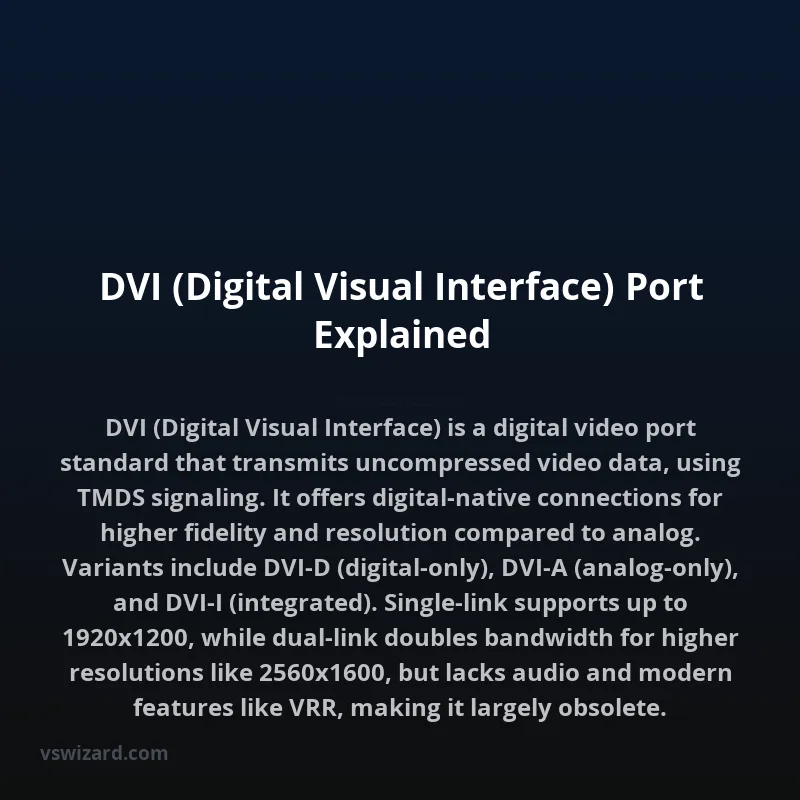
DVI’s evolution saw the introduction of different connector variants and signal configurations to meet varying needs. DVI-A (Analog) ports were designed to carry only analog signals, effectively functioning as a refined VGA connector. DVI-D (Digital) ports transmit exclusively digital signals. DVI-I (Integrated) ports combine both digital and analog signal capabilities, allowing for greater flexibility and backward compatibility. Furthermore, the concept of single-link versus dual-link DVI was introduced to address increasing bandwidth demands. Single-link DVI supports a maximum resolution of 1920x1200 at 60 Hz, while dual-link DVI effectively doubles the bandwidth by using two TMDS links, enabling higher resolutions (e.g., 2560x1600 at 60 Hz) or higher refresh rates at lower resolutions.
Technical Architecture and Signal Transmission
The DVI interface employs a robust encoding and transmission scheme based on Transition Minimized Differential Signaling (TMDS) technology. Each TMDS channel consists of a differential signaling pair that carries data. The process begins with the source device's graphics controller encoding raw video data into 10-bit symbols, with 8 bits representing pixel data and 2 bits for control and encoding purposes (e.g., for pre-emphasis and equalization). This encoding minimizes signal transitions to aid in reliable high-speed transmission. These encoded symbols are then transmitted over three TMDS data channels, alongside a fourth TMDS channel dedicated to the pixel clock signal. The clock signal is essential for synchronizing the receiver with the data stream, ensuring accurate pixel reconstruction at the display.
A crucial aspect of DVI’s technical design is its plug-and-play capability, facilitated by the Extended Display Identification Data (EDID) protocol. When a DVI cable is connected, the display device transmits its capabilities (supported resolutions, refresh rates, color depths, etc.) to the source device via EDID information, typically communicated over the DDC (Display Data Channel), which uses the I²C communication protocol. This allows the graphics card to automatically configure the optimal display settings. The DVI connector itself, commonly the Type D (24-pin), features a robust pin arrangement designed for secure physical connection and electrical integrity. The differential nature of TMDS signaling inherently offers good noise immunity, which is critical for maintaining signal quality over the specified cable lengths (typically up to 10 meters for full bandwidth, though longer passive cables can be used with reduced performance). For analog transmission within DVI-A and DVI-I, standard VGA signaling principles apply, requiring DACs (Digital-to-Analog Converters) in the source and ADCs (Analog-to-Digital Converters) in the display.
DVI Connector Types and Pinouts
The DVI standard defines several connector types and corresponding pinouts, dictating the functionality and signal compatibility. The most common connectors are:
- DVI-D (Digital): Transmits only digital video signals. It comes in single-link (18-pin) and dual-link (24-pin) configurations. The dual-link version uses additional pins to carry a second set of TMDS data channels, thereby doubling the bandwidth.
- DVI-A (Analog): Transmits only analog video signals, essentially a VGA signal adapted for the DVI connector. It uses a 29-pin connector, with a subset of pins dedicated to analog signaling.
- DVI-I (Integrated): Combines both digital and analog capabilities. It also has 18-pin (single-link) and 24-pin (dual-link) versions for digital signals, along with pins for analog signals. This makes DVI-I connectors compatible with DVI-D cables and, with the appropriate adapter, with VGA sources or displays.
The pinout for the DVI-D dual-link connector (24-pin) is structured to support the three TMDS data channels, the clock channel, DDC communication, and auxiliary signals. Each TMDS channel consists of two differential pins (e.g., TDMS1A, TDMS1B). The DDC interface utilizes pins for SDA (Serial Data) and SCL (Serial Clock), enabling EDID communication. An auxiliary pin (AX) is available for hot-plug detection and other control functions.
Single-Link vs. Dual-Link DVI
The distinction between single-link and dual-link DVI is fundamental to its performance capabilities. Single-link DVI utilizes one TMDS data channel and one clock channel, providing sufficient bandwidth for resolutions up to 1920x1200 at 60 Hz and color depths of 24 bits per pixel (8-8-8). This was adequate for most displays and graphics cards upon DVI's introduction.
As display resolutions and refresh rates increased, the need for higher bandwidth became critical. Dual-link DVI addresses this by employing a second set of TMDS data channels, effectively doubling the available bandwidth. This allows for higher resolutions such as 2560x1600 at 60 Hz, or maintaining higher refresh rates at resolutions below its maximum, up to 2048x1536 at 85 Hz. The increased bandwidth is crucial for professional applications like graphic design, video editing, and CAD, where detailed imagery and smooth motion are paramount.
Industry Standards and Compliance
DVI is an open standard, meaning it is not encumbered by proprietary licensing fees, which contributed to its widespread adoption. The primary specification, DVI 1.0, was developed by the DDWG and is administered by VESA. Compliance with the DVI standard ensures interoperability between devices from different manufacturers. This adherence to a defined technical specification is crucial for the reliable transmission of high-resolution digital video signals.
Key technical aspects governed by the standard include electrical signaling characteristics (TMDS clock rates, voltage levels, signal integrity), connector physical dimensions and pinouts, EDID protocols for device identification, and digital signal encoding methods. Manufacturers of graphics cards, monitors, and cables must adhere to these specifications to ensure their products function correctly when connected. The standard also defines the electrical characteristics for both digital (TMDS) and analog (VGA) signaling where applicable in DVI-I and DVI-A connectors, ensuring compatibility across different implementation types.
Applications and Use Cases
The DVI interface has seen extensive application across a broad spectrum of visual display technologies since its inception. It became the de facto standard for connecting desktop computer graphics cards to CRT monitors and, more significantly, to the emerging LCD flat-panel displays of the early to mid-2000s. Its digital-native transmission was particularly beneficial for LCDs, which are inherently digital devices, thus avoiding the signal degradation that could occur with analog connections.
Beyond personal computing, DVI found its way into professional environments. High-resolution displays used in medical imaging, scientific visualization, and broadcast production often utilized DVI ports for their fidelity and bandwidth. Digital projectors, both for business presentations and home theater, commonly featured DVI inputs. The dual-link variant was especially valued in professional graphics workstations and for driving large, high-resolution displays in control rooms and design studios, where maximum visual clarity and detail were essential. Its robustness and reliable connection also made it suitable for industrial and embedded display systems.
Performance Metrics and Limitations
The performance of a DVI connection is primarily dictated by its bandwidth, which is a function of the TMDS clock frequency and the number of active TMDS links. For a single-link DVI connection, the maximum pixel clock rate is 165 MHz. This supports resolutions up to 1920x1200 at 60 Hz with 24-bit color. For dual-link DVI, the pixel clock rate can be doubled to 330 MHz, enabling resolutions up to 2560x1600 at 60 Hz, or higher refresh rates at lower resolutions.
Despite its advantages over analog interfaces, DVI has limitations. It does not support audio transmission, requiring a separate audio cable. Unlike its successor, HDMI, DVI does not natively support HDCP (High-bandwidth Digital Content Protection), although some implementations might include it. The maximum recommended cable length for DVI is typically around 10 meters to maintain signal integrity at maximum resolutions and refresh rates, although passive extension cables can be used, often with a reduction in achievable bandwidth or increased risk of signal degradation. Furthermore, DVI lacks the advanced features found in newer digital interfaces, such as variable refresh rate (VRR) technologies like Adaptive-Sync or FreeSync, which are crucial for modern gaming.
DVI vs. Modern Digital Interfaces
The landscape of digital video interfaces has evolved significantly, with DVI being largely superseded by newer standards like HDMI (High-Definition Multimedia Interface) and DisplayPort. HDMI, developed by a consortium of electronics manufacturers, combines video and audio transmission over a single cable and includes support for HDCP. It has become the dominant interface for consumer electronics, including televisions, Blu-ray players, and gaming consoles.
DisplayPort, developed by VESA, is another significant advancement. It offers even higher bandwidth capabilities than HDMI, supports multi-stream transport (allowing multiple independent displays to be driven from a single port), and natively incorporates features like Adaptive-Sync for variable refresh rates, making it ideal for high-performance gaming monitors and professional workstations. While DVI offered a critical bridge from analog to digital video, its limitations in bandwidth, lack of audio transport, and absence of modern features have led to its phasing out in favor of these more capable and integrated interfaces.
| Specification | DVI-D Single-Link | DVI-D Dual-Link | DVI-I Single-Link | DVI-I Dual-Link | DVI-A |
| Max Resolution @ 60 Hz | 1920x1200 | 2560x1600 | 1920x1200 | 2560x1600 | 2048x1536 |
| Max Pixel Clock | 165 MHz | 330 MHz | 165 MHz | 330 MHz | 150 MHz |
| TMDS Channels | 1 | 2 | 1 | 2 | N/A (Analog) |
| Audio Support | No | No | No | No | No |
| HDCP Support | Optional | Optional | Optional | Optional | N/A |
| Connector Pins | 18 | 24 | 29 (Total, includes analog pins) | 29 (Total, includes analog pins) | 29 |
| Signal Type | Digital | Digital | Digital & Analog | Digital & Analog | Analog |
Future Outlook
While the DVI interface has been largely phased out of new consumer electronics and PC hardware in favor of HDMI and DisplayPort, its legacy persists in specific industrial and legacy equipment. The robustness of its digital transmission and the widespread availability of DVI ports on older monitors and professional displays mean that it may still be encountered in certain professional or embedded systems. However, for new installations and advancements in display technology, DVI is considered obsolete, having served its purpose as a crucial transitional standard from analog video to the integrated, high-bandwidth digital interfaces that define modern audiovisual connectivity.