DisplayPort (DP) specifications delineate a standardized digital display interface designed for high-bandwidth video and audio transmission between a host device, such as a computer graphics card, and a display device, like a monitor or television. Developed by the Video Electronics Standards Association (VESA), DisplayPort utilizes a packet-based data transfer protocol, enabling robust support for advanced features including high resolutions, high refresh rates, multi-stream transport (MST), and adaptive-sync technologies like AMD FreeSync and NVIDIA G-Sync. Its architecture facilitates a direct connection, bypassing intermediate signal conversions often required by older analog interfaces, thereby minimizing signal degradation and latency.
The core of DisplayPort functionality lies in its micro-packet architecture, which allows for flexible allocation of bandwidth for video, audio, and auxiliary data streams. This architecture, coupled with differential signaling and advanced encoding schemes, ensures signal integrity over extended cable lengths and supports a scalable framework for future enhancements. The specifications cover physical layer characteristics, link layer protocols, and protocol negotiation, defining the electrical signaling, connector types, cable requirements, and the handshake procedures necessary for establishing a functional display link. Adherence to these specifications ensures interoperability across a wide range of hardware from different manufacturers.
History and Evolution
The initial DisplayPort 1.0 specification was released in 2006, aiming to supersede older standards like VGA and DVI, and to provide a more flexible and capable interface for the evolving display technologies. Subsequent revisions have progressively increased bandwidth, improved efficiency, and introduced new functionalities:
- DisplayPort 1.1 (2007): Introduced support for encryption (HDCP) and extended display identification data (EDID) over the link.
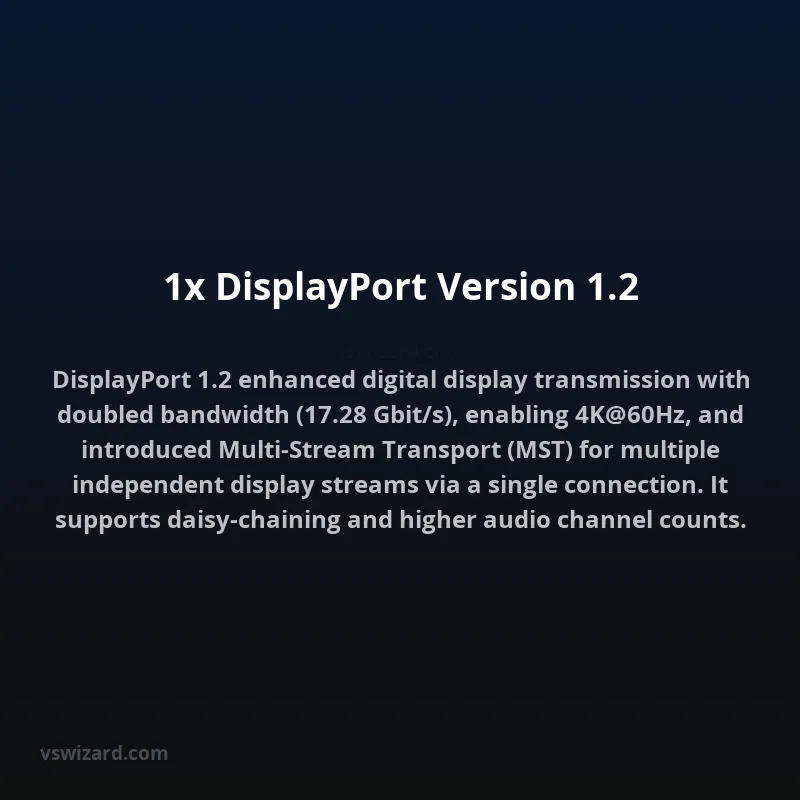
- DisplayPort 1.2 (2010): A significant upgrade, doubling the maximum bandwidth to 21.6 Gbps, enabling 4K resolution at 60Hz, and introducing Multi-Stream Transport (MST) for daisy-chaining multiple displays from a single port.
- DisplayPort 1.3 (2014): Increased per-lane data rate, enabling support for 5K resolution at 30Hz or 4K at 120Hz. It also introduced support for USB Type-C alternate mode.
- DisplayPort 1.4 (2016): Further enhanced bandwidth to 32.4 Gbps, offering support for HDR (High Dynamic Range) metadata transport and DSC (Display Stream Compression), allowing for higher resolutions and refresh rates, including 8K at 60Hz with HDR.
- DisplayPort 2.0 (2019): A substantial leap in bandwidth, reaching up to 80 Gbps, designed to support future high-resolution, high-refresh-rate displays and VR/AR applications. It introduced new modulation schemes (16b/18b) and support for up to 16K resolution.
Architecture and Mechanism
DisplayPort employs a point-to-point serial interface that operates in a micro-packet-based manner. The link comprises several lanes, typically four main data lanes, each operating at high speeds. Data is transmitted in packets, allowing for dynamic allocation of bandwidth. This packet-based approach is fundamentally different from the continuous clock signals of older parallel interfaces.
Physical Layer
The physical layer defines the electrical signaling characteristics, including voltage levels, impedance, and data rates per lane. It utilizes differential signaling to minimize noise susceptibility and maximize signal integrity. The standard specifies connectors, with the primary connector being a 20-pin interface, and a smaller Mini DisplayPort connector also widely adopted. USB Type-C ports can also carry DisplayPort signals through an 'Alternate Mode'.
Link Layer
The link layer manages the establishment and maintenance of the DisplayPort link. This involves a negotiation process where the source (e.g., graphics card) and sink (e.g., monitor) devices exchange capabilities and configure the link parameters. This includes determining the number of active lanes, link rate, and supported color depths.
Video and Audio Transmission
Video data is transmitted in DisplayPort packets, along with auxiliary data for control signals (like EDID and DPCD) and audio streams. The flexibility of the packet-based system allows for efficient transmission of uncompressed video, or compressed video using DSC in newer versions, to support higher resolutions and refresh rates than would otherwise be possible over the available bandwidth.
Key Features and Capabilities
DisplayPort specifications incorporate several advanced features essential for modern display technologies:
- Multi-Stream Transport (MST): Allows multiple independent display streams to be sent over a single DisplayPort cable, enabling daisy-chaining of monitors or connection of multiple displays to a single port.
- Adaptive-Sync: A core component of the DisplayPort 1.2a specification and onwards, it enables variable refresh rates, synchronizing the display's refresh rate with the graphics card's frame output to eliminate screen tearing and stuttering.
- Display Stream Compression (DSC): Introduced in DisplayPort 1.4, DSC is a visually lossless compression algorithm that significantly reduces the bandwidth required for video transmission, enabling higher resolutions and refresh rates.
- HDR Support: Newer specifications include provisions for transmitting High Dynamic Range (HDR) metadata, allowing for displays to render a wider range of colors and luminance levels.
- USB Type-C Alternate Mode: DisplayPort signals can be carried over a USB Type-C connector, providing a versatile single-cable solution for video, data, and power.
Technical Specifications Table
The following table summarizes key bandwidth and resolution capabilities across different DisplayPort versions:
| DisplayPort Version | Max Bandwidth (Gbps) | Max Data Rate (Gbps/lane) | Typical Max Resolution/Refresh Rate (Uncompressed) | Typical Max Resolution/Refresh Rate (with DSC) |
|---|---|---|---|---|
| 1.0/1.1 | 10.8 | 2.7 | 2560x1600 @ 60Hz | N/A |
| 1.2 | 21.6 | 5.4 | 3840x2160 @ 60Hz | N/A |
| 1.3/1.4 | 32.4 | 8.1 | 3840x2160 @ 120Hz / 7680x4320 @ 30Hz | 7680x4320 @ 60Hz (with DSC) |
| 2.0/2.1 | 80 (UHBR 20) | 20 | 7680x4320 @ 60Hz (8-lane, w/o DSC) | 15360x8640 @ 30Hz (8-lane, w/o DSC) / 7680x4320 @ 120Hz (w/ DSC) |
Industry Standards and Compliance
DisplayPort is managed by VESA, an industry consortium comprising numerous technology companies. VESA develops and maintains the detailed technical specifications, ensuring interoperability and promoting the adoption of the standard. Compliance with these specifications is crucial for devices to function correctly and to be marketed as supporting DisplayPort. The standard also integrates with other industry standards, such as HDCP for content protection and USB for connectivity via Alternate Mode.
Practical Implementation Considerations
Implementing DisplayPort requires careful consideration of several factors, including the host controller capabilities, cable quality, and sink device support. The specifications define strict requirements for cable construction, including impedance matching and shielding, to maintain signal integrity, particularly at higher data rates. Active cables incorporating signal re-drivers or re-timers may be necessary for longer runs or to compensate for signal loss. The adoption of USB Type-C has further complicated implementation, requiring robust negotiation protocols to correctly switch between USB data, DisplayPort video, and power delivery functions.
Performance Metrics
The primary performance metric for DisplayPort is its total bandwidth, which directly dictates the maximum resolution, refresh rate, and color depth that can be supported. This bandwidth is influenced by the specific version of the specification, the number of data lanes utilized, and the link data rate. Other critical performance aspects include latency, signal-to-noise ratio (SNR), and the effectiveness of any compression algorithms employed.
Conclusion
DisplayPort specifications represent a sophisticated, extensible digital interface standard that has consistently evolved to meet the demands of increasingly high-resolution and high-refresh-rate displays. Its packet-based architecture, advanced features like MST and DSC, and adaptability through USB Type-C Alternate Mode position it as a foundational technology for modern visual computing and digital signage. Continued development under VESA ensures its relevance for future display technologies, including immersive VR/AR applications and ultra-high-definition displays.