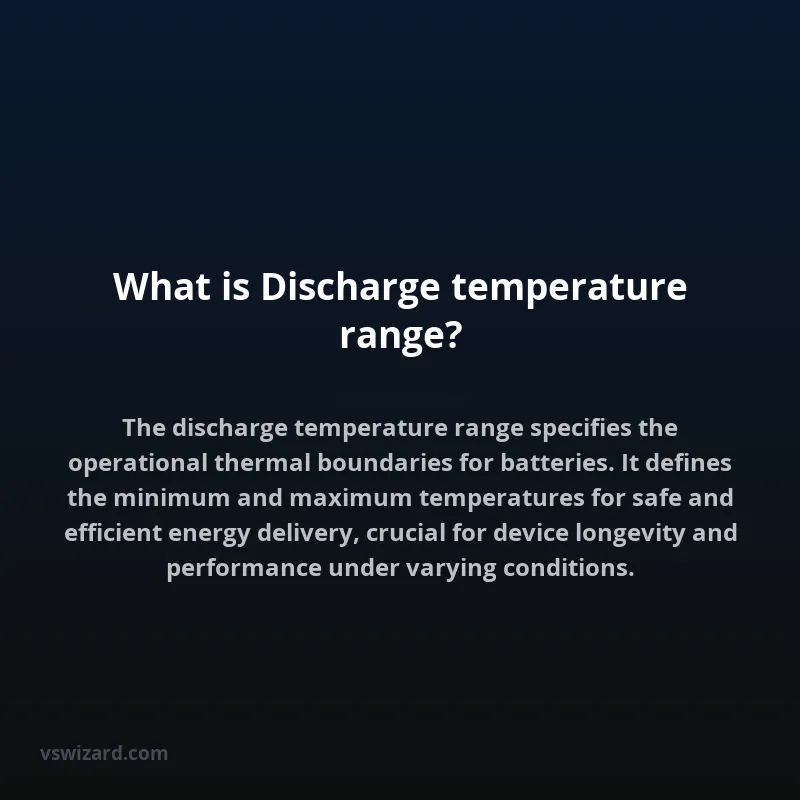
The discharge temperature range is a critical performance parameter for electrochemical energy storage devices, particularly batteries. It delineates the operational boundaries within which a battery can safely and effectively deliver its stored energy. This range is defined by both a lower and an upper temperature limit, below which the battery's electrochemical kinetics and ion transport mechanisms become severely hindered, leading to reduced power output and efficiency, and above which accelerated degradation, thermal runaway risks, and potential damage to internal cell components can occur. Precisely defining and adhering to this range is fundamental for ensuring battery longevity, safety, and optimal energy delivery under various environmental conditions.
The physical and chemical processes governing a battery's discharge behavior are intrinsically temperature-dependent. At sub-optimal low temperatures, the electrolyte viscosity increases, impeding ion diffusion across the electrochemical double layer and within the bulk electrolyte. This results in increased internal resistance, thereby limiting the rate at which the battery can supply current and sustain its voltage. Conversely, elevated temperatures accelerate parasitic reactions, such as solid electrolyte interphase (SEI) growth and electrode material corrosion, and can lead to the breakdown of electrolyte components. These effects not only degrade the battery's capacity and cycle life but also pose significant safety hazards by increasing internal pressure and the risk of thermal events. Therefore, the discharge temperature range serves as a crucial specification for system designers and end-users to match battery capabilities with application demands and environmental constraints.
Mechanism of Action and Temperature Dependencies
The discharge process in a battery involves the movement of ions through the electrolyte and electrons through the external circuit, driven by chemical potential differences. Temperature fundamentally influences the rates of these charge transfer and mass transport processes.
Ion Transport and Electrolyte Properties
At lower temperatures, the increased viscosity of the electrolyte reduces the mobility of charge carriers (ions). This leads to a higher charge transfer resistance and a lower ionic conductivity. The diffusion coefficients of ions within the electrolyte also decrease, limiting the rate at which reactants can reach the electrode-electrolyte interfaces. This phenomenon is particularly pronounced in systems with non-aqueous electrolytes, which are common in lithium-ion batteries. The Arrhenius equation often describes the temperature dependence of ionic conductivity, indicating an exponential increase in conductivity with rising temperature within the operational range.
Electrode Kinetics and Interfacial Phenomena
The electrochemical reactions at the anode and cathode also exhibit temperature dependence. Reaction rates generally increase with temperature according to the Eyring equation or similar kinetic models, up to a point. However, elevated temperatures can promote undesirable side reactions. For instance, in lithium-ion batteries, higher temperatures accelerate the decomposition of the electrolyte and the formation of an unstable SEI layer on the anode. This consumes active lithium and electrolyte, leading to capacity fade and increased internal resistance. High temperatures can also induce phase changes or structural degradation in electrode active materials, further impairing performance and safety.
Thermal Management and Heat Dissipation
During discharge, electrochemical processes generate heat due to internal resistance (Joule heating) and irreversible electrochemical reactions. The rate of heat generation is proportional to the square of the current and the internal resistance (P = I²R). Effective thermal management systems are required to dissipate this heat and maintain the battery's temperature within its safe operating range. If the rate of heat generation exceeds the rate of heat dissipation, the battery temperature will rise, potentially exceeding the upper limit of the discharge temperature range and leading to accelerated degradation or thermal runaway.
Industry Standards and Specifications
Several international and industry-specific standards define test conditions and reporting requirements for battery performance, including parameters related to discharge temperature. These standards aim to ensure comparability of performance data across different manufacturers and battery chemistries.
Key Standards Bodies
- IEC (International Electrotechnical Commission): Standards like IEC 62133 specify safety requirements and testing procedures for portable sealed secondary cells and batteries. Performance testing often includes discharge cycles at defined temperature ranges.
- ISO (International Organization for Standardization): ISO standards, particularly those related to electric road vehicles (e.g., ISO 12405), often detail battery performance and testing protocols, including temperature limitations.
- SAE (Society of Automotive Engineers): SAE standards are crucial for automotive applications, covering various aspects of battery performance, safety, and testing under different thermal conditions.
- UL (Underwriters Laboratories): UL standards focus heavily on safety but also encompass performance aspects, including those affected by temperature.
Common Testing Protocols
Standardized tests typically involve discharging the battery at specified C-rates (multiples of the nominal capacity) at various controlled ambient temperatures. These tests measure parameters such as delivered capacity, voltage profile, and energy efficiency. The results are then used to determine the nominal discharge temperature range and characterize performance under extended conditions.
Applications and Implications
The discharge temperature range is a pivotal specification across numerous applications, dictating the feasibility and performance envelopes of energy storage systems.
Consumer Electronics
For portable devices like smartphones, laptops, and wearables, the discharge temperature range influences usability in varying climates. Operation at extremely low temperatures can result in significantly reduced battery life, while high temperatures (e.g., direct sunlight) can lead to performance throttling or even shutdown for safety. Manufacturers must balance battery chemistry selection and thermal management to accommodate typical ambient conditions.
Electric Vehicles (EVs)
EVs operate in diverse environmental conditions, making the discharge temperature range critical. Cold weather significantly impacts range and charging speed due to increased internal resistance. High temperatures can stress the battery pack, necessitating robust active cooling systems. The ability to discharge efficiently across a broad temperature spectrum directly affects vehicle utility and driver experience. Battery Management Systems (BMS) play a crucial role in monitoring and managing temperature to keep the battery within its optimal range.
Grid-Scale Energy Storage
Utility-scale battery storage systems often operate in environments with wide diurnal and seasonal temperature fluctuations. The discharge temperature range determines the operational efficiency and lifespan of these systems. Systems deployed in hot climates require enhanced cooling, while those in colder regions may need heating systems to maintain performance during discharge and charging.
Aerospace and Defense
Applications in aerospace and defense demand reliable performance under extreme temperature variations. Batteries for satellites, drones, and military equipment must function effectively from cryogenic lows to high operating temperatures, often necessitating specialized battery chemistries and advanced thermal control.
Performance Metrics and Characterization
Several metrics are used to quantify a battery's performance within its discharge temperature range, and how its behavior deviates outside these limits.
Capacity Fade and Energy Efficiency
Capacity retention and energy efficiency are directly impacted by temperature. As temperature decreases, ionic conductivity drops, increasing internal resistance and reducing the deliverable capacity. As temperature increases beyond the optimal range, parasitic reactions accelerate, leading to faster capacity fade and reduced cycle life. Energy efficiency, defined as the ratio of discharged energy to charged energy, also tends to decrease at both extremes of the temperature range.
Power Capability and Voltage Sag
The maximum power that can be delivered by a battery is limited by its internal resistance and kinetics, both of which are temperature-dependent. At low temperatures, increased internal resistance leads to significant voltage sag (a drop in terminal voltage under load) and reduced power capability. At high temperatures, while kinetics might improve initially, accelerated degradation can also limit sustained power output and lead to voltage instability.
Internal Resistance Measurement
Internal resistance is a key indicator of a battery's health and temperature-dependent performance. It is typically measured using techniques like AC impedance spectroscopy or DC pulse methods. A rise in internal resistance at low temperatures indicates kinetic limitations, while a sustained rise across temperatures can signal irreversible degradation.
Lifetime and Cycle Life
Operating a battery outside its specified discharge temperature range significantly accelerates its aging mechanisms, thereby reducing its overall lifetime and cycle life. Exposure to extreme temperatures can cause physical damage, such as dendrite formation (in some chemistries) or electrode material cracking, which are irreversible and lead to premature failure.
Advanced Engineering and Future Outlook
Research and development are continuously striving to expand the operational temperature range of batteries and improve their performance across existing limits.
Materials Science Innovations
Developments in electrolyte formulations, including solid-state electrolytes and advanced ionic liquids, aim to improve ionic conductivity and stability at both low and high temperatures. Novel electrode materials with enhanced thermal stability and resistance to parasitic reactions are also crucial.
Thermal Management Systems
Sophisticated active and passive thermal management strategies, such as phase change materials (PCMs), microchannel liquid cooling, and advanced insulation techniques, are being integrated into battery packs to maintain optimal operating temperatures, thereby enabling wider effective discharge temperature ranges.
Battery Management Systems (BMS)
Intelligent BMS algorithms are being developed to dynamically optimize battery operation based on real-time temperature monitoring. These systems can adjust charge/discharge rates, precondition the battery, and provide early warnings of potential thermal issues, maximizing performance and safety within the defined temperature boundaries.
| Battery Chemistry | Typical Lower Discharge Temp (°C) | Typical Upper Discharge Temp (°C) | Notes |
|---|---|---|---|
| Lithium-ion (NMC) | -20 | 60 | Performance degrades significantly below -10°C. Upper limit is safety/degradation constrained. |
| Lithium-ion (LFP) | -30 | 55 | Generally more tolerant to low temps than NMC but still exhibits capacity loss. |
| Lead-Acid | -20 | 50 | Capacity drops significantly at low temps. High temps accelerate sulfation and water loss. |
| Nickel-Metal Hydride (NiMH) | -10 | 60 | Less sensitive than Li-ion at low temps, but efficiency suffers. |
| Solid-State Batteries (Emerging) | -40 | 150+ | Potential for significantly wider ranges, dependent on specific electrolyte and electrode materials. |
The continuous pursuit of batteries capable of operating reliably under more extreme thermal conditions is driven by the expanding applications of energy storage. Enhancing the intrinsic thermal robustness of battery chemistries, coupled with intelligent thermal management and control systems, will be key to unlocking the full potential of advanced battery technologies across a broader spectrum of operational environments.