Data transfer rate in 4G, also known as mobile data speed, quantifies the volume of digital information transmitted per unit of time between a user's device and the network's base station. This metric is fundamental to the performance of Long-Term Evolution (LTE) and its advanced variants, defining the experiential quality of mobile broadband services. It is typically measured in bits per second (bps), with common units being kilobits per second (Kbps), megabits per second (Mbps), and gigabits per second (Gbps). The achievable data transfer rate is a complex function of numerous factors, including the employed radio access technology (e.g., LTE-Advanced, LTE-Advanced Pro), spectral bandwidth allocated, signal strength and quality (signal-to-noise ratio), MIMO (Multiple-Input Multiple-Output) configuration, modulation and coding schemes (MCS), network congestion, and the capabilities of both the user equipment (UE) and the base transceiver station (BTS).
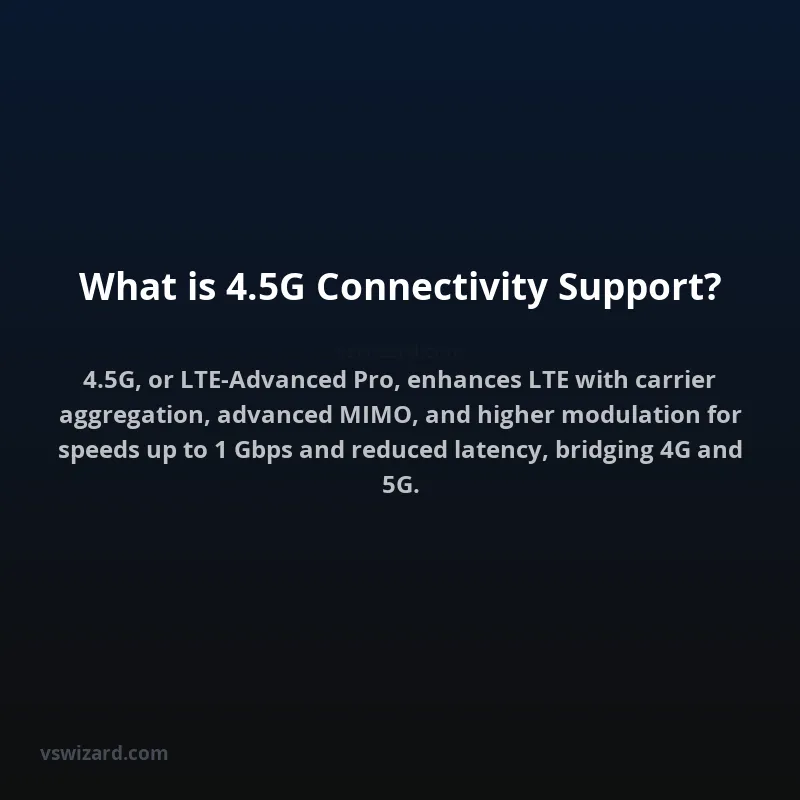
The physical layer mechanisms underpinning 4G data transfer rates involve sophisticated techniques such as Orthogonal Frequency-Division Multiple Access (OFDMA) in the downlink and Single-Carrier Frequency-Division Multiple Access (SC-FDMA) in the uplink, which enable efficient spectral utilization and mitigate inter-symbol interference. Advanced antenna technologies, particularly MIMO, are critical for enhancing spectral efficiency and achieving higher throughput by transmitting multiple data streams concurrently over different spatial layers. Furthermore, carrier aggregation, a key feature of LTE-Advanced and beyond, allows the combination of multiple frequency bands to increase the total bandwidth available, thereby directly boosting the maximum achievable data transfer rates. The theoretical peak data rates are defined by international standards bodies like the 3GPP (3rd Generation Partnership Project), but real-world performance is invariably lower due to overhead, channel conditions, and protocol limitations.
Industry Standards and Evolution
The evolution of 4G data transfer rates is intricately tied to the standardization efforts by the 3GPP. Initial LTE specifications (Release 8) established theoretical peak downlink rates of 100 Mbps and uplink rates of 50 Mbps. Subsequent releases progressively enhanced these capabilities. LTE-Advanced (Release 10) introduced carrier aggregation, significantly increasing peak rates to up to 1 Gbps downlink. Further refinements through LTE-Advanced Pro (Releases 13 and beyond) saw theoretical peak rates climb towards 3 Gbps downlink, incorporating technologies like higher-order modulation schemes (e.g., 256QAM) and enhanced MIMO configurations (e.g., 4x4 MIMO). These standards define the framework, but actual deployment and performance depend on operator spectrum allocation, infrastructure investment, and hardware capabilities.
Mechanism of Action and Key Technologies
The core mechanism for data transfer in 4G relies on packet-switched networks utilizing the IP protocol. Radio transmission employs OFDMA in the downlink, dividing the available frequency spectrum into numerous narrow subcarriers. This allows for efficient data transmission, robust performance in the presence of multipath fading, and flexible resource allocation to different users. Uplink utilizes SC-FDMA, which offers similar spectral efficiency to OFDMA but with lower peak-to-average power ratio (PAPR), crucial for battery efficiency in user devices. MIMO technology leverages multiple antennas at both the transmitter and receiver to transmit independent data streams (spatial multiplexing) or to improve signal robustness through diversity coding. Carrier aggregation combines multiple Component Carriers (CCs) from different frequency bands, effectively widening the data pipe. Higher-order modulation, such as 64-QAM and 256-QAM, encodes more bits per symbol, increasing spectral efficiency, but requires better signal quality.
Performance Metrics and Measurement
Data transfer rate is typically assessed through peak theoretical rates and average real-world throughput. Peak rates represent the maximum achievable under ideal laboratory conditions with full spectrum, optimal signal quality, and no other users. Real-world average throughput, however, reflects performance under typical network conditions, considering factors like signal degradation, interference, and shared bandwidth. Key metrics include:
- Download Speed: The rate at which data is received by the user device.
- Upload Speed: The rate at which data is sent from the user device.
- Latency: The time delay in data packet transmission, crucial for interactive applications.
- Jitter: The variation in latency, impacting real-time streaming.
Measurement is commonly performed using speed test applications and services that download/upload files of specific sizes and calculate the rate, or by monitoring network traffic using specialized diagnostic tools.
| Feature | LTE (Release 8) | LTE-Advanced (Release 10) | LTE-Advanced Pro (Release 13+) |
|---|---|---|---|
| Peak Downlink Rate (Theoretical) | 100 Mbps | 1 Gbps | 3 Gbps |
| Peak Uplink Rate (Theoretical) | 50 Mbps | 500 Mbps | 1.5 Gbps |
| Carrier Aggregation | No | Yes | Enhanced |
| MIMO | Up to 2x2 | Up to 8x8 (DL) | Enhanced MIMO, CoMP |
| Modulation (DL) | QPSK, 16QAM, 64QAM | QPSK, 16QAM, 64QAM, 256QAM | 256QAM, 1024QAM (planned) |
| Spectrum Bandwidth | Up to 20 MHz | Up to 100 MHz (aggregated) | Up to 300 MHz (aggregated) |
Practical Implementation and Factors Affecting Speed
The practical realization of 4G data transfer rates involves the interplay of network infrastructure, spectrum availability, and user equipment capabilities. Mobile network operators deploy base stations equipped with advanced radio units and antenna systems. The amount of spectrum allocated to an operator is a primary determinant of potential throughput; wider bandwidth directly translates to higher data rates. Signal propagation characteristics—distance from the base station, physical obstructions (buildings, foliage), and atmospheric conditions—significantly impact signal strength and quality, thereby limiting achievable speeds. Network congestion, caused by a high number of active users sharing the same cell, leads to reduced individual data rates through resource division. User device capabilities, including its supported LTE category, antenna configuration, and modem chipset, also cap the maximum attainable speeds.
Limitations and Future Outlook
While 4G technologies have provided substantial improvements in mobile data speeds over previous generations, limitations persist. Achieving theoretical peak rates is exceptionally rare in real-world scenarios. Latency, although reduced compared to 3G, can still be a bottleneck for highly time-sensitive applications. Spectrum scarcity and interference management remain ongoing challenges for operators. The transition towards 5G and subsequent generations aims to address these limitations by offering significantly higher data rates, lower latency, and greater network capacity through new spectrum bands, advanced antenna techniques (e.g., Massive MIMO, beamforming), and a more flexible network architecture.