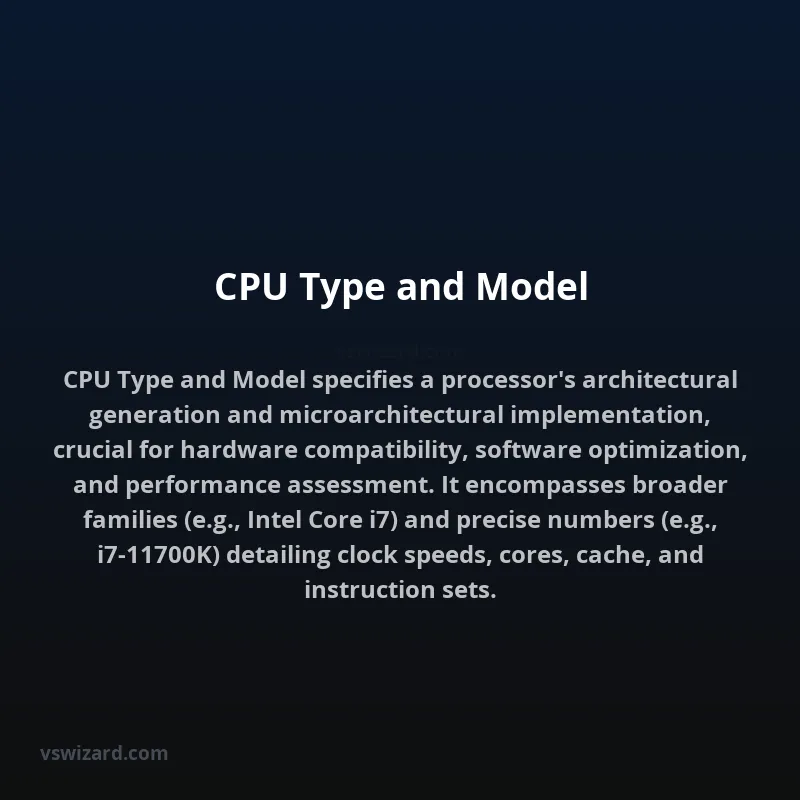
The designation 'CPU Type and Model' serves as a critical identifier for central processing units (CPUs), encapsulating both the architectural generation and specific microarchitectural implementation of a processor. This dual classification is paramount for system integrators, software developers, and hardware diagnosticians, enabling precise hardware compatibility checks, performance benchmarking, and the application of hardware-specific optimizations. The 'Type' often refers to the broader processor family (e.g., Intel Core i7, AMD Ryzen 5, ARM Cortex-A76), indicating fundamental design characteristics, core count ranges, and supported instruction set architectures. The 'Model' number (e.g., Intel Core i7-11700K, AMD Ryzen 7 5800X, ARM Cortex-A76 AE) provides granular differentiation within a type, specifying clock speeds, cache hierarchy configurations, integrated graphics capabilities, power envelopes, and other detailed performance-defining parameters.
Understanding the CPU Type and Model is foundational for effective system design and utilization. For operating systems and application software, this information dictates the availability of specific instruction sets (like AVX-512 or ARMv8.2-A extensions), which can be leveraged for significant performance gains. In firmware and BIOS development, it's essential for configuring hardware resources, managing thermal states, and ensuring proper power delivery. For end-users and system administrators, it informs purchase decisions, compatibility with software requirements, and the feasibility of performance tuning or upgrades. The specificity of the model number is often tied to the silicon fabrication process node, the number of physical cores, the presence and configuration of hyper-threading or simultaneous multithreading (SMT), and cache sizes (L1, L2, L3), all of which fundamentally influence computational throughput and latency.
Processor Identification Mechanisms
The identification of CPU type and model is achieved through a combination of hardware-based reporting mechanisms and software-level queries. Hardware itself exposes this information via dedicated registers and interfaces. The CPUID instruction on x86 architectures is a fundamental tool, returning an extensive set of processor information, including vendor identification, brand string, feature flags, and specific model information when provided with appropriate input leaf values. On ARM architectures, the Main System Control Register (MPIDR) and various Memory-mapped Control Registers (e.g., ACTLR, CPACR) provide access to core type, revision, and processor identification. Software, such as operating system kernels and diagnostic utilities, interrogates these low-level hardware interfaces during boot-up or on demand to ascertain the precise CPU characteristics. This data is then often presented to the user or application through abstracted APIs or system information utilities.
Hardware-Level Reporting
At the silicon level, each CPU is provisioned with unique identifiers programmed during the manufacturing process. For x86 processors, the Intel/AMD vendor strings are universally recognized. The specific model identifier is typically encoded to reflect the processor family, stepping, and model number. For instance, on Intel x86, a combination of the EAX register value for the CPUID instruction (e.g., leaf 0x01) provides the Processor Type, Family, Model, and Stepping. Similarly, ARM processors utilize a distinct set of registers to enumerate processor types, implementer codes, and core identifiers, allowing for a clear disambiguation of diverse System-on-Chip (SoC) configurations.
Software-Level Enumeration
Operating systems and hypervisors abstract hardware reporting for broader compatibility and ease of use. On Linux, commands like lscpu parse output from the kernel's hardware detection mechanisms, which in turn query CPUID or equivalent ARM registers. The /proc/cpuinfo file provides detailed, albeit sometimes less structured, information. On Windows, System Information (msinfo32.exe) or PowerShell cmdlets like Get-CimInstance Win32_Processor retrieve and display CPU details. Virtualization platforms also leverage these mechanisms to present guest operating systems with virtualized CPU types and models, often emulating specific hardware for compatibility or performance tuning.
Architecture and Microarchitecture Definitions
The 'Type' of a CPU generally aligns with its architectural generation and fundamental design philosophy, often associated with specific Instruction Set Architectures (ISAs) like x86-64 or ARMv8-A. The 'Model' delves into the microarchitecture, which is the specific implementation of that ISA by a given manufacturer. Microarchitectural differences are critical as they dictate performance characteristics, power efficiency, and the underlying logic design.
Instruction Set Architecture (ISA)
The ISA defines the set of instructions that a CPU can execute. Major ISAs include:
- x86/x86-64: Predominantly used in desktop, laptop, and server markets, known for its complex instruction set computing (CISC) heritage.
- ARM: Dominant in mobile devices and increasingly in servers and embedded systems, based on a reduced instruction set computing (RISC) philosophy.
- RISC-V: An open-source ISA gaining traction for its modularity and customizability.
The ISA is the most basic classification, defining the language the CPU speaks. The CPU Type and Model must conform to a specific ISA.
Microarchitectural Implementations
Within a given ISA, manufacturers design various microarchitectures. These are proprietary implementations that optimize for different goals:
- Performance Cores (P-cores): Optimized for high single-threaded performance, featuring larger caches, higher clock speeds, and more complex execution units.
- Efficient Cores (E-cores): Optimized for power efficiency and multi-threaded throughput, typically with smaller caches and lower clock speeds, allowing for higher density.
- Specialized Cores: Designed for specific tasks, such as AI acceleration or real-time processing.
The specific model number often indicates which microarchitecture is employed (e.g., Intel's 'Skylake', 'Tiger Lake', 'Alder Lake' microarchitectures, or AMD's 'Zen 2', 'Zen 3' microarchitectures).
Performance Metrics and Benchmarking
The CPU Type and Model directly influence a wide array of performance metrics. Clock speed (GHz) is a primary indicator, but it is heavily modulated by the microarchitecture, cache hierarchy, and the number of cores.
Key Performance Indicators (KPIs)
- Clock Speed: Base and boost frequencies, indicating the rate of instruction execution.
- Core Count: The number of physical processing units.
- Thread Count: The number of logical processors, often a multiple of core count due to technologies like Hyper-Threading or SMT.
- Cache Size (L1, L2, L3): The amount and speed of on-chip memory, crucial for reducing data access latency.
- IPC (Instructions Per Clock): A measure of the efficiency of the microarchitecture, indicating how many instructions can be executed per clock cycle.
- TDP (Thermal Design Power): An indicator of the maximum heat a CPU is expected to generate, influencing cooling requirements and sustained performance.
Benchmarking Standards
Various benchmarks exist to evaluate CPU performance based on their type and model. These include:
- Synthetic Benchmarks: Tools like Cinebench, Geekbench, and PassMark measure raw CPU power through simulated workloads.
- Real-World Application Benchmarks: Measuring performance in specific applications like video encoding (e.g., HandBrake), gaming frame rates, or complex scientific simulations.
- Instruction Set Specific Benchmarks: Tools designed to test the efficiency of advanced instruction sets (e.g., AVX benchmarks).
Comparing benchmark results across different CPU Type and Model designations provides objective data for performance assessment.
| Attribute | Intel Core i9-13900K | AMD Ryzen 9 7950X | Apple M2 Max |
|---|---|---|---|
| Architecture | x86-64 | x86-64 | ARMv8.4-A (Custom) |
| Microarchitecture | Raptor Lake | Zen 4 | Avalanche |
| Core Count | 24 (8P + 16E) | 16 | 12 |
| Thread Count | 32 | 32 | 12 |
| Max Boost Clock | 5.8 GHz | 5.7 GHz | ~3.7 GHz |
| L3 Cache | 36 MB | 64 MB | N/A (Unified Cache) |
| TDP | 125W (Base) | 170W (Base) | ~60-90W (SoC) |
| Integrated Graphics | Intel UHD Graphics 770 | AMD Radeon Graphics | Apple GPU (30-core) |
Industry Standards and Evolution
The evolution of CPU Type and Model is driven by advancements in semiconductor physics, manufacturing processes (e.g., lithography nodes), and architectural innovation aimed at increasing performance, improving power efficiency, and adding new functionalities. Industry standards are established by ISA bodies (like ARM Holdings for ARM) and through de facto adoption by major manufacturers. Standards like the PCIe interface, DDR memory types, and socket specifications ensure interoperability between CPUs and other system components.
Manufacturing Process Nodes
The manufacturing process node (e.g., 10nm, 7nm, 5nm) dictates transistor density and power efficiency. Smaller nodes allow for more transistors per unit area, leading to more complex designs or reduced power consumption at equivalent performance levels. Each new node generation typically enables the creation of new CPU types and models with enhanced capabilities.
Technological Advancements
Key advancements influencing CPU evolution include:
- Multi-core architectures: Transition from single-core to multi-core designs.
- Heterogeneous computing: Integration of different types of cores (P-cores, E-cores) on a single die.
- Advanced cache hierarchies: Larger, faster, and more intelligent cache systems.
- Instruction set extensions: Addition of specialized instructions for tasks like AI, cryptography, and scientific computing.
- Chiplet architectures: Modular design where multiple smaller dies (chiplets) are interconnected on a single package, offering flexibility and improved yields.
Applications and Practical Implications
The specific CPU Type and Model is a primary determinant of a system's suitability for various tasks and workloads, from consumer computing to high-performance computing (HPC) and embedded systems.
Consumer Devices
For personal computers and mobile devices, the CPU Type and Model dictates performance in everyday tasks, gaming, content creation, and battery life. Intel's Core series (i3, i5, i7, i9) and AMD's Ryzen series are common in desktops and laptops, while ARM-based designs from Qualcomm (Snapdragon), Apple (M-series), and MediaTek dominate mobile and ultra-portable computing.
Servers and Data Centers
In server environments, CPU Type and Model is crucial for determining processing capacity, power efficiency, and compatibility with enterprise software. Intel Xeon and AMD EPYC processors are standard, offering high core counts, large memory capacities, and advanced reliability features.
Embedded Systems and IoT
For embedded systems, microcontrollers, and Internet of Things (IoT) devices, power efficiency, cost, and specific functionalities often take precedence. ARM Cortex-M and Cortex-A series are widely used, alongside specialized processors designed for real-time operations or low-power connectivity.
Pros and Cons
Pros
- Performance Targeting: Allows users and developers to select CPUs optimized for specific workloads (e.g., high core counts for servers, high clock speeds for gaming).
- Compatibility Assurance: Precise identification enables verification of hardware and software compatibility.
- Optimization Potential: Software can be optimized to leverage specific instruction sets and microarchitectural features of particular CPU models.
- Diagnostic Clarity: Simplifies troubleshooting and system analysis.
Cons
- Complexity: The vast number of types and models can be overwhelming for non-technical users.
- Rapid Obsolescence: New models are released frequently, making older models less competitive.
- Vendor Lock-in: Different architectures (x86 vs. ARM) and proprietary extensions can limit software portability.
- Misleading Metrics: Relying solely on clock speed can be deceptive without considering IPC and microarchitecture.
Future Outlook
The future of CPU Type and Model designation will likely involve increased heterogeneity, with greater integration of specialized processing units (AI accelerators, NPUs, GPUs) directly onto the CPU die or within the CPU package. The ongoing pursuit of power efficiency will continue to drive advancements in microarchitectures and fabrication processes, potentially leading to a more pronounced divergence between performance-oriented and efficiency-oriented core designs across all ISA families. Furthermore, the rise of open-source ISAs like RISC-V may foster a more diverse ecosystem of CPU types and models, challenging the dominance of established proprietary architectures. Precise identification will remain critical, potentially evolving to include more detailed specifications regarding specialized co-processors and their interconnects.