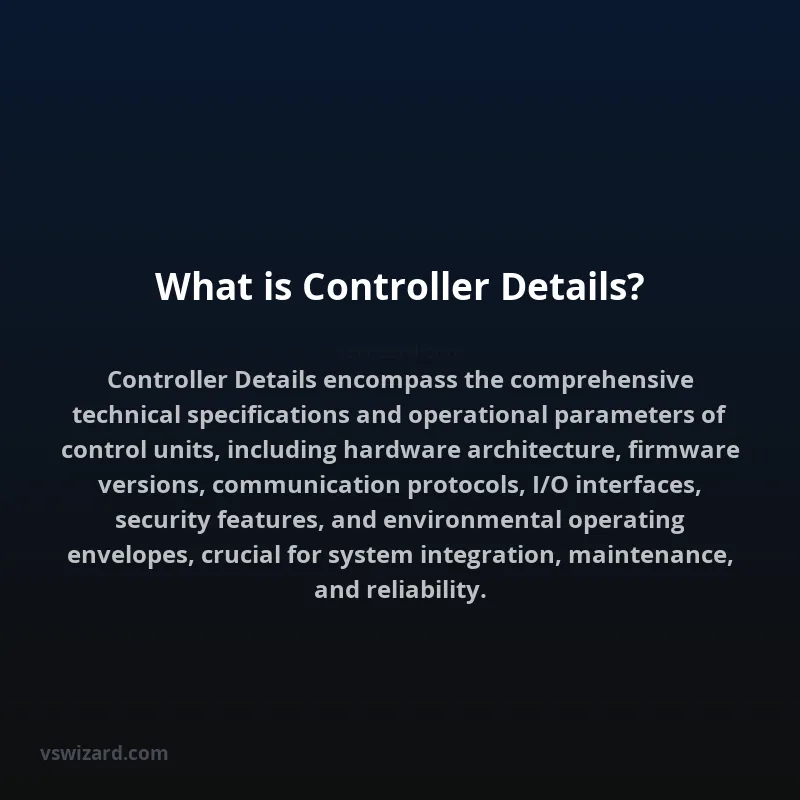
Controller Details delineate the comprehensive set of parameters, configurations, and operational characteristics inherent to any given control unit. This encompasses not merely the physical interfaces and power requirements, but extends to the intricate firmware versions, communication protocols, security credentials, diagnostic capabilities, and environmental operating envelopes. Understanding these minutiae is critical for seamless integration into larger systems, accurate performance monitoring, effective troubleshooting, and robust system maintenance. The granularity of controller details dictates the depth of interaction possible and the reliability of its function within a specified operational context, ranging from industrial automation and aerospace systems to consumer electronics and embedded IoT devices.
The specification of Controller Details serves as a foundational element in systems engineering, interfacing, and lifecycle management. It provides a standardized lexicon and framework for describing the behavior, limitations, and interaction paradigms of a control system component. This detailed information is essential for hardware compatibility checks, software driver development, interoperability assessments between disparate subsystems, and the creation of comprehensive documentation for end-users and maintenance personnel. Furthermore, it underpins safety-critical applications by ensuring that controllers operate within their validated parameters and that potential failure modes are well-understood and mitigated through proper configuration and monitoring, adhering to rigorous industry standards and regulatory requirements.
Mechanism of Action and Core Components
The operational mechanism of a controller is fundamentally dictated by its internal architecture, which typically comprises a Central Processing Unit (CPU) or microcontroller, memory (RAM and non-volatile storage for firmware/configuration), input/output (I/O) interfaces, and often specialized co-processors or Field-Programmable Gate Arrays (FPGAs) for dedicated functions. Controller details specify the type of CPU (e.g., ARM Cortex-M, x86), clock speed, cache size, and instruction set architecture (ISA). Memory details include capacity, type (e.g., DDR4, Flash), and access speeds. I/O interfaces are described by their physical connectors (e.g., USB, Ethernet, GPIO, CAN bus), electrical signaling standards (e.g., TTL, RS-232, LVDS), and data transfer rates. Firmware details encompass the version number, build date, and specific features implemented, such as real-time operating system (RTOS) support, communication stack versions (e.g., TCP/IP, MQTT, Modbus/TCP), and onboard diagnostic routines.
Input/Output Specifications
Input/Output (I/O) specifications are paramount in defining a controller's interaction with its environment and other system components. This includes the enumeration of digital and analog input/output pins, their voltage levels (e.g., 3.3V, 5V), current sinking/sourcing capabilities, and associated peripheral multiplexing (e.g., ADC, PWM, SPI, I2C). Details also cover specialized interfaces like Ethernet ports (specifying speed, duplex mode, PoE capability), serial communication ports (baud rate, data bits, parity, stop bits), USB ports (version, host/device mode), and fieldbus connections (e.g., CAN, PROFIBUS, EtherCAT). The precision of these details ensures correct wiring, impedance matching, signal integrity, and prevents electrical damage or data corruption.
Communication Protocols and Network Interfaces
Controllers engage in data exchange through various communication protocols, and their details specify supported standards. For embedded systems and IoT, these might include lightweight protocols like MQTT, CoAP, or HTTP/S over TCP/IP. Industrial automation frequently relies on fieldbus protocols such as Modbus (RTU/TCP), CANopen, PROFIBUS, or EtherCAT, each with distinct message structures, addressing schemes, and real-time capabilities. Network interface details include MAC addresses, IP address configuration methods (static, DHCP), subnet masks, gateway configurations, and support for network management protocols like SNMP. Security considerations, such as TLS/SSL support, authentication mechanisms (e.g., OAuth, certificates), and encryption algorithms, are increasingly vital controller details.
Industry Standards and Compliance
The design and operation of controllers are governed by a myriad of industry-specific standards that dictate performance, safety, reliability, and interoperability. In automotive contexts, ISO 26262 for functional safety and AUTOSAR for software architecture are crucial. Aerospace applications often adhere to DO-178C for airborne software and DO-254 for hardware design. Industrial control systems frequently follow IEC 61508 (functional safety), IEC 61131 (programmable controllers), and standards related to specific communication protocols like EtherNet/IP or PROFINET. Medical devices are subject to IEC 62304 for medical device software lifecycle processes and FDA regulations. Compliance with these standards requires meticulous documentation of controller details, including hardware component qualifications, software validation processes, and adherence to rigorous testing and certification procedures.
Environmental and Electrical Specifications
Environmental specifications define the conditions under which a controller is designed to operate reliably. This includes operating temperature range (ambient), humidity tolerance (non-condensing), vibration resistance, shock survival, and ingress protection ratings (IP codes) against dust and water. Electrical specifications detail power supply requirements (voltage, current draw, power consumption), transient voltage suppression, electromagnetic compatibility (EMC) compliance (e.g., FCC, CE, CISPR standards), and electrostatic discharge (ESD) protection levels. These parameters are essential for selecting appropriate enclosures, power management solutions, and ensuring long-term operational stability in diverse deployment scenarios.
Security Features and Access Control
Modern controllers, particularly those connected to networks, incorporate security features to protect data integrity, system availability, and intellectual property. Controller details related to security include hardware-based security modules (HSMs) or Trusted Platform Modules (TPMs) for secure key storage and cryptographic operations, secure boot mechanisms to ensure firmware integrity, and role-based access control (RBAC) for user authentication and authorization. Firmware update mechanisms, secure over-the-air (OTA) update capabilities, and intrusion detection/prevention systems are also critical security-related details. Compliance with cybersecurity standards like IEC 62443 for industrial automation or NIST guidelines is increasingly a requirement.
Applications and Use Cases
Controller details are paramount across a vast spectrum of applications. In industrial automation, Programmable Logic Controllers (PLCs) and Industrial PCs (IPCs) manage manufacturing processes, robotics, and material handling systems, requiring detailed specifications for real-time performance, I/O density, and environmental robustness. In automotive systems, Electronic Control Units (ECUs) manage engine performance, braking systems (ABS, ESC), infotainment, and advanced driver-assistance systems (ADAS), necessitating strict adherence to functional safety and communication standards like CAN FD. Consumer electronics, such as smart home devices, wearables, and appliances, rely on microcontrollers with detailed specifications for power efficiency, cost-effectiveness, and wireless connectivity (e.g., Wi-Fi, Bluetooth Low Energy). Aerospace and defense applications demand highly reliable and certifiable controllers for flight control, navigation, and mission systems, where failure is not an option.
Integration and Interoperability
Seamless integration and interoperability are direct consequences of well-defined controller details. By understanding the communication protocols, data formats, electrical signaling, and APIs exposed by a controller, system integrators can ensure compatibility with other hardware and software components. This involves matching network speeds, ensuring data type compatibility, implementing correct handshake procedures, and potentially developing custom drivers or middleware. The availability of detailed device descriptions, such as Electronic Data Sheets (EDS) for industrial networks or standardized API documentation, significantly accelerates the integration process and reduces the likelihood of costly errors or performance bottlenecks. Open standards and modular architectures, where controller details are explicitly published and adhere to conventions, foster ecosystem development and reduce vendor lock-in.
Performance Metrics and Diagnostics
Key performance metrics defined within controller details include processing throughput (e.g., MIPS, FLOPS), response latency (e.g., interrupt latency, task switching time), data transfer rates for I/O and network interfaces, and power consumption under various load conditions. Diagnostic capabilities are equally important, detailing the types of self-tests the controller can perform (e.g., Built-In Self-Test or BIST), error logging mechanisms, fault reporting formats, and available debugging interfaces (e.g., JTAG, SWD). These metrics and diagnostic features enable performance optimization, predictive maintenance, and rapid troubleshooting, ensuring the controller operates within its intended parameters and that any deviations are quickly identified and addressed.
| Specification Category | Example Parameters | Typical Units | Importance |
|---|---|---|---|
| Processing Unit | Clock Speed, Core Count, Architecture | GHz, Count, ISA | Determines computational capacity and instruction set compatibility. |
| Memory | RAM Capacity, Storage Capacity, Type | GB, GB, DDR5/NAND Flash | Influences program size, data buffering, and execution speed. |
| I/O Interfaces | Number of GPIOs, Ethernet Speed, USB Version | Count, Mbps/Gbps, 3.0/4.0 | Defines physical connectivity options and data throughput. |
| Communication Protocols | Supported Standards (e.g., MQTT, CAN, TCP/IP) | Protocol Name | Enables interoperability and data exchange with other systems. |
| Power Requirements | Input Voltage Range, Max Current Draw | VDC, A | Critical for power supply selection and system design. |
| Environmental Operating Range | Temperature, Humidity | °C, % RH (non-condensing) | Ensures reliable operation in specific deployment conditions. |
| Security Features | Secure Boot Support, Encryption Algorithms | Boolean, AES/RSA | Protects against unauthorized access and data tampering. |
Evolution and Future Trends
The evolution of controller details reflects advancements in semiconductor technology, networking capabilities, and software engineering. Early controllers were characterized by low clock speeds, limited memory, and simple I/O, primarily focused on discrete control tasks. The advent of microprocessors and microcontrollers enabled more complex logic and computation. The increasing integration of networking interfaces, from serial ports to high-speed Ethernet and wireless protocols, has transformed controllers into connected devices capable of distributed control and data aggregation. Future trends indicate a move towards more powerful, heterogeneous processing architectures (e.g., combining CPUs, GPUs, AI accelerators), enhanced security features embedded at the hardware level, increased autonomy through advanced AI/ML capabilities running at the edge, and greater interoperability driven by standardized APIs and data models. The meticulous documentation of these evolving details will remain critical for managing system complexity and ensuring reliable operation.
Alternatives and Considerations
While dedicated controllers form the backbone of many systems, alternative approaches exist, each with its own set of detailed considerations. In some applications, particularly those requiring massive parallel processing or specialized computational tasks like advanced signal processing or machine learning inference, dedicated hardware accelerators (e.g., FPGAs, ASICs, NPUs) may be employed instead of or in conjunction with traditional controllers. For simpler control loops or data acquisition tasks, Distributed Control Systems (DCS) or Supervisory Control and Data Acquisition (SCADA) systems might abstract control logic, with the 'controller' aspect being a distributed component within a larger supervisory framework. The choice of alternative depends on factors such as performance requirements, cost constraints, power budgets, development complexity, and the need for specialized functionalities. Each alternative necessitates a distinct set of detailed specifications for integration and operation.