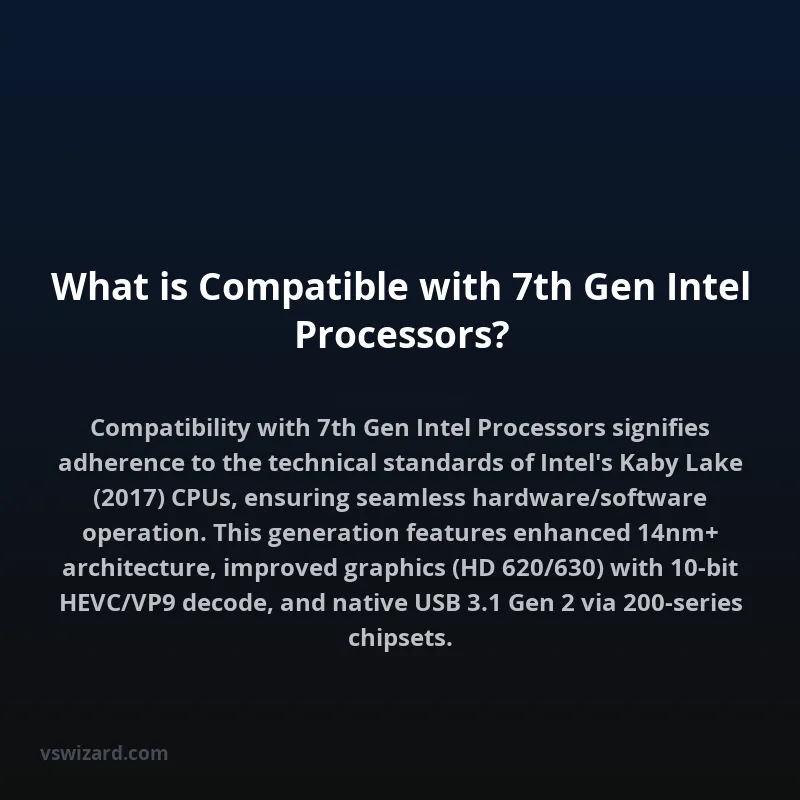
The designation "Compatible with 7th Gen Intel Processors" denotes a technical specification indicating that a particular hardware component, software application, or peripheral device has been validated or designed to function optimally with Intel's seventh generation of Core microprocessors. This generation, codenamed Kaby Lake, was launched in early 2017 and represents a refinement of the Skylake architecture, primarily focusing on improved power efficiency, integrated graphics performance, and support for modern display standards such as 4K resolution and High Dynamic Range (HDR) content. Compatibility implies that the product adheres to the technical interfaces, power delivery standards, and instruction set extensions supported by these CPUs, ensuring seamless integration and preventing potential operational anomalies or performance degradation.
Ensuring compatibility with 7th Gen Intel Processors involves adherence to specific platform requirements, including the LGA 1151 socket, the Intel 200-series chipset (or select 100-series chipsets with BIOS updates), and DDR4 memory support. For hardware components, this might involve USB 3.1 Gen 2 support, NVMe SSD interfaces, and specific power consumption envelopes. For software, compatibility ensures that the application can leverage the CPU's instruction sets (e.g., AVX2, SSE4.2) and execute without encountering architectural incompatibilities or requiring emulation layers. This designation serves as a critical assurance for consumers and IT professionals, simplifying system building and troubleshooting by confirming interoperability with a widely adopted processor family.
Architecture and Technical Specifications of 7th Gen Intel Processors
Microarchitecture (Kaby Lake)
The 7th Generation Intel Core processors, codenamed Kaby Lake, are manufactured on an enhanced 14nm+ process node. This iterative refinement over the previous 14nm Skylake architecture provides increased transistor density and improved thermal characteristics, enabling higher clock speeds and greater power efficiency. Key architectural improvements include:
- Clock Speed Enhancements: Higher base and boost clock frequencies due to improved transistor performance.
- Power Efficiency: Optimized power management features for extended battery life in mobile devices and reduced energy consumption in desktops.
- Integrated Graphics (Intel HD Graphics 620/630): Enhanced graphics processing units supporting HEVC (H.265) 10-bit decoding and VP9 decoding for improved video playback and streaming capabilities. Support for up to three independent displays.
- Platform Controller Hub (PCH): Primarily the Intel 200-series chipsets (e.g., Z270, H270, B250), which offer native support for Intel Optane Memory and USB 3.1 Gen 2. Older 100-series chipsets (e.g., Z170, H170, B150) may require a BIOS update to support Kaby Lake processors.
Socket and Memory Support
These processors utilize the LGA 1151 socket, a physical interface for connecting the CPU to the motherboard. They are designed to work with DDR4 memory, supporting speeds typically up to 2400 MHz natively, with higher frequencies achievable through overclocking on compatible chipsets (e.g., Z270). Dual-channel memory configurations are standard for optimal bandwidth.
Key Technologies and Instruction Sets
7th Gen processors support a range of advanced instruction set extensions crucial for performance in modern applications:
- AVX2 (Advanced Vector Extensions 2): For accelerating complex mathematical and scientific computations.
- SSE4.2 (Streaming SIMD Extensions 4.2): Enhances string and text processing, as well as general-purpose computation.
- Intel Turbo Boost Technology 2.0: Dynamically increases processor clock speed when demanding tasks are detected, within thermal and power limits.
- Intel Hyper-Threading Technology: Allows each processor core to handle multiple threads simultaneously, improving multitasking performance.
Compatibility Considerations for Peripherals and Software
Hardware Interoperability
Hardware components that are "Compatible with 7th Gen Intel Processors" typically leverage the I/O capabilities provided by the Kaby Lake platform and its associated chipsets. This includes:
- USB Standards: Native support for USB 3.1 Gen 2 (10 Gbps) on 200-series chipsets, and backward compatibility with USB 3.0/2.0.
- Storage Interfaces: Support for SATA 6 Gbps and NVMe M.2 SSDs, often accelerated by Intel Optane Memory technology on compatible motherboards.
- Display Outputs: Integration with Intel HD Graphics 620/630, enabling multiple high-resolution displays via DisplayPort, HDMI, and DVI interfaces.
- PCIe Lanes: Direct PCIe 3.0 lanes from the CPU for high-speed peripherals like graphics cards, alongside additional lanes provided by the chipset for expansion cards and storage devices.
Software and Driver Requirements
Software compatibility ensures that applications can run efficiently and without errors. This often implies that the software:
- Is optimized to utilize the Kaby Lake architecture's capabilities.
- Does not rely on deprecated instruction sets or features absent in 7th Gen processors.
- Requires drivers that are specifically designed for or validated with Windows 10 (the primary operating system for this generation) and the associated Intel chipset drivers.
Manufacturers of peripherals and software vendors perform rigorous testing to ascertain and declare compatibility, providing users with confidence in system stability and performance.
Performance Metrics and Benchmarking
Performance is evaluated through synthetic benchmarks and real-world application tests. Key metrics include CPU clock speeds, core counts, cache sizes, and integrated graphics performance. For 7th Gen processors, comparisons are often made against their predecessors (6th Gen Skylake) and successors (8th Gen Coffee Lake).
Comparison Table: 7th Gen vs. 6th Gen Intel Processors
| Feature | 6th Gen Intel Core (Skylake) | 7th Gen Intel Core (Kaby Lake) |
|---|---|---|
| Manufacturing Process | 14nm | 14nm+ |
| Base Clock Speeds | Slightly Lower | Slightly Higher |
| Turbo Boost Frequencies | Slightly Lower | Slightly Higher |
| Integrated Graphics | Intel HD Graphics 520/530 | Intel HD Graphics 620/630 |
| Video Decode Support | H.264, HEVC (8-bit) | H.264, HEVC (10-bit), VP9 |
| Chipset Support | 100-series | 200-series (native), 100-series (BIOS update) |
| USB 3.1 Gen 2 | Via Add-on Controller | Native on 200-series Chipsets |
| Intel Optane Memory | No | Yes (on 200-series Chipsets) |
| Power Efficiency | Good | Improved |
Applications and Use Cases
The 7th Gen Intel processors, and by extension, components compatible with them, are suitable for a wide range of applications:
- General Computing: Everyday tasks like web browsing, document editing, and email.
- Multimedia Consumption: High-definition video playback (including 4K HDR content), streaming, and audio processing.
- Productivity: Office applications, light photo editing, and basic video editing.
- Gaming: Entry-level to mid-range gaming, especially when paired with a discrete graphics card. The integrated graphics are capable of running less demanding titles.
- Business Workstations: Suitable for standard office environments and business applications.
Evolution and Future Outlook
The 7th Gen Intel processors represented a significant evolutionary step in mobile and desktop computing, particularly in power efficiency and multimedia capabilities. While newer generations have since surpassed Kaby Lake in raw performance and feature sets, the ecosystem built around 7th Gen compatibility remains relevant for certain market segments, especially in the refurbished or budget PC market. Understanding this compatibility is crucial for maintaining and upgrading existing systems or when selecting components for new builds where specific legacy support or cost-effectiveness is a priority.