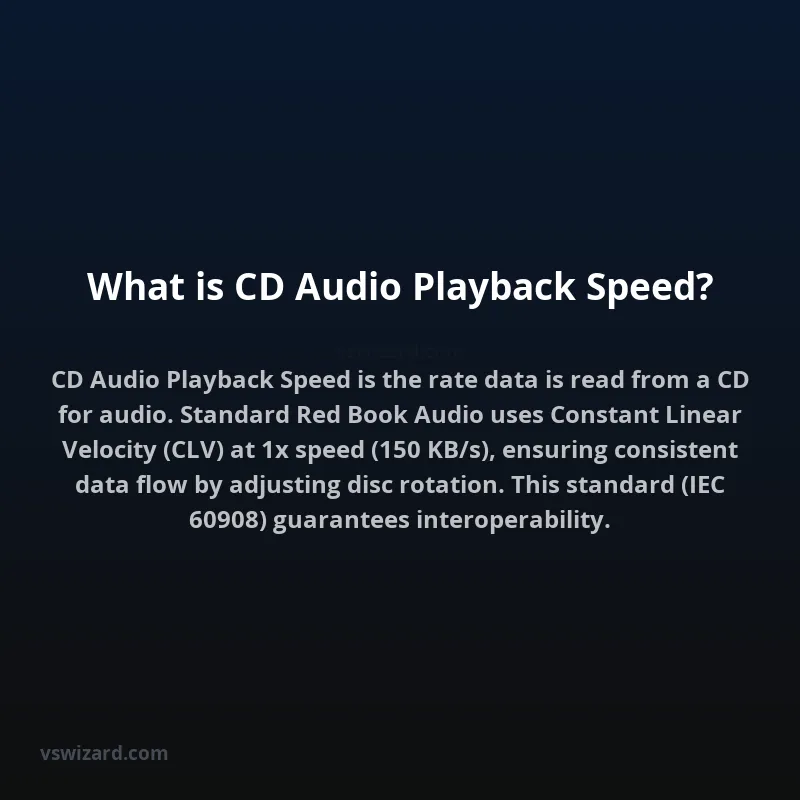
CD Audio Playback Speed fundamentally refers to the rate at which data from a Compact Disc (CD) is read and converted into an analog audio signal for reproduction. This speed is intrinsically linked to the disc's rotational velocity and the data density encoded on its surface. The standard, known as Red Book Audio, dictates a constant linear velocity (CLV) playback, where the disc spins faster when the playback head is near the outer edge and slower near the inner edge to maintain a consistent data transfer rate. This approach ensures that the audio stream is uninterrupted and accurately rendered, preserving the fidelity of the recorded sound information.
The nominal playback speed for CD audio is defined as 1x, which corresponds to a data transfer rate of 150 kilobytes per second (KB/s) or 1.411 megabits per second (Mb/s). This rate is derived from the sampling frequency (44.1 kHz), bit depth (16 bits per sample), and the number of audio channels (stereo, i.e., two channels) used in the digital audio encoding process. Specifically, (44,100 samples/sec/channel) * (16 bits/sample) * (2 channels) = 1,411,200 bits/sec, which, when converted to bytes and accounting for overhead, approximates the 150 KB/s rate required for error correction and framing. Deviations from this precise speed can lead to audible artifacts such as pitch distortion or temporal inaccuracies.
Mechanism of Action
CD audio playback relies on a laser pickup system that reads data from the reflective surface of the CD. The disc rotates, and the laser beam, typically a semiconductor laser operating at a wavelength of 780 nanometers (nm), is focused onto the track. Variations in reflectivity caused by microscopic pits and lands on the disc surface modulate the reflected laser light. A photodiode detector converts these light intensity changes into an electrical signal. This raw data stream is then processed through demodulation, error detection and correction (using algorithms like CIRC - Cross-Interleaved Reed-Solomon Code), digital-to-analog conversion (DAC), and finally, analog filtering and amplification to produce the audible sound.
The speed at which the disc rotates is controlled by a sophisticated servo system. For CLV, the servo adjusts the motor speed in real-time based on the radial position of the laser pickup. As the laser moves from the inner radius (around 23mm) to the outer radius (around 58mm), the rotational speed decreases from approximately 500 revolutions per minute (RPM) to 200 RPM. This ensures that the linear speed of the data tracks passing under the laser remains constant at approximately 1.2 to 1.4 meters per second (m/s), hence the 150 KB/s data rate.
Industry Standards
The foundational standard for CD audio playback speed is defined within the High Sierra Group (HSG) format, later refined and formally adopted by the International Organization for Standardization (ISO) as ISO 9660 for data CDs, and critically, by the International Electrotechnical Commission (IEC) as IEC 60908 for audio CDs (Red Book standard). The Red Book standard specifically mandates the aforementioned 44.1 kHz sampling rate, 16-bit quantization, stereo channels, and the 150 KB/s data transfer rate. This universal specification ensured interoperability across all CD players manufactured worldwide, regardless of the brand.
Data Transfer Rate Specifications
| Parameter | Value | Unit |
| Nominal Data Rate (1x) | 150 | KB/s |
| Nominal Data Rate (1x) | 1.4112 | Mb/s |
| Sampling Frequency | 44,100 | Hz |
| Quantization Depth | 16 | Bits per sample |
| Number of Channels | 2 | (Stereo) |
| Minimum Rotational Speed (Outer Track) | 200 | RPM |
| Maximum Rotational Speed (Inner Track) | 500 | RPM |
| Linear Velocity | 1.2 - 1.4 | m/s |
Evolution and Variations
While the 1x speed (150 KB/s) is the de facto standard for Red Book audio, the underlying CD-ROM technology evolved to support higher data transfer rates, often referred to as 2x, 4x, 8x, etc. These higher speeds are primarily relevant for CD-ROMs intended for data storage, not for standard audio playback. For instance, a 2x CD-ROM drive reads data at approximately 300 KB/s. While some specialized professional audio applications might involve manipulating playback speeds for effects or analysis, standard consumer audio playback is locked to the 1x rate to maintain audio integrity as defined by the original standards.
Data CD Speeds vs. Audio CD Speeds
- Audio CDs (Red Book): Strictly adhere to 1x speed (150 KB/s).
- Data CDs (CD-ROM): Support multiple speeds (2x, 4x, 8x, 24x, 52x, etc.) for faster data retrieval. A drive rated at '52x' can read data at approximately 52 * 150 KB/s = 7800 KB/s or 7.8 MB/s.
Practical Implementation and Performance Metrics
In practical terms, the playback speed is managed by the CD drive's firmware and servo control system. The drive identifies the disc type (audio, data, mixed-mode) and operates accordingly. For audio playback, the system targets the precise 150 KB/s data stream. Performance can be gauged by the accuracy of this data rate. Excessive jitter (timing variations) in the recovered data stream, caused by mechanical instability, contamination on the disc surface, or imperfections in the drive's optical or servo systems, can lead to audible noise, clicks, or pops, even if the average playback speed is maintained.
Measurement of playback accuracy involves analyzing the extracted digital audio stream for timing deviations. Tools used in professional audio mastering and quality assurance can measure Absolute Bit Reproducibility and assess the Error Rate (e.g., $C_2$ error rate, Block Error Rate - BLER). A pristine audio CD playback should exhibit near-zero error rates and minimal jitter, indicating that the playback speed is consistent and the data is being read reliably at the standard 150 KB/s.
Limitations and Considerations
The CLV system, while effective for maintaining a constant data rate, necessitates rapid changes in motor speed, leading to increased mechanical complexity and potential for servo lag or instability, especially during rapid track seeking. Furthermore, the physical limitations of the disc material and the laser pickup system define the ultimate attainable data densities and playback speeds. Exceeding the physical capabilities of the disc or the drive can result in data read errors.
Future Outlook
While CD audio playback speed remains a fixed standard for the format, the underlying technologies that read and process digital audio have advanced significantly. Modern digital audio playback, prevalent in streaming services and solid-state media, utilizes much higher inherent data rates and sophisticated error concealment techniques, often operating at variable speeds optimized for network conditions or storage efficiency. However, the enduring legacy of CD audio playback speed lies in its role as the foundational digital audio standard that enabled widespread adoption of digital music and set performance benchmarks for high-fidelity audio reproduction.