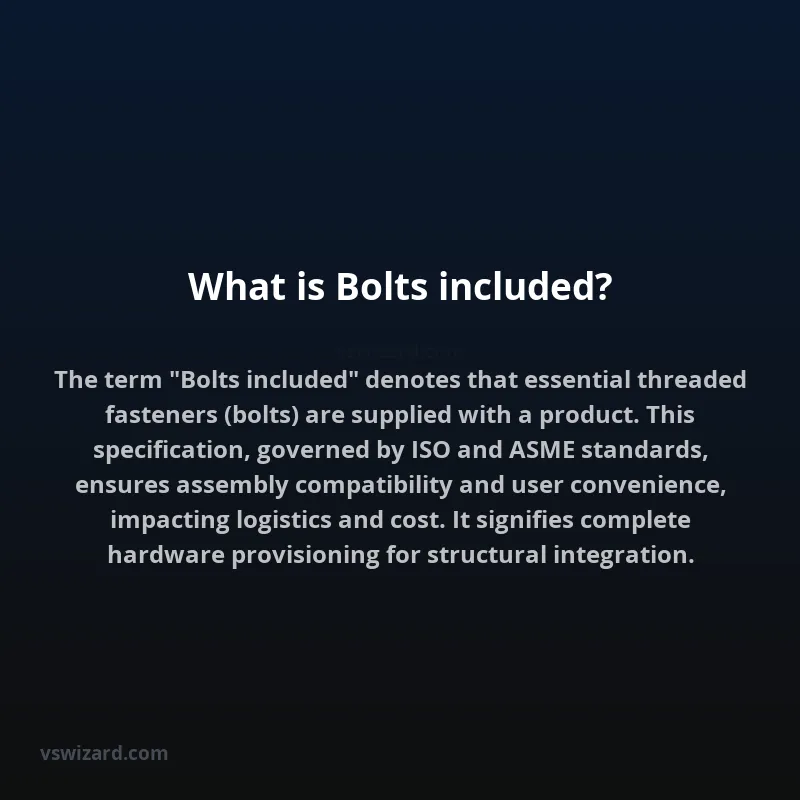
The term "Bolts included" signifies a direct declaration within product packaging or technical specifications that fastening elements, specifically bolts, are provided as part of the delivered unit. This designation is crucial for assembly-intensive products, ensuring that end-users or installers possess the requisite hardware for structural integration without necessitating a separate procurement phase for these critical components. The specificity of "bolts" implies a particular type of threaded fastener, typically characterized by a head and a cylindrical shaft with external threading, designed for use with a nut or directly into a tapped hole. The inclusion of these fasteners directly impacts the logistical planning, time-to-assembly, and overall cost-effectiveness of a product's deployment.
In the context of technical specifications and packaging content, the explicit inclusion of bolts serves as a verifiable metric against bill of materials (BOM) and assembly instructions. It preempts potential delays and errors stemming from missing hardware, which can range from simple structural bolts (e.g., hex head bolts per ISO 4014/4017, carriage bolts per ISO 8677) to specialized types such as machine bolts or lag bolts, depending on the application. The exact type, material, grade, diameter, and length of the included bolts are invariably detailed in accompanying documentation to ensure correct application and structural integrity. This practice is foundational to standardized manufacturing and assembly processes across diverse industrial sectors, from consumer electronics to heavy machinery.
Mechanism of Action and Engineering Principles
Bolts function as mechanical fasteners that, when used with a nut or in a pre-tapped hole, create a clamped joint. The mechanism relies on the principle of tension generated by the rotation of the bolt or nut. As the bolt is tightened, its threads engage with the corresponding threads of the nut or mating component, creating a force that pulls the joined parts together. This tensile force, known as preload, is critical for maintaining joint integrity under various operational loads, including shear, tension, and vibration. The effectiveness of a bolted joint is governed by several engineering principles:
- Friction: The friction between the bolt threads and the nut/hole threads, as well as between the bearing surfaces of the bolt head/nut and the joined components, resists loosening.
- Tensile Stress: The applied torque during tightening induces tensile stress in the bolt shank, which must remain below the material's yield strength to prevent permanent deformation.
- Clamping Force: The resulting axial tension in the bolt creates a clamping force that holds the assembled parts together.
- Material Properties: The strength, hardness, and corrosion resistance of the bolt material (e.g., steel alloys like Grade 8.8, 10.9, or stainless steel grades 304, 316) dictate the maximum clamping force and service environment suitability.
The inclusion of bolts as part of a product package necessitates adherence to strict dimensional tolerances and material standards to ensure predictable performance and safety. Manufacturers often specify a particular grade of bolt and its corresponding torque specifications to achieve the desired clamping force without over-stressing the fastener or the joined components.
Industry Standards and Specifications
The provision of included bolts is governed by a range of international and national standards that dictate their design, manufacturing, material properties, and testing. These standards ensure interchangeability, performance consistency, and safety across different manufacturers and applications.
Key Standards Bodies and Their Relevance
- ISO (International Organization for Standardization): Publishes standards such as ISO 4014/4017 for hexagonal head bolts, ISO 8677 for carriage bolts, and ISO 898 for mechanical properties of fasteners made of carbon steel and alloy steel.
- ASME (American Society of Mechanical Engineers): Develops standards like ASME B18.2.1 for square and hex bolts and screws, and ASME B18.5 for round head bolts.
- DIN (Deutsches Institut für Normung): Historically significant, many DIN standards (e.g., DIN 933 for hexagonal head bolts) have been harmonized with ISO standards.
The specific standards referenced for included bolts directly inform their geometrical dimensions (e.g., thread pitch, head size), material composition, mechanical strength grades (e.g., Class 4.6, 8.8, A2-70), and surface treatments (e.g., zinc plating, passivation).
Verification and Quality Control
Manufacturers implement rigorous quality control measures to verify that the included bolts meet the specified standards. This typically involves:
- Dimensional inspection (caliper, micrometer, go/no-go gauges).
- Material analysis (spectrometry).
- Mechanical testing (tensile strength, proof load, hardness testing).
- Coating thickness measurement.
The "Bolts included" designation implies that these verification processes have been completed, and the hardware is certified for its intended use.
| Bolt Type | Standard Example | Material Grade Example | Key Characteristic |
|---|---|---|---|
| Hex Head Bolt | ISO 4017 | Grade 8.8 | High tensile strength for structural applications |
| Carriage Bolt | ISO 8677 | Class 4.8 | Smooth, domed head with square neck for anti-rotation |
| Machine Bolt | ASME B18.2.1 | Grade 2 | General purpose fastener for use with a nut |
| Stainless Steel Bolt | ISO 3506 | A2-70 (304 equivalent) | Corrosion resistance for exposed environments |
Applications and Implications
The practice of including bolts is ubiquitous across numerous industries where assembly is a requisite step in product realization. Its implications are far-reaching, impacting project timelines, cost structures, and the user experience.
Sector-Specific Examples
- Furniture Manufacturing: Flat-pack furniture relies heavily on included bolts, nuts, and specialized tools for assembly by the end-consumer.
- Construction and Infrastructure: Structural steel components, pre-fabricated modules, and mounting hardware for fixtures invariably come with specified bolts.
- Automotive Industry: While often pre-assembled on production lines, repair kits and aftermarket parts frequently include necessary fasteners.
- Aerospace: Highly specialized, certified bolts are critical components and are meticulously documented and included in assembly kits for aircraft manufacturing and maintenance.
- Electronics: Enclosures, mounting brackets for servers, and consumer electronics often contain small, precise bolts.
Logistical and Economic Considerations
The decision to include bolts affects inventory management, packaging design, and supply chain logistics. Manufacturers must balance the cost of procuring and packaging hardware against the potential for increased sales and customer satisfaction due to ease of assembly. Conversely, the exclusion of bolts might be a strategy to reduce packaging weight and cost, or to allow users to select specialized fasteners (e.g., tamper-proof bolts, high-security bolts) suited to their specific environmental or security needs. The clarity of the "Bolts included" designation mitigates ambiguity and ensures that the product is ready for its intended assembly upon arrival.
Pros and Cons of Inclusion
Advantages
- Enhanced User Experience: Simplifies assembly for the end-user, reducing frustration and potential errors.
- Time and Cost Savings: Eliminates the need for the customer to source compatible fasteners, saving time and preventing mispurchases.
- Guaranteed Compatibility: Ensures that the provided bolts are dimensionally and materially appropriate for the assembly, maintaining structural integrity.
- Streamlined Logistics: Integrates hardware into the primary product packaging, simplifying kitting and distribution.
Disadvantages
- Increased Packaging Costs: Additional components add to the weight and volume of packaging, increasing material and shipping expenses.
- Inventory Management Complexity: Requires accurate tracking of fastener stock alongside the main product.
- Potential for Over-Specification: Standard included hardware might not meet niche requirements for extreme environments or security needs.
- Waste Generation: If the user already possesses suitable fasteners or upgrades them, the included ones may become redundant waste.
Alternatives and Complementary Systems
While the inclusion of standard bolts is common, alternative fastening methods and systems exist, often employed for specific advantages in assembly speed, durability, or security.
- Tool-less Assembly: Designs incorporating snap-fits, latches, or click mechanisms that require no separate fasteners.
- Rivets: Permanent fasteners installed by deforming the rivet shank, offering high shear strength.
- Adhesives: Structural bonding agents used to join components, providing a seamless and often aesthetically pleasing finish.
- Welding: Fusion of materials, typically metals, to create a permanent joint.
- Specialized Fasteners: Tamper-resistant screws, self-tapping screws, and blind rivets offer enhanced security or installation flexibility.
In many complex assemblies, a combination of these methods, including standard bolts, is utilized to optimize performance, cost, and assembly efficiency. The "Bolts included" specification typically refers to the primary structural or assembly fasteners required for initial setup.
Conclusion
The designation "Bolts included" is a precise technical specification denoting the complete provisioning of essential threaded fasteners within a product's packaging. This practice is integral to modern manufacturing and distribution, directly impacting assembly efficiency, cost, and end-user experience. Adherence to international standards (ISO, ASME) for the bolts themselves ensures their mechanical properties and dimensional compatibility. While offering significant advantages in convenience and guaranteed fit, manufacturers must balance this with the logistical costs and the potential need for specialized alternative fastening solutions in certain applications. The ongoing evolution of assembly technologies continues to influence the prevalence and type of fasteners supplied, but the fundamental principle of ensuring all necessary hardware is present remains a critical aspect of product readiness.