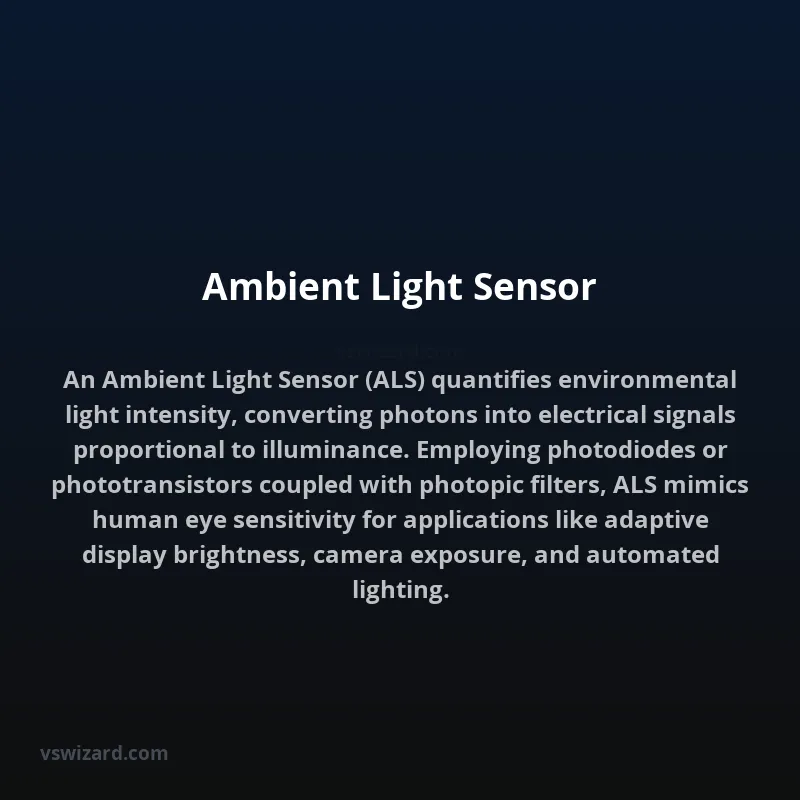
An ambient light sensor (ALS) is a photoelectric transducer designed to quantify the intensity of light within its immediate environment. Functionally, it converts luminous flux, measured in lumens, into an electrical signal, typically voltage or current, which can then be interpreted by a processing unit. This conversion is predicated on the principles of the photoelectric effect, where photons striking a photosensitive material (such as a photodiode or phototransistor) excite electrons, thereby generating a measurable electrical output proportional to the incident photon flux. The spectral response of an ALS is a critical design parameter, aiming to mimic the human eye's sensitivity to different wavelengths of visible light, ensuring that the measured illuminance accurately reflects perceived brightness. Advanced ALS units incorporate filters and specific semiconductor materials to achieve a more precise color temperature sensitivity and photopic curve matching, thereby enhancing their utility in applications demanding accurate color rendering or adaptive display adjustments.
The primary objective of an ambient light sensor is to enable automated system responses to varying illumination conditions, optimizing user experience, power consumption, and device performance. By continuously monitoring the surrounding light levels, an ALS facilitates dynamic adjustments to display backlighting, camera exposure settings, and color temperature correction in electronic devices. For instance, in smartphones and laptops, an ALS reduces screen brightness in dim environments to conserve battery life and prevent eye strain, while increasing it in bright conditions for legibility. In industrial settings, ALS units can be employed for automated lighting control, ensuring consistent illumination levels for manufacturing processes or security surveillance, and in automotive applications, they manage dashboard illumination and headlight activation based on external light conditions. The sensitivity range, accuracy, response time, and spectral fidelity are key performance indicators that dictate the suitability of an ALS for specific applications.
Mechanism of Action and Physics
Photodiodes and Phototransistors
The fundamental operation of most ambient light sensors relies on semiconductor-based photodetectors, primarily photodiodes and phototransistors. A photodiode is a p-n junction or p-i-n diode that converts light into an electrical current or voltage. When photons with energy greater than the semiconductor's bandgap energy strike the depletion region, they generate electron-hole pairs. These charge carriers are then swept across the junction by the built-in electric field, creating a photocurrent proportional to the incident light intensity. The spectral response is determined by the semiconductor material's bandgap; silicon is commonly used for visible light detection due to its appropriate bandgap (approximately 1.1 eV), which allows it to absorb photons in the visible spectrum. Germanium photodiodes have a lower bandgap and are sensitive to infrared light.
A phototransistor is essentially a bipolar junction transistor (BJT) where the base current is controlled by light instead of an electrical signal. Light striking the base-region generates the photocurrent, which is then amplified by the transistor's current gain (beta, β). This amplification results in a larger output current compared to a photodiode, offering higher sensitivity but typically with a slower response time and less linearity. The base terminal can be brought out for external control, allowing for more sophisticated circuit designs, but in many ALS applications, the phototransistor functions as a two-terminal device where light directly controls the collector-current.
Irradiance and Illuminance Conversion
Ambient light sensors are designed to measure illuminance, which is the luminous flux incident on a unit area, expressed in lux (lx). However, the raw output of a photodetector is typically proportional to irradiance, which is the radiant flux incident on a unit area, expressed in watts per square meter (W/m²). To accurately measure illuminance, an ALS must incorporate a photopic filter. This filter is spectrally shaped to attenuate wavelengths that the human eye is less sensitive to and pass wavelengths that it is more sensitive to, closely matching the CIE (International Commission on Illumination) photopic luminous efficacy function (V(λ)). Without proper photopic correction, the sensor's output would not correlate with perceived brightness. The transfer function of an ALS generally follows a power law or logarithmic relationship between illuminance and its output signal, requiring calibration and linearization in the associated circuitry.
Industry Standards and Characterization
CIE Standards
The International Commission on Illumination (CIE) provides foundational standards for photometry and colorimetry, which are essential for understanding and specifying ambient light sensor performance. The CIE 1931 standard observer function, and its scotopic counterpart for low-light vision, define the average spectral sensitivity of the human eye to light. Ambient light sensors designed for accurate brightness perception must approximate this photopic curve. Deviation from the photopic curve can lead to inaccurate brightness adjustments, especially under different light sources with varying spectral power distributions (e.g., incandescent, fluorescent, LED, or daylight).
Performance Metrics
Key performance metrics for ambient light sensors include:
- Sensitivity: The ratio of electrical output (e.g., current, voltage) to incident illuminance (lux). Higher sensitivity allows detection of lower light levels.
- Dynamic Range: The span of light intensities the sensor can accurately measure, typically expressed in lux (e.g., 0.1 lx to 100,000 lx).
- Response Time: The time it takes for the sensor's output to reach a stable value after a change in light intensity (rise time and fall time).
- Accuracy and Linearity: How closely the sensor's output tracks the true illuminance and the linearity of this relationship.
- Spectral Response: How well the sensor's sensitivity matches the human eye's photopic luminous efficacy function (V(λ)).
- Temperature Drift: The change in sensor output due to variations in ambient temperature.
- Field of View (FOV): The angular extent over which the sensor can detect light.
Applications
Consumer Electronics
Ambient light sensors are ubiquitous in modern consumer electronics. In smartphones, tablets, and laptops, they are crucial for automatic display brightness control, optimizing viewing comfort and power efficiency. They also enable features like adaptive color temperature adjustment (e.g., Apple's True Tone or Google's Night Light) to reduce blue light emission in the evening. In digital cameras, ALS can assist in determining optimal exposure settings and white balance. Smartwatches and fitness trackers use them to adjust screen visibility in various lighting conditions.
Automotive Systems
Within vehicles, ALS plays a vital role in enhancing driver safety and comfort. They automatically control the brightness of instrument clusters, infotainment displays, and dashboard lighting. Furthermore, ALS data is often used in conjunction with rain sensors and other inputs to automate headlight activation, ensuring proper illumination of the road ahead while preventing glare for oncoming drivers.
Smart Lighting and Building Automation
In smart home systems and commercial building management, ALS units contribute to energy savings and improved lighting quality. By measuring natural daylight levels, these sensors can dynamically dim or switch off artificial lighting, reducing electricity consumption. They facilitate adaptive lighting scenarios that maintain consistent illuminance levels across a space, irrespective of fluctuating external light, thereby enhancing productivity and user comfort.
Industrial and Scientific Use
ALS finds applications in industrial automation for process monitoring and quality control, ensuring consistent lighting conditions for visual inspection tasks. In scientific research, calibrated ALS units can be used in experiments requiring precise light level measurements, though they are often superseded by more specialized lux meters for high-precision metrology.
Architecture and Implementation
Integrated Circuits (ICs)
Modern ambient light sensors are predominantly implemented as integrated circuits (ICs) that combine the photosensitive element, signal conditioning circuitry (amplifiers, filters), analog-to-digital converters (ADCs), and communication interfaces (e.g., I²C, SMBus) onto a single chip. This integration offers significant advantages in terms of size, cost, power consumption, and performance. The photodetector itself is often a photodiode fabricated on the same silicon substrate as the control and readout electronics. The I²C interface allows for easy communication with microcontrollers or system-on-chips (SoCs) in host devices.
Standalone Modules
For certain applications or prototyping, standalone ALS modules are available. These typically consist of a sensor element, basic signal conditioning, and a microcontroller programmed to output a calibrated analog voltage or digital value corresponding to illuminance. These modules are often used in hobbyist projects or as replacements for existing systems where a full IC integration is not feasible.
Calibration and Compensation
Accurate operation of an ALS requires careful calibration. Factory calibration establishes the relationship between the sensor's raw output and standard illuminance units (lux). Compensation algorithms are often implemented in the host device's firmware to correct for non-linearity, temperature drift, and variations in spectral response under different light sources. Some advanced ALS ICs include built-in digital processing to provide linearized, calibrated illuminance readings directly over a digital interface, simplifying the host system's design.
Technical Specifications Table
| Parameter | Typical Value Range | Unit | Notes |
| Sensor Type | Silicon Photodiode / Phototransistor | N/A | Commonly integrated with photopic filter |
| Input Light Range | 0.01 - 100,000 | lux | Varies significantly by model |
| Output Interface | Analog Voltage, I²C, SMBus | N/A | I²C is common for digital integration |
| Supply Voltage | 1.8 - 3.3 | V DC | Low power consumption is typical |
| Operating Temperature | -40 to +85 | °C | Can affect accuracy |
| Response Time | 5 - 100 | ms | Rise/fall time |
| Spectral Matching | CIE Photopic Curve (V(λ)) | N/A | Accuracy of matching is critical |
| Sensitivity | 0.001 - 0.5 | LSB/lux or V/lux | Dependent on gain and architecture |
| Accuracy | ±5% to ±15% | % | Relative to calibrated standard |
| Field of View | ~ ±50 to ±180 | degrees | Directional vs. omnidirectional |
Evolution and Future Trends
The evolution of ambient light sensors has been driven by the demand for more sophisticated user interfaces, enhanced power management, and miniaturization in electronic devices. Early ALS implementations were often discrete components with limited accuracy and dynamic range. The advent of integrated circuit technology has led to highly compact, low-power, and accurate ALS solutions. Future trends include further improvements in spectral accuracy to better mimic human perception under diverse lighting conditions, enhanced robustness against interference, and integration with other sensing modalities (e.g., proximity sensors, color sensors) into single, multi-functional modules. Research is also ongoing into novel sensing materials and architectures that could offer improved performance or enable new functionalities.
Challenges and Limitations
Despite their widespread adoption, ambient light sensors face several challenges. Achieving precise photopic matching across a wide range of light sources and temperatures remains difficult, as spectral power distributions of common light sources vary. Reflections and glare from surfaces near the sensor can also lead to erroneous readings. The physical placement of the sensor is critical; for instance, a sensor placed behind a tinted display might not accurately reflect external light conditions. Furthermore, the accuracy of ALS measurements is inherently limited by manufacturing tolerances and the quality of the photopic filter. For highly precise photometric measurements, specialized laboratory-grade lux meters are still required.