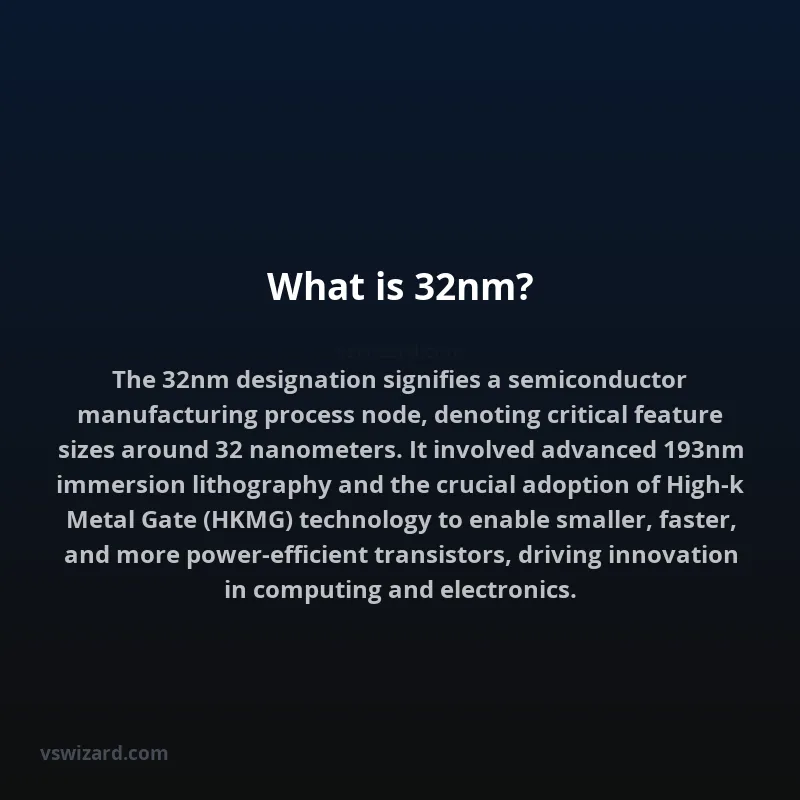
The '32nm' designation refers to a semiconductor fabrication process node, specifically indicating the nominal feature size, often related to the gate length of a transistor, achieved during the photolithography process. This metric is a key indicator of transistor density and performance improvements in integrated circuits (ICs). The 32nm node represented a significant advancement in shrinking transistor dimensions, enabling more complex and power-efficient chips compared to previous generations like 45nm and 65nm. It was a crucial step in the ongoing miniaturization trend governed by Moore's Law, allowing for higher transistor counts within a given silicon die area, which translates to enhanced computational power and reduced energy consumption per operation. The development and implementation of 32nm processes involved sophisticated advancements in lithography techniques, materials science, and device physics to overcome the physical limitations associated with shrinking feature sizes.
Implementing the 32nm process node required a transition to more advanced lithographic methods, often involving immersion lithography, which uses a liquid medium between the final lens element and the wafer to increase the numerical aperture (NA) of the optical system. This enhancement allows for finer resolution and improved critical dimension (CD) control. Furthermore, the 32nm node saw the widespread adoption of high-k dielectric materials and metal gate electrodes (HKMG) to mitigate gate leakage currents that become problematic at such small dimensions. The transition to HKMG materials, such as hafnium-based oxides for the dielectric and various metal alloys for the gate, was essential for maintaining transistor performance and power integrity. This technological leap enabled the production of processors, graphics chips, and other complex ICs with increased performance-per-watt, paving the way for more sophisticated mobile devices, servers, and computing platforms.
Process Technology and Lithography
The 32nm node specifically refers to a manufacturing process for creating integrated circuits where the critical dimensions of transistors, particularly the gate length, are approximately 32 nanometers. Achieving this level of miniaturization is contingent upon advanced photolithography techniques. At this scale, traditional deep ultraviolet (DUV) lithography becomes challenging. Therefore, 32nm processes typically employed 193nm immersion lithography, a technique that uses ultraviolet light at a wavelength of 193nm and immerses the final optical element in a liquid (usually ultrapure water) to increase the effective NA and consequently, the resolution.
Key Lithographic Techniques
- 193nm Immersion Lithography: The cornerstone of 32nm manufacturing, this method significantly improved the resolution capabilities of 193nm DUV scanners.
- Multi-Patterning: Due to the limitations of optical lithography in defining features smaller than roughly half the wavelength of light used (even with immersion), techniques like Double Patterning (DP) or even Triple Patterning (TP) became essential. These methods involve multiple exposures and etching steps to define dense features.
- Advanced Photoresists: Specialized photoresist materials with enhanced sensitivity and resolution characteristics were developed to accurately pattern the wafer at 32nm.
Transistor Architecture and Materials
At the 32nm node, transistor structures evolved to incorporate technologies that counter leakage currents and improve switching speeds, which become more pronounced with reduced dimensions. The most significant advancement was the widespread adoption of High-k Metal Gate (HKMG) technology.
High-k Metal Gate (HKMG)
Traditionally, transistors used silicon dioxide (SiO2) as the gate dielectric and polysilicon as the gate electrode. As gate lengths shrunk, the SiO2 layer had to be made thinner to maintain gate control, leading to excessive quantum mechanical tunneling (leakage current). The 32nm node saw the industry-wide transition to:
- High-k Dielectrics: Materials with a higher dielectric constant (k value) than SiO2, such as hafnium-based oxides (e.g., HfO2, HfSiO), allowed for a physically thicker layer while achieving the same or better capacitance. This drastically reduced gate leakage current.
- Metal Gate Electrodes: Replacing polysilicon gates with metal gates (e.g., TaN, TiN, W) was necessary to prevent Fermi-level pinning effects and to integrate effectively with the high-k dielectrics, ensuring optimal work functions for both NMOS and PMOS transistors.
Strain Engineering
To further boost transistor performance, 32nm processes also incorporated advanced strain engineering techniques:
- Stress Memorization Layer (SML): A process step that induces stress in the silicon lattice after gate formation.
- Embedded Stress Spacers (eSiGe/eSiC): Germanium (Ge) is embedded in the source/drain regions of NMOS transistors to create compressive strain, enhancing hole mobility. Carbon (C) is used in PMOS transistors for tensile strain, improving electron mobility.
Performance and Power Efficiency
The 32nm node offered substantial improvements in both performance and power efficiency over its predecessors. Shrinking transistors lead to shorter gate lengths and reduced interconnect lengths, resulting in faster switching speeds and lower parasitic capacitances. Combined with HKMG and strain engineering, this allowed for:
- Increased clock frequencies.
- Lower operating voltages.
- Reduced dynamic and static power consumption.
This enabled the creation of more powerful processors with better battery life in mobile applications and higher density, lower-power solutions for servers and data centers.
Industry Adoption and Key Players
The 32nm process node was a significant milestone, particularly for leading foundries and Integrated Device Manufacturers (IDMs) during its era. It was implemented in a wide array of semiconductor products.
Foundries and IDMs
Major semiconductor manufacturers that successfully developed and produced chips using 32nm technology included:
- Intel
- TSMC (Taiwan Semiconductor Manufacturing Company)
- Samsung Electronics
- GlobalFoundries
- IBM (through alliances and R&D)
Applications
The 32nm node was widely adopted across various computing and electronic segments:
- CPUs (Central Processing Units) for desktops, laptops, and servers
- GPUs (Graphics Processing Units)
- System-on-Chips (SoCs) for mobile devices and tablets
- Chipsets and network processors
- Solid State Drives (SSDs)
Comparison with Adjacent Nodes
The 32nm node sits chronologically and technologically between the 45nm/40nm nodes and the 22nm/20nm nodes. Key differences lie in the lithographic techniques, transistor structures, and material advancements.
| Feature | 45nm/40nm Node | 32nm Node | 22nm/20nm Node |
|---|---|---|---|
| Lithography | 193nm DUV (dry or basic immersion) | 193nm Immersion Lithography | 193nm Immersion Lithography with advanced Multi-Patterning (e.g., LELE) |
| Gate Dielectric | SiO2 | High-k dielectric (e.g., HfO2) | High-k dielectric |
| Gate Electrode | Polysilicon | Metal Gate (HKMG) | Metal Gate (HKMG) |
| Transistor Density | Lower | Higher | Significantly Higher |
| Power Efficiency | Good | Very Good | Excellent |
| Performance | Good | Very Good | Excellent |
| Key Technology | Early HKMG exploration, strain engineering | Widespread HKMG, advanced strain engineering | Tri-gate (Intel), FinFETs (foundries), further multi-patterning |
Challenges and Limitations
Despite its advantages, the 32nm node presented significant challenges:
- Lithographic Complexity: Achieving the required resolution and CD uniformity necessitated the complex and costly multi-patterning techniques.
- Process Variability: Slight variations in manufacturing could lead to significant differences in transistor performance, requiring stringent process control.
- Cost of Ownership: The advanced equipment, materials, and complex processes led to higher manufacturing costs.
- Interconnect Scaling: As transistors shrank, interconnect wires also needed to shrink, leading to increased resistance and capacitance (RC delay), a persistent challenge in scaling.
Evolution and Next Steps
The 32nm node was a transitional process, bridging the gap between older bulk CMOS technologies and the more advanced FinFET (3D transistor) architectures. Following 32nm, nodes like 22nm and 20nm introduced the first generation of FinFET transistors (or Intel's Tri-Gate, a precursor) to overcome fundamental scaling limitations of planar transistors and achieve further improvements in performance and power efficiency.
Conclusion
The 32nm process node represented a critical inflection point in semiconductor manufacturing, characterized by the widespread adoption of 193nm immersion lithography and the essential transition to High-k Metal Gate (HKMG) technology. These advancements were fundamental in enabling further miniaturization, leading to chips with enhanced performance, reduced power consumption, and greater density. While subsequent nodes continued to push the boundaries of physics and engineering with 3D transistor architectures and even more complex lithographic techniques, the 32nm node solidified key technological pillars that remain foundational in modern IC design and fabrication, facilitating the sophisticated electronic systems prevalent today.