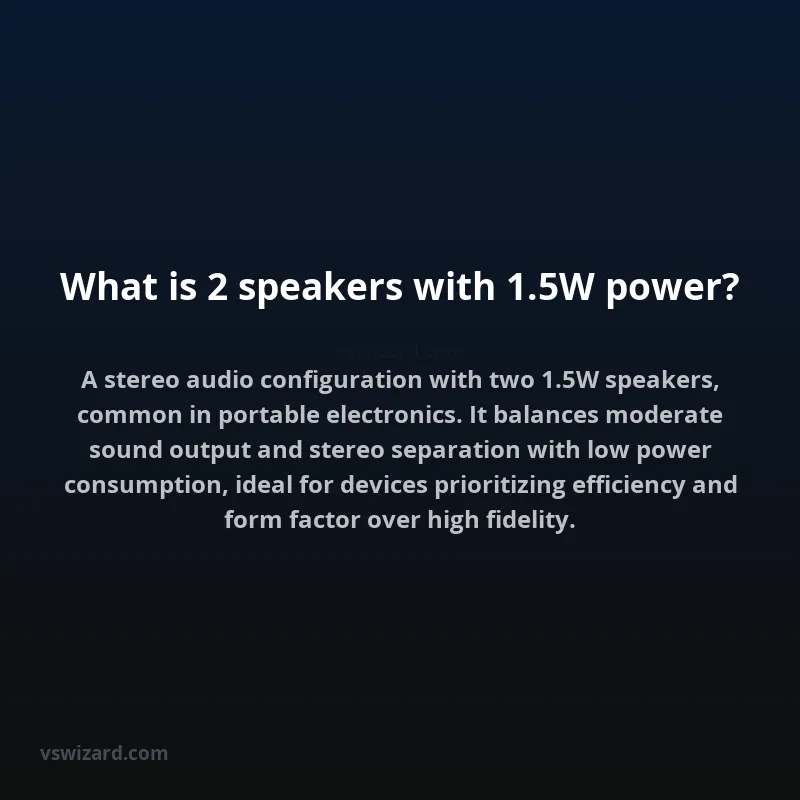
The configuration of "2 speakers with 1.5W power" denotes a specific audio output system comprising two discrete electroacoustic transducers, each rated to handle a maximum continuous power input of 1.5 Watts (W). This specification directly pertains to the electrical power delivered to the speaker drivers, influencing their acoustic output in terms of maximum sound pressure level (SPL) and distortion characteristics. The 1.5W rating signifies a relatively low-power audio amplification scenario, typically employed in portable electronic devices, embedded systems, or low-fidelity audio playback applications where power efficiency and compact form factors are prioritized over high acoustic performance. The impedance of these speakers, typically ranging from 4 to 8 ohms, is a critical parameter that must be matched with the output impedance of the accompanying amplifier to ensure optimal power transfer and minimize signal reflections.
The implementation of two such speakers suggests a stereo audio configuration, enabling sound localization and a broader soundstage compared to a single-channel mono system. Each speaker is driven by a separate audio channel from an amplifier, which in this context, would likely be designed to output approximately 1.5W per channel into the specified speaker impedance. The physical size and design of the speaker drivers (e.g., diameter, cone material, magnet structure) are intrinsically linked to their power handling capabilities and frequency response. While 1.5W per channel is modest, the use of two speakers can contribute to perceived loudness and stereo separation, making it a common choice for applications like small Bluetooth speakers, laptop internal audio, personal audio players, and certain types of consumer electronics where cost and power consumption are significant design constraints.
Audio Transducer Fundamentals
Electrodynamic Speaker Mechanism
The fundamental principle governing the operation of most common loudspeakers, including those specified at 1.5W, is the electrodynamic effect. A voice coil, a cylindrical winding of conductive wire, is attached to a diaphragm (cone or dome). This voice coil is suspended within the magnetic field of a permanent magnet. When an alternating electrical current, representing the audio signal, flows through the voice coil, it generates a corresponding fluctuating magnetic field. This induced magnetic field interacts with the static magnetic field of the permanent magnet, resulting in a repulsive or attractive force. This force causes the voice coil and the attached diaphragm to move back and forth, displacing air and generating sound waves. The amplitude and frequency of the diaphragm's excursion directly correspond to the amplitude and frequency of the input audio signal, thereby reproducing the original sound.
Power Handling and SPL
The 1.5W power rating is an indicator of the maximum continuous electrical power the speaker can safely dissipate without suffering thermal damage or mechanical failure. It is directly correlated with the maximum Sound Pressure Level (SPL) the speaker can produce. Higher power input generally results in greater diaphragm excursion and thus higher SPL. However, exceeding the rated power can lead to voice coil overheating, insulation breakdown, or mechanical limitations causing distortion and permanent damage. The sensitivity of a speaker, often expressed in decibels (dB) per Watt per meter (dB/W/m), quantifies how efficiently it converts electrical power into acoustic energy. A higher sensitivity speaker will produce a greater SPL for a given power input.
Technical Specifications and Performance Metrics
Impedance Matching
Speaker impedance is the opposition presented by the speaker to the flow of alternating current, measured in ohms (Ω). For a 1.5W system, common impedance values for the speakers would be 4Ω or 8Ω. The amplifier's output impedance must be closely matched to the speaker's impedance for efficient power transfer. If the speaker's impedance is too low relative to the amplifier's capabilities, the amplifier may overheat or be damaged due to excessive current draw. Conversely, if the impedance is too high, less power will be delivered to the speaker, resulting in lower volume.
Frequency Response and Distortion
The frequency response describes the range of audible frequencies (typically 20 Hz to 20 kHz) that a speaker can reproduce and the relative output level across that range. For 1.5W systems, particularly those in compact devices, the frequency response is often limited, with reduced output at very low bass frequencies and potentially less extended high-frequency reproduction. Total Harmonic Distortion (THD) is a key metric indicating the level of unwanted harmonic frequencies introduced by the speaker system. For low-power applications, maintaining low THD at the rated 1.5W is crucial for perceived audio quality, preventing harshness and muddiness.
Applications and Integration
Consumer Electronics
Systems featuring two 1.5W speakers are prevalent in portable audio devices such as small Bluetooth speakers, portable CD players, and some personal radios. They are also commonly found as internal audio solutions in laptops, tablets, and entry-level desktop computer monitors, where space and power constraints are significant. The stereo configuration enhances the listening experience for multimedia consumption and casual audio playback.
Embedded Systems and IoT Devices
In the realm of the Internet of Things (IoT) and embedded systems, such speaker configurations can be integrated into smart home devices, alarm systems, notification units, and interactive displays. The primary function here is often for audible alerts, voice prompts, or simple audio feedback, where high fidelity is secondary to cost-effectiveness and low power consumption.
Comparative Analysis
| Feature | 2 Speakers, 1.5W Each (Stereo) | Single Speaker, 3W (Mono) | 2 Speakers, 3W Each (Stereo) |
|---|---|---|---|
| Total Power Output | 3W | 3W | 6W |
| Audio Output Type | Stereo | Mono | Stereo |
| Soundstage | Wider, localized | Limited | Wider, localized |
| Potential Loudness | Moderate | Moderate | Higher |
| Power Consumption | Lower per channel | Moderate | Higher |
| Complexity | Moderate | Simpler | Moderate |
| Typical Application | Laptops, small portable speakers | Simple alerts, basic audio | Larger portable speakers, soundbars |
Design Considerations
Cabinet Acoustics
The acoustic enclosure (cabinet) in which the speakers are housed plays a vital role in their performance. For small, low-power speakers, the enclosure volume and design (e.g., sealed, ported) significantly influence bass response. Even with 1.5W drivers, a well-designed enclosure can optimize low-frequency extension and minimize unwanted resonances. The physical separation of the two speakers also impacts the stereo imaging and perceived spatial quality of the audio.
Amplifier Selection
The choice of amplifier is critical for driving two 1.5W speakers. Class D amplifiers are often preferred in these low-power applications due to their high efficiency, which translates to less heat generation and longer battery life in portable devices. The amplifier must be capable of delivering a stable 1.5W into the specified speaker impedance (e.g., 4Ω or 8Ω) with acceptable levels of noise and distortion.
Future Outlook
While 1.5W per speaker represents a foundational level of audio output, ongoing advancements in miniaturization, power efficiency, and digital signal processing continue to enhance the performance of such systems. Future iterations may see improved driver materials, more sophisticated acoustic modeling for compact enclosures, and integrated amplification with advanced audio enhancement algorithms. The demand for compact, power-efficient audio solutions in an increasingly connected and portable world ensures the continued relevance of well-engineered low-power speaker configurations.