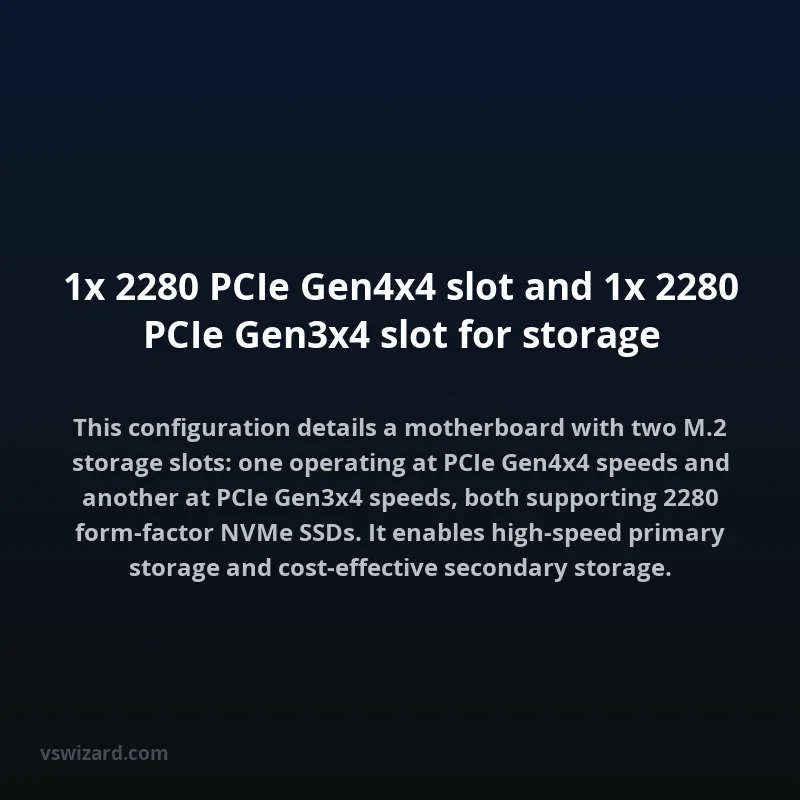
The designation '1x 2280 PCIe Gen4x4 slot and 1x 2280 PCIe Gen3x4 slot for storage' describes a motherboard's specific storage interface configuration, delineating two distinct M.2 slots optimized for NVMe Solid State Drives (SSDs). The '2280' refers to the physical dimensions of the M.2 form factor: 22 millimeters in width and 80 millimeters in length, a prevalent standard for high-performance SSDs. The critical differentiating factor lies in the peripheral component interconnect express (PCIe) generation and the number of lanes allocated to each slot. A PCIe Gen4x4 interface leverages the enhanced bandwidth and reduced latency characteristic of the fourth generation of PCIe, operating with four dedicated lanes (x4) to achieve significantly higher sequential read/write speeds compared to its predecessor.
Conversely, the PCIe Gen3x4 slot utilizes the third generation of PCIe, also with four lanes (x4). While still offering substantial performance for storage applications, its theoretical maximum throughput per lane is approximately half that of Gen4. This configuration indicates a motherboard designed to accommodate a mix of storage performance tiers, allowing for the installation of a cutting-edge, high-speed NVMe SSD in the Gen4x4 slot for primary operating system and application loading, alongside a capable Gen3x4 NVMe SSD for supplementary storage or less demanding workloads. The coexistence of these slots acknowledges the incremental advancements in storage technology and provides a balanced approach to performance and cost-effectiveness in system build.
M.2 Interface and NVMe Protocol
Mechanism of Operation
The M.2 slot provides a direct connection to the system's CPU or chipset via PCIe lanes, bypassing traditional SATA bus limitations. This direct bus access is fundamental to the high-speed data transfer rates achieved by NVMe SSDs. NVMe (Non-Volatile Memory Express) is a protocol specifically designed to leverage the low latency and parallelism of flash-based storage devices over PCIe, in contrast to the AHCI (Advanced Host Controller Interface) protocol, which was developed for slower, mechanical hard disk drives connected via SATA.
Each M.2 slot connects to the system's bus using a defined number of PCIe lanes. The 'x4' designation signifies that each slot is configured to utilize four PCIe lanes. The performance disparity between Gen4 and Gen3 arises from the evolutionary improvements in the PCIe standard itself. PCIe Gen4 doubles the data transfer rate per lane compared to Gen3. Therefore, a PCIe Gen4x4 interface offers a theoretical maximum bandwidth of approximately 8 GB/s (Gigabytes per second) per direction, while a PCIe Gen3x4 interface is limited to approximately 4 GB/s per direction. This difference is crucial for demanding tasks such as large file transfers, video editing, and high-resolution gaming where storage I/O is a significant bottleneck.
Physical Form Factor and Keying
The M.2 standard, formalized by PCI-SIG, defines physical connectors and form factors. The '2280' specification dictates a card width of 22mm and a length of 80mm. M.2 slots typically feature notches or 'keys' to prevent incorrect insertion of SSDs with different interface types. Common key types for NVMe SSDs are 'M' key (supporting PCIe x4 and SATA) and 'B' key (supporting SATA and PCIe x2). An 'M' keyed slot is required for a full PCIe x4 connection, which is standard for high-performance NVMe SSDs. The presence of both a Gen4x4 and a Gen3x4 slot implies they are both designed to accept M-keyed M.2 NVMe SSDs, with the motherboard's Southbridge or PCH (Platform Controller Hub) providing the respective PCIe generation connectivity.
PCIe Generations and Bandwidth
PCIe Gen4x4 Performance
A PCIe Gen4x4 interface is engineered to maximize data throughput. It utilizes four parallel data transmission paths operating at the signaling rate of PCIe Gen4. Each lane on Gen4 operates at 16 GT/s (Gigatransfers per second), which translates to approximately 2 GB/s of raw throughput per lane after accounting for 128b/130b encoding overhead. Multiplying this by four lanes yields a theoretical maximum of approximately 8 GB/s for unidirectional transfer.
PCIe Gen3x4 Performance
In contrast, PCIe Gen3 operates at 8 GT/s per lane. With four lanes (x4), this results in a theoretical maximum throughput of approximately 4 GB/s per direction. While this is significantly less than Gen4, it remains considerably faster than SATA III (6 Gbps, or approximately 0.6 GB/s).
Slot Allocation and Bandwidth Considerations
Motherboards often feature a primary M.2 slot designated as Gen4x4, directly connected to the CPU for optimal performance, especially for the boot drive. Secondary M.2 slots, or those shared with other peripherals (like SATA ports or additional PCIe slots), might operate at Gen3 speeds or a reduced lane count (e.g., x2) to manage the finite PCIe lanes provided by the CPU and chipset. The configuration '1x 2280 PCIe Gen4x4 slot and 1x 2280 PCIe Gen3x4 slot' explicitly separates these performance tiers, typically with the Gen4x4 slot intended for the highest-performance NVMe SSD and the Gen3x4 slot for secondary, high-capacity storage.
| Interface | PCIe Generation | Lanes | Theoretical Max Bandwidth (Per Direction) | Typical Real-World Speeds (Sequential Read) |
|---|---|---|---|---|
| M.2 Slot 1 | PCIe Gen4x4 | 4 | ~8 GB/s | Up to 7000 MB/s |
| M.2 Slot 2 | PCIe Gen3x4 | 4 | ~4 GB/s | Up to 3500 MB/s |
Implementation and Practical Application
System Integration
Integrating NVMe SSDs into such a system involves physically installing the M.2 drives into their respective slots. Users must ensure the drives are compatible with the slot's keying (typically M-key for NVMe) and form factor (2280). The motherboard's BIOS/UEFI must be configured to recognize and boot from the NVMe drives if one is intended as the primary boot device. Operating system installation and driver support are also critical for unlocking the full performance potential of the NVMe protocol.
Performance Differentiation
The primary advantage of this dual-slot configuration is the ability to strategically deploy storage solutions. The Gen4x4 slot is ideal for the OS, frequently used applications, and active project files where rapid loading and access times are paramount. The Gen3x4 slot offers a compelling option for large game libraries, media storage, or as a secondary drive for less performance-critical data, providing a balance between speed and cost. This setup allows users to experience flagship SSD performance for their most demanding tasks without necessitating multiple high-end drives.
Pros and Cons
Pros
- Performance Tiering: Enables the use of a high-speed Gen4 NVMe SSD for primary tasks while still offering substantial speed for secondary storage via the Gen3 NVMe slot.
- Cost Optimization: Allows users to pair a cutting-edge drive with a more cost-effective, yet still performant, Gen3 drive.
- Flexibility: Supports two M.2 NVMe SSDs, increasing storage capacity and potentially improving overall system responsiveness.
- Direct PCIe Connection: Both slots utilize the direct PCIe bus, offering significantly higher bandwidth and lower latency than SATA-based storage.
Cons
- Bandwidth Limitation: The Gen3x4 slot, while fast, is limited to half the theoretical bandwidth of the Gen4x4 slot.
- Potential Thermal Throttling: High-performance NVMe SSDs, particularly Gen4 models, can generate significant heat. Both slots may require heatsinks or good chassis airflow to prevent thermal throttling and maintain optimal performance.
- Shared Resources: Depending on the motherboard's chipset and CPU implementation, these M.2 slots might share PCIe lanes with other onboard devices (e.g., SATA ports, additional M.2 slots, expansion slots), potentially reducing bandwidth for those devices when the M.2 slots are in use.
Alternatives and Future Outlook
Single Slot Configurations
Many motherboards feature only a single M.2 slot, or multiple slots all operating at the same PCIe generation (e.g., all Gen4 or all Gen3). Users with such boards must choose a single primary NVMe SSD or rely on SATA SSDs for secondary storage.
Higher Lane Configurations
Enthusiast-grade motherboards may offer multiple Gen4x4 slots, or even support for PCIe Gen5, providing further increases in bandwidth for extremely demanding professional workloads. However, PCIe Gen5 SSDs are still nascent and expensive, and for most consumer applications, Gen4x4 provides ample performance.
Future Trends
The industry is steadily moving towards PCIe Gen5 and beyond for storage. However, PCIe Gen4 NVMe SSDs have reached a high degree of maturity, offering excellent performance for a wide range of applications. Configurations like the one described (1x Gen4x4 and 1x Gen3x4) represent a pragmatic approach for current-generation hardware, balancing peak performance with cost-effectiveness and broad compatibility. As PCIe Gen5 adoption increases, we may see motherboards offering more Gen5 slots, but the need for Gen3 compatibility will likely persist for some time for legacy support and budget-conscious builds.