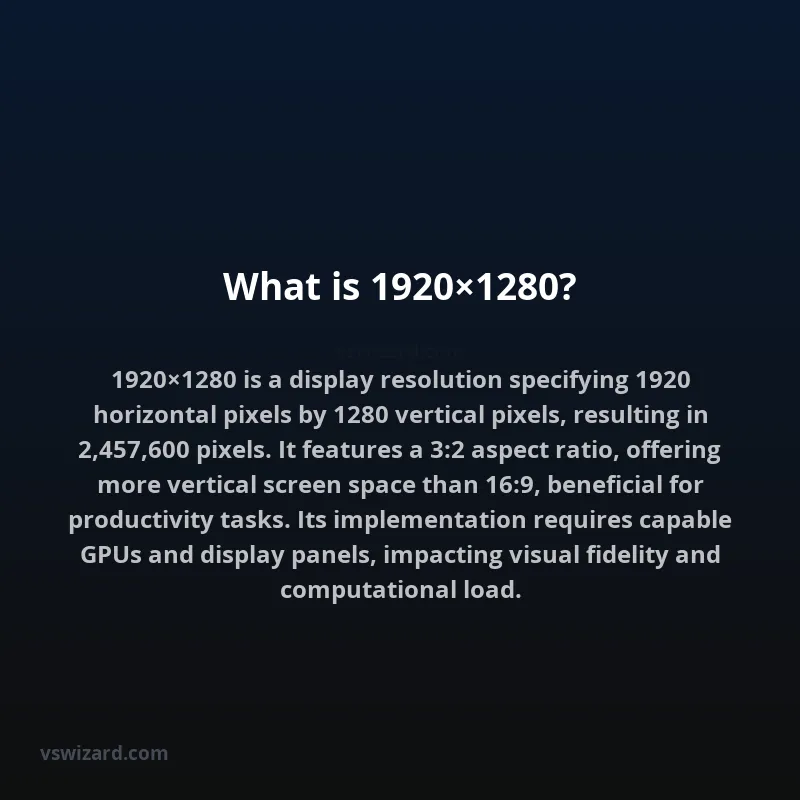
The designation '1920×1280' precisely defines a display resolution, specifying the number of horizontal pixels by the number of vertical pixels. This particular resolution corresponds to a total pixel count of 2,457,600 pixels, rendering images and text with a specific level of detail and sharpness. It represents a 16:10 aspect ratio, which is wider than the more ubiquitous 16:9 ratio but narrower than the 21:9 ultra-widescreen formats. This aspect ratio was historically favored in certain computing contexts, particularly for monitors and portable devices, as it offers more vertical screen real estate compared to 16:9 displays of equivalent width, which can enhance productivity for tasks involving extensive scrolling or multi-pane interfaces.
This resolution is a specific instance within the broader landscape of digital display standards, characterized by its precise pixel dimensions and associated aspect ratio. The implementation of 1920×1280 requires graphics processing units (GPUs) capable of rendering the frame buffer at this resolution and display panels engineered with the requisite pixel density and matrix structure. Its adoption has been influenced by the trade-offs between visual fidelity, computational load on the graphics hardware, and the physical dimensions of display devices. The precise number of pixels dictates the fineness of detail that can be rendered, directly impacting the clarity of text, the subtlety of gradients in images, and the overall immersive quality of visual content.
Display Resolution and Pixel Structure
The fundamental principle behind 1920×1280 resolution lies in the discrete nature of digital displays, which are composed of a grid of individual pixels. Each pixel is a minuscule element capable of emitting light and color. In a 1920×1280 display, there are 1920 pixels arranged horizontally across the screen and 1280 pixels arranged vertically. The total number of pixels, 1920 multiplied by 1280, determines the display's pixel density when combined with its physical dimensions (e.g., screen size in inches). A higher pixel density, often measured in pixels per inch (PPI), generally results in sharper images and more legible text, as individual pixels become less perceptible to the human eye.
Aspect Ratio: 16:10
The aspect ratio of a display refers to the proportional relationship between its width and its height. For a 1920×1280 resolution, the ratio of horizontal pixels to vertical pixels is 1920 / 1280. Simplifying this fraction yields 192 / 128, which further simplifies to 3 / 2, or 1.5. This corresponds to a 16:10 aspect ratio (16/10 = 1.6, close to 1.5, with the slight difference due to how ratios are typically represented. The exact ratio is 1920/1280 = 1.5. A 16:10 aspect ratio is technically 1.6:1, but in practice, resolutions like 1920x1200 (16:10) and 1920x1280 (1.5:1, which is 3:2) are often discussed in related contexts. It is crucial to note that 1920×1280 is precisely a 3:2 aspect ratio (1920/1280 = 1.5 = 3/2), not 16:10. The 16:10 aspect ratio typically corresponds to resolutions such as 1920x1200.
Distinction from 16:9 and 16:10
It is vital to distinguish 1920×1280 (a 3:2 aspect ratio) from other common resolutions. A 16:9 aspect ratio, prevalent in modern widescreen televisions and many computer monitors, would correspond to resolutions like 1920x1080 (Full HD). A true 16:10 aspect ratio is represented by resolutions such as 1920x1200. The 3:2 aspect ratio of 1920×1280 offers a slightly different viewing experience, providing more vertical space than 16:9 and a slightly narrower field of view than 16:10. This distinction impacts content display; for instance, content mastered in 16:9 will be letterboxed on a 3:2 display, and content mastered in 3:2 may be pillarboxed on a 16:9 display.
Technical Implementation and Hardware Requirements
The effective rendering of 1920×1280 resolution necessitates specific hardware capabilities. Graphics processing units (GPUs) must be equipped with sufficient video memory (VRAM) and processing power to manage the frame buffer and render complex scenes at this resolution. The display panel itself, whether an LCD, OLED, or other technology, must be capable of illuminating 1920×1280 individual pixels with accurate color reproduction and refresh rates. Connectivity standards, such as HDMI, DisplayPort, or DVI, must also support the bandwidth required to transmit the video signal without compression artifacts or latency.
Pixel Density and Perceived Sharpness
Pixel density, measured in PPI, is a critical factor in the perceived sharpness of a 1920×1280 display. For example, a 15-inch laptop screen with 1920×1280 resolution would have a PPI of approximately 166 PPI (calculated using the diagonal screen size: sqrt(1920^2 + 1280^2) / 15). This density is generally considered good for clear text rendering and detailed imagery, particularly at typical viewing distances for laptops. In comparison, a 27-inch monitor at the same resolution would yield a lower PPI of around 103 PPI, which might result in a less crisp appearance, especially for fine text, when viewed closely.
Refresh Rate and Frame Rate
The refresh rate, measured in Hertz (Hz), indicates how many times per second the display updates its image. While the resolution defines the number of pixels, the refresh rate influences the smoothness of motion. For a 1920×1280 resolution, common refresh rates include 60Hz, 120Hz, and higher. A higher refresh rate is particularly beneficial for dynamic content such as video games and fast-paced video playback, reducing motion blur and improving visual fluidity. The GPU's ability to consistently output frames at or above the display's refresh rate at 1920×1280 resolution is crucial for achieving optimal performance.
Applications and Use Cases
Historically, 1920×1280 resolution found favor in professional computing environments and among enthusiasts who valued the increased vertical screen space. This included graphic designers, software developers, and users who frequently worked with multiple windows or large documents, as the 3:2 aspect ratio provided more room for tool palettes and content.
Monitors and Laptops
While 16:9 resolutions like 1920x1080 and 2560x1440 became dominant, 1920×1280 (or its close relative 1920x1200, 16:10) appeared in some high-end laptop models and specialized monitors. These devices aimed to offer a slightly more ergonomic and productive viewing experience for productivity-oriented tasks.
Mobile Devices and Tablets
Certain high-resolution mobile devices, particularly tablets and some smartphones, have utilized resolutions in the 3:2 or 16:10 aspect ratio range, including those approximating 1920×1280, to provide a more document-like or app-friendly viewing surface.
Technical Specifications Table
| Specification | Value |
| Horizontal Resolution | 1920 pixels |
| Vertical Resolution | 1280 pixels |
| Total Pixels | 2,457,600 pixels |
| Aspect Ratio | 3:2 (1.5:1) |
| Common Usage Context | Certain laptops, professional monitors, some mobile devices. |
| Comparison Ratio (vs 16:9) | +12% vertical pixels |
| Comparison Ratio (vs 16:10) | -5.9% vertical pixels (1280 vs 1200 for 16:10) |
Evolution and Alternatives
The development of display resolutions has been driven by technological advancements in panel manufacturing, graphics processing, and evolving user demands for visual fidelity and immersive experiences. Resolutions have progressively increased from VGA (640×480) and XGA (1024×768) to current standards like 4K (3840×2160) and 8K (7680×4320).
Dominance of 16:9
The widespread adoption of the 16:9 aspect ratio, driven by the consumer electronics industry's focus on widescreen television broadcasts and movie formats, led to it becoming the de facto standard for many display categories. This standardization simplified content creation and hardware manufacturing. Consequently, resolutions like 1920×1080 and 3840×2160 (4K UHD) in 16:9 became far more prevalent than 1920×1280.
Emergence of Ultra-Wide and High-Resolution Displays
In recent years, there has been a resurgence in interest in non-standard aspect ratios, particularly ultra-wide formats (21:9 and 32:9) for gaming and productivity, and a continued push for higher resolutions beyond 4K. However, specific resolutions like 1920×1280 remain relevant for niche applications where their unique aspect ratio offers distinct advantages.